What Is an MBA in Logistics & Supply Chain Management?

MBA in Logistics & SCM Explained

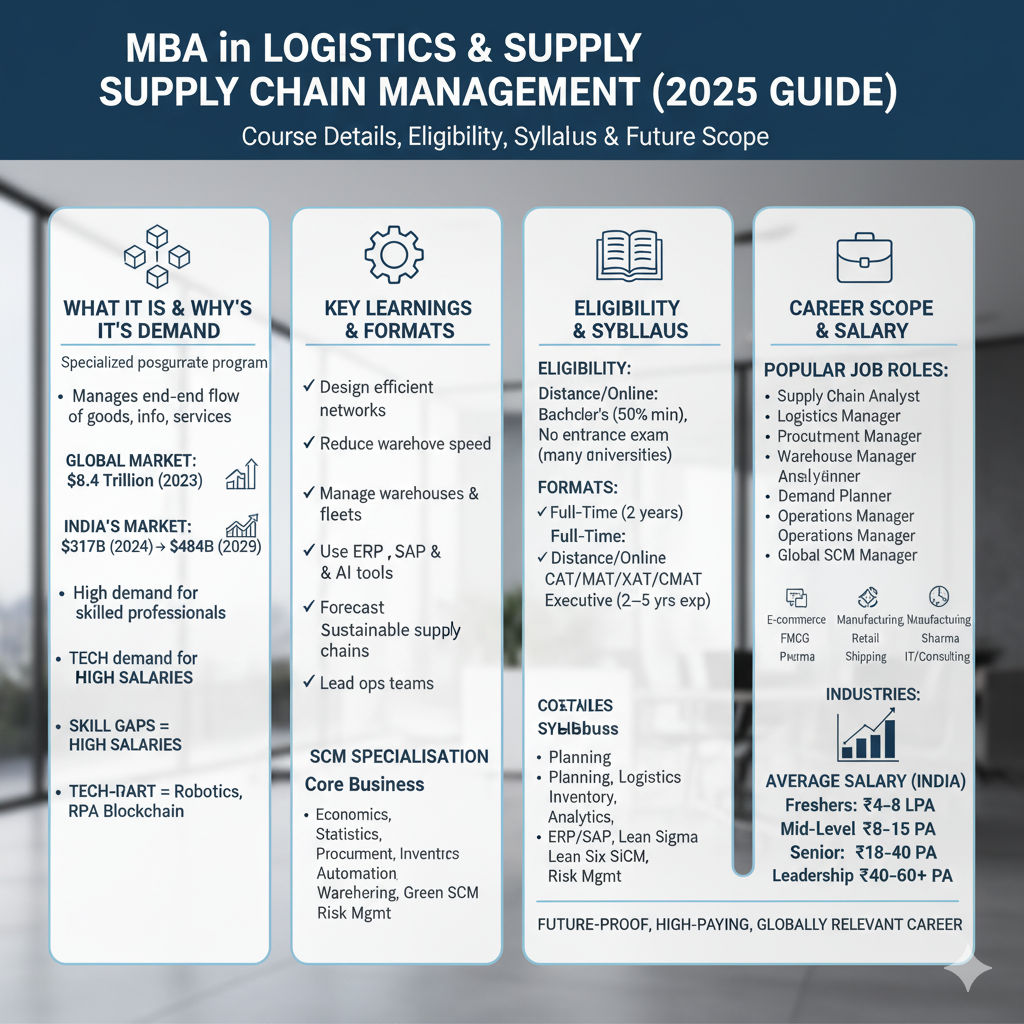
An MBA in Logistics and Supply Chain Management (SCM) is a specialized postgraduate program training you to manage the end-to-end flow of goods, information, and services procurement, warehousing, transportation, analytics, and modern supply chain technologies. With India’s logistics market valued at roughly USD 317 billion (2024) and projected to grow significantly by 2029, demand for skilled SCM professionals is rising sharply, with salaries ranging from ₹4-8 LPA for freshers to ₹40-60+ LPA in leadership roles.

Note: Market size figures cited in this article are general industry estimates; verify current data from primary market research sources before citing them in formal contexts.


Table of Contents

  1. Understanding an MBA in Logistics & SCM
  2. Why This MBA Is in High Demand
  3. Who Should Choose This MBA?
  4. Eligibility Criteria
  5. Detailed Syllabus
  6. Career Scope and Salary
  7. Distance MBA vs Executive MBA in SCM
  8. FAQs

Understanding an MBA in Logistics & Supply Chain Management

A Logistics & SCM MBA blends business management fundamentals with operational expertise — teaching you how to manage everything from sourcing raw materials to delivering finished products to customers.

You’ll learn how to:

  • Design efficient supply chain networks
  • Reduce logistics costs and improve speed
  • Manage warehouses, fleets, and distribution
  • Use ERP, TMS, WMS, SAP, and AI tools
  • Forecast demand with analytics
  • Build sustainable and resilient supply chains
  • Lead cross-functional operations teams

Formats available:

Why This MBA Is in High Demand

The Logistics Sector Is Booming

  • Global logistics market value has been estimated at roughly USD 8.4 trillion (2023)
  • Expected CAGR (2024–2030): approximately 5–7%
  • India’s logistics market (2024): estimated around USD 317 billion
  • Projected to reach approximately USD 484 billion by 2029

E-commerce, warehousing, D2C brands, exports, EV logistics, and smart supply chains are fueling substantial job creation.

Skill Gaps Drive Higher Salaries

Most companies struggle to find professionals who understand:

  • Inventory optimisation
  • Multi-modal transport
  • Demand forecasting
  • ERP/SAP systems
  • Data-driven operations

This shortage translates into higher salaries and quicker promotions for SCM graduates.

Technology Is Transforming Supply Chains

SCM is now a tech-first industry. You’ll work with IoT for real-time tracking, AI/ML for forecasting, robotics in warehouses, RPA for process automation, and blockchain for transparent supply chains. An MBA equips you to manage these innovations, not just use them.

This program is well-suited for:

  • Working professionals needing flexible study options
  • Graduates who want to enter operations/logistics
  • Engineers transitioning into manufacturing/plant roles
  • Retail, e-commerce, and warehouse professionals
  • Managers preparing for leadership through an Executive MBA in logistics and supply chain

If you enjoy problem-solving, analytics, technology, and operations, you’ll likely thrive in this field.

Distance MBA / Online MBA:

  • Bachelor’s degree (any stream)
  • Minimum 50% marks (varies by institute)
  • No entrance exam in many distance-mode programs

Full-Time MBA:

  • Bachelor’s degree
  • Entrance exam: CAT, MAT, XAT, CMAT, or institute-specific exam

Executive MBA:

  • Graduation plus 2–5 years of experience
  • Some institutes conduct personal interviews
Your Guide to MBA in Supply Chain

Detailed Syllabus: What You Will Study

A. Core Business Subjects

  • Managerial Economics

  • Business Statistics

  • Marketing Management

  • Financial Management

  • Human Resource Management

  • Operations Management

B. Logistics & SCM Specialisation

Supply Chain Fundamentals

  • Supply Chain Planning & Strategy

  • Logistics & Distribution

  • Procurement & Sourcing

  • Inventory & Material Management

Technology & Analytics

  • Supply Chain Analytics

  • ERP/SAP, TMS & WMS

  • Digital Supply Chain Transformation

  • Automation, IoT, AI in Logistics

Operations Excellence

  • Lean Six Sigma

  • Quality Management

  • Warehouse Layout & Design

  • Transportation & Freight Management

Sustainability & Global SCM

  • Green Supply Chain

  • Reverse Logistics

  • International Trade & Compliance

  • Risk Management & Resilience Planning

This curriculum prepares you for real-world decision-making, not just theoretical knowledge.

Career Scope After MBA in Logistics & Supply Chain Management

The career scope is substantial because every company has a supply chain.

Popular job roles: Supply Chain Analyst, Logistics Manager, Procurement Manager, Warehouse Operations Manager, Transportation Manager, Demand Planner, Inventory Controller, Production Planner, Supply Chain Consultant, Operations Manager, Category Manager, Global SCM Manager, 3PL/4PL Coordinator

Industries that hire MBA SCM graduates: E-commerce (Amazon, Flipkart), FMCG (HUL, Nestlé), Manufacturing & Automotive (Tata, Mahindra), Retail & D2C, Pharma & Healthcare, Shipping, Freight & Logistics, IT/Consulting (Accenture, Infosys)

Average salary range in India:

Level Salary Range
Freshers ₹4–8 LPA
Mid-Level Roles ₹8–15 LPA
Senior Roles ₹18–40 LPA
Leadership Roles ₹40–60+ LPA

Benefits of Distance/Online MBA in SCM:

  • Flexible for working professionals
  • Learn while earning
  • Cost-effective compared to full-time MBA
  • Industry-relevant curriculum
  • Access to digital tools and case studies

Benefits of an Executive MBA:

  • Fast-track leadership opportunities
  • Industry networking
  • Strategic-level coursework
  • Designed for experienced managers

If you can’t leave your job, a distance MBA in logistics and supply chain management is generally the more practical option.

Conclusion

An MBA in Logistics and Supply Chain Management is one of the more rewarding and future-ready business degrees available today. Whether you choose a full-time, distance, online, or executive program, the skills you gain — forecasting, operations, procurement, analytics, automation — position you for strong career growth across industries.

FAQ's

  • 1. What is an MBA in Logistics and Supply Chain Management?

    A specialized postgraduate program training you to manage the end-to-end flow of goods, information, and services covering procurement, warehousing, transportation, analytics, and modern supply chain technologies.

  • 2. . Is an MBA in Logistics and SCM worth it?

    For many professionals, yes — SCM jobs are considered future-proof, salaries are rising due to skill shortages, and global career mobility is strong for skilled graduates.

  • 3. What is the eligibility for a distance MBA in SCM?

    Generally a bachelor's degree in any stream with a minimum 50% marks, and many distance-mode programs don't require an entrance exam.

  • 4. What career roles are available after this MBA?

    Supply Chain Analyst, Logistics Manager, Procurement Manager, Warehouse Operations Manager, Demand Planner, and Global SCM Manager, among others.

  • 5. What is the salary range after an MBA in Logistics & SCM?

    Roughly ₹4-8 LPA for freshers, ₹8-15 LPA at mid-level, ₹18-40 LPA in senior roles, and ₹40-60+ LPA in leadership positions.

  • 6. Which technologies are reshaping supply chain management?

    IoT for real-time tracking, AI/ML for forecasting, robotics in warehouses, RPA for process automation, and blockchain for supply chain transparency.