Something significant is happening across every industry right now. Hospitals are running on cloud-based records systems. Banks are automating entire compliance workflows. Retailers are using AI to manage inventory in real time. And right at the centre of all of it; making the decisions, managing the teams, and aligning the technology with the business; are IT management career professionals who understand both the technical and human sides of transformation.
The demand for people who can lead through technology is not just growing; it is accelerating in a way that is creating genuine, well-compensated opportunities. Digital transformation careers and cloud computing careers are no longer niche paths reserved for engineers. They are mainstream leadership tracks that organisations across fintech, healthcare, manufacturing, and consulting are actively trying to fill.
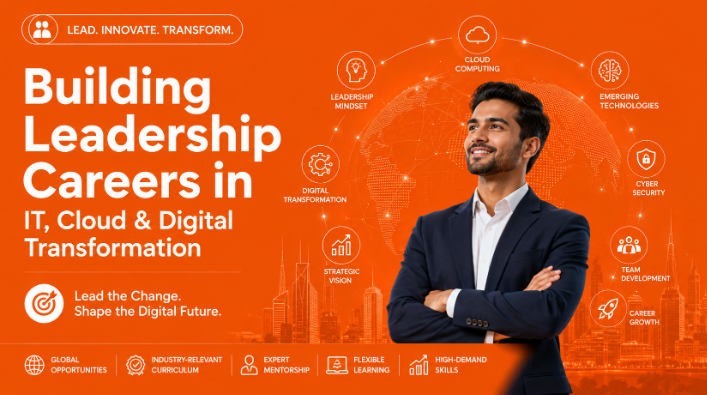
This long-form guide covers everything you need to know about building IT leadership careers: the roles, the skills, the technologies, the market data, and how the right management education can accelerate your trajectory.
Understanding Leadership Careers in IT & Digital Transformation
What is IT & Digital Transformation Leadership?
IT leadership is a fundamentally different discipline – one that requires you to translate complex technology decisions into business outcomes, manage cross-functional teams, and define a digital transformation strategy that keeps the organisation competitive.
The scope of leadership in the IT industry today spans cloud architecture strategy, cybersecurity governance, IT infrastructure management, and the management of enterprise-wide digital transformation programmes.
Why Leadership Skills Matter in IT?
Technology without strategic direction is expensive noise. How to build a leadership career in IT starts with understanding this: organisations do not need more people who know how the systems work; they need people who can decide which systems to build, how to fund them, how to secure them, and how to get teams aligned around using them. That is the leadership gap, and it is wide open.
Read More: Career Opportunities After PGDM Executive in Information Technology
Emerging Technologies Shaping IT Leadership Careers
Cloud Computing and Digital Infrastructure
If there is one technology that has fundamentally restructured the role of IT leadership, it is cloud computing. The global cloud computing market was valued at USD 912.77 billion in 2025 and is projected to reach USD 5.95 trillion by 2035 at a CAGR of 20.61%. Every organisation operating at scale is wondering whether to go all-in on a single provider, adopt a multi-cloud strategy, or build a hybrid cloud architecture that balances control with scalability.
Read More: Multi-Cloud vs Hybrid Cloud: What’s the Difference?
Automation, AI & Cybersecurity Trends
AI is not coming for IT jobs; it is coming for the parts of IT jobs that should not require human attention in the first place. Meanwhile, cybersecurity leadership is one of the fastest-growing and highest-paying specialisations in IT management. Tools like SOAR security – Security Orchestration, Automation and Response – are transforming how organisations respond to threats, and they require experienced managers to deploy and oversee them.
Read More: SOAR: A Powerful Tool for IT Security
High-Demand Leadership Roles in IT & Cloud Management
Here is where the career opportunities in cloud and digital transformation get genuinely exciting. These are the roles that organisations are actively struggling to fill.
- IT Project Manager
- Cloud Solutions Architect
- Digital Transformation Manager
- IT Consultant
- Cybersecurity Manager
- Infrastructure & Systems Manager
Cloud computing roles specifically are growing 25% faster than the average occupation, with 317,700 job openings annually in the United States alone.
Read More: What Are the Most In-Demand Job Profiles for PGDM IT Management Graduates in India and Abroad?
Skills Required to Build Leadership Careers in IT
Understanding the skills required for IT leadership roles is critical for any professional serious about this career path. They fall into two distinct but equally important categories:
Technical Skills for Modern IT Leaders
- Cloud computing and virtualization: Understanding IaaS, PaaS, SaaS architectures, and the governance models that keep cloud environments secure and cost-effective.
- IT infrastructure management: Designing and overseeing the systems, networks, and platforms that keep modern businesses running.
- Data analytics and business intelligence: Extracting actionable insight from operational data to inform strategic decisions.
- Cybersecurity and risk management: Building organisational security posture, overseeing compliance frameworks, and leading incident response.
- Digital transformation strategy: Designing and executing the roadmaps that move businesses from legacy systems to digital-first operating models.
Management & Strategic Skills
- Leadership and team management: Building and developing cross-functional technical teams, managing performance, and creating a culture of innovation.
- Strategic thinking and decision-making: Aligning technology investments with business objectives and making high-stakes decisions under uncertainty.
- Change management and innovation: Leading organisations through technology-driven transformation without losing momentum or team cohesion.
- Communication and stakeholder management: Presenting complex technical strategies to non-technical leadership, boards, and clients.
- Agile and project management methodologies: Managing technology projects iteratively, adapting to changing requirements without losing delivery discipline.
Read More: Advantages of IT System Management
How Digital Transformation is Creating Career Opportunities
The future of IT management careers is being written by digital transformation. Every sector is restructuring around digital-first models, and each of those restructuring efforts needs a leader to drive it. Digital transformation careers are consequently showing up in industries.
Over 90% of organisations face IT skills shortages in 2026, at an estimated cost of USD 5.5 trillion globally. That gap is the opportunity for professionals who combine genuine technical grounding with strong leadership and strategic management capabilities.
Read More: Trends in IT Industry and How PG Diploma in IT Management Can Shape Your Career
Benefits of Pursuing a PGDM in IT & Digital Transformation
The benefits of PGDM in IT and digital transformation are direct and measurable. A PGDM programme in IT management careers builds the managerial layer that technical roles cannot teach on the job alone: strategic planning, financial acumen, organisational leadership, and the ability to drive change at an enterprise level.
MIT SDE’s PGDM and Executive PGDM programmes in IT Management are AICTE-approved, industry-aligned, and designed specifically for working professionals who need to move into leadership without pausing their careers. The curriculum covers strategies around emerging IT trends, cloud strategy, IT system management and cybersecurity governance; all taught through real-world case studies, live projects, and industry mentorship.
Read More: Top Job Roles After PGDM Executive in Information Technology: Skills & ROI Explained
Conclusion: The Future of Leadership Careers in IT & Digital Transformation
The convergence of cloud computing, AI, and cybersecurity leadership is creating a leadership demand that the market genuinely cannot fill fast enough. IT leadership careers are no longer confined to technology companies; they are everywhere, in every sector, at every scale of business.
The professionals who will define the next decade of business are the ones who refuse to stay purely technical, who invest in building the strategic and managerial capabilities that technology alone cannot provide.
The window is open. The market is ready. The only question is whether you are.
Explore MIT SDE’s IT Management & Digital Transformation Programmes
MIT SDE offers AICTE-approved online and distance PGDM programmes in IT and Digital Transformation; built for working professionals targeting leadership roles in cloud, cybersecurity, and enterprise technology management. No career break required.
Visit mitsde.com and start building the leadership career in IT that the market is actively waiting for.