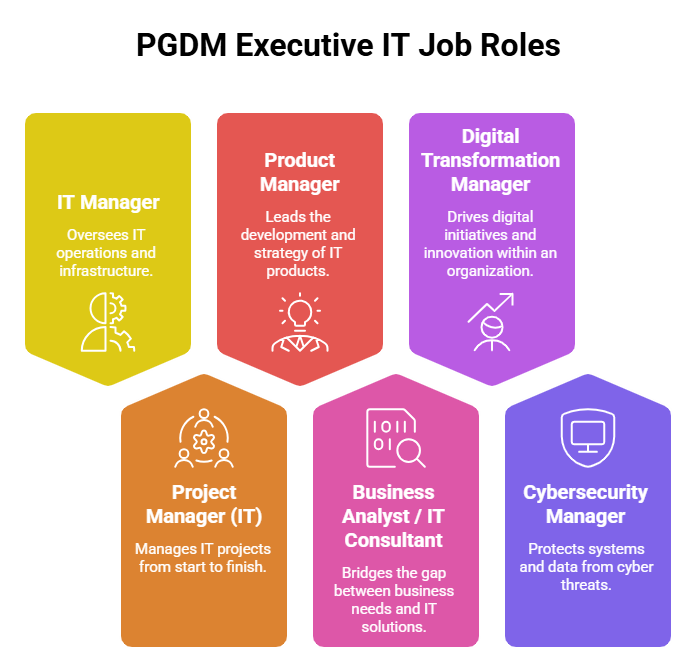
The top job roles after PGDM Executive in Information Technology include IT Manager, Product Manager, Business Analyst, Project Manager, Digital Transformation Lead, and Cybersecurity Manager. These roles offer strong salary growth, leadership opportunities, and high PGDM IT ROI for working professionals seeking management careers in technology-driven industries.
Introduction
Technology is no longer limited to coding or infrastructure—it now drives business growth, customer experience, and strategic decisions. That’s why professionals with both technical knowledge and management expertise are in high demand.
A PGDM Executive in Information Technology is designed for working professionals who want to move from technical execution into leadership roles. It combines management principles with IT strategy, analytics, operations, and digital transformation.
If you’re wondering about the job roles after PGDM Executive in Information Technology, this guide explains career opportunities, required skills, salaries, and return on investment (ROI).
Why PGDM Executive in Information Technology Matters in 2026
According to Gartner, worldwide IT spending continues to grow annually, driven by AI, cloud, cybersecurity, and enterprise software. Companies now need leaders who understand both business and technology.
This creates demand for professionals who can:
- Lead IT teams
- Align tech investments with business goals
- Manage digital transformation
- Improve efficiency through automation
- Handle cybersecurity and compliance
That is exactly where a PGDM Executive in IT becomes valuable.
Top Job Roles After PGDM Executive in Information Technology
1. IT Manager
An IT Manager oversees technology systems, teams, budgets, and infrastructure.
Key Responsibilities:
- Managing IT operations
- Leading support and engineering teams
- Budget planning
- Vendor management
- Ensuring uptime and security
Average Salary in India:
₹10 LPA – ₹22 LPA
Best For:
Professionals with prior technical or infrastructure experience.
2. Project Manager (IT)
One of the most common IT leadership roles, Project Managers ensure projects are delivered on time and within budget.
Responsibilities:
- Project planning
- Team coordination
- Stakeholder communication
- Risk management
- Delivery tracking
Average Salary:
₹12 LPA – ₹25 LPA
Popular Certifications:
- PMP
- Scrum Master
- Agile
3. Product Manager
Product Managers bridge business needs, users, and engineering teams.
Responsibilities:
- Product roadmap planning
- Feature prioritization
- Market analysis
- Revenue growth strategy
Average Salary:
₹15 LPA – ₹35 LPA
Example Companies:
Infosys, TCS, Amazon, Microsoft
4. Business Analyst / IT Consultant
Business Analysts solve operational problems using technology.
Responsibilities:
- Requirement gathering
- Process improvement
- Data reporting
- ERP/CRM implementation support
Average Salary:
₹8 LPA – ₹18 LPA
5. Digital Transformation Manager
Companies modernizing legacy systems need leaders who understand business change.
Responsibilities:
- Cloud migration projects
- Automation strategy
- AI adoption planning
- Process redesign
Average Salary:
₹18 LPA – ₹40 LPA
6. Cybersecurity Manager
With increasing cyber threats, security leadership is a fast-growing career path.
Responsibilities:
- Security governance
- Risk management
- Incident response
- Compliance management
Average Salary:
₹15 LPA – ₹35 LPA
Salary Comparison Table
Job Role | Experience Needed | Average Salary (India) |
IT Manager | 5–10 Years | ₹10–22 LPA |
Project Manager | 5–12 Years | ₹12–25 LPA |
Product Manager | 4–10 Years | ₹15–35 LPA |
Business Analyst | 3–8 Years | ₹8–18 LPA |
Digital Transformation Lead | 7+ Years | ₹18–40 LPA |
Cybersecurity Manager | 5+ Years | ₹15–35 LPA |
Figures vary by city, industry, and employer.
Skills You Gain in PGDM Executive in IT
A strong program helps build both technical and managerial capability.
Core Skills:
- Strategic IT Management
- Leadership & Team Management
- Finance for Managers
- Data Analytics
- Product Strategy
- Agile Project Management
- Cloud & Digital Transformation Basics
- Cybersecurity Governance
- Communication & Negotiation
These skills directly improve employability for job roles after PGDM Executive in Information Technology.
PGDM IT ROI: Is It Worth It?
Short Answer: Often Yes—If Used Strategically
Example ROI Calculation:
Factor | Before PGDM | After PGDM |
Annual Salary | ₹8 LPA | ₹14 LPA |
Salary Increase | — | ₹6 LPA |
Program Cost | ₹3–6 Lakhs | — |
Approx Recovery Time | — | 1 Year |
For many professionals, the PGDM IT ROI becomes positive within 12–24 months.
Additional ROI Benefits:
- Faster promotions
- Leadership eligibility
- Better job mobility
- Stronger professional network
- Higher long-term earnings
Industries Hiring PGDM IT Professionals
These sectors actively recruit executive IT management talent:
- IT Services
- SaaS Companies
- Banking & Fintech
- Manufacturing
- Healthcare Tech
- E-commerce
- Logistics
- Telecom
- Consulting
How to Maximise Career Growth After PGDM
Step-by-Step Plan
1. Choose a Specialisation
Focus on Product, Project Management, Analytics, or Cybersecurity.
2. Build Certifications
Add PMP, ITIL, AWS, Scrum, or Data certifications.
3. Strengthen LinkedIn Profile
Highlight business + technology achievements.
4. Use Real Projects
Show ROI from your workplace initiatives.
5. Network With Alumni
Referrals often accelerate management hiring.
Key Takeaways
- The best job roles after PGDM Executive in Information Technology include IT Manager, Product Manager, Project Manager, and Business Analyst.
- Salaries can range from ₹8 LPA to ₹40+ LPA depending on experience.
- Programs help professionals transition from technical execution to leadership.
- Strong PGDM IT ROI is possible within 1–2 years.
- Demand is rising across AI, cloud, digital transformation, and cybersecurity sectors.
FAQs
1. What are the top job roles after PGDM Executive in Information Technology?
IT Manager, Project Manager, Product Manager, Business Analyst, Cybersecurity Manager, and Transformation Lead.
2. Is PGDM Executive in IT good for working professionals?
Yes. It is designed for professionals who want promotions, leadership roles, or career switches.
3. What is the salary after PGDM Executive in IT?
Many professionals move into ₹10–25 LPA roles, depending on experience and company.
4. What is the ROI of PGDM IT?
Many candidates recover course costs in 1–2 years through salary growth.
5. Can non-coders pursue this program?
Yes. Operations, support, sales-tech, and analyst professionals can also benefit.
Conclusion
A PGDM Executive in Information Technology can be a career accelerator for professionals ready to move into management. As businesses increasingly depend on technology, leaders who understand both systems and strategy are becoming indispensable. If you want better pay, promotions, and future-ready opportunities, this path offers strong long-term value.