For professionals looking to advance, choosing the right PGDM in banking and finance colleges is a pivotal decision. As the world of finance goes through digital transformation, choosing a course that helps you cover the nuances of AI and data is extremely important. A key factor in this choice is the curriculum. The curriculum of your chosen course must be detailed and comprehensive enough to cover traditional banking fundamentals while remaining agile enough to include modern FinTech.
At MIT School of Distance Education (MIT SDE), our PGDM in Banking and Financial Services is designed to offer this balance. Whether you are pursuing your PGDM Banking and Financial Services in Bangalore’s tech-driven environment or looking for a PGDM Banking and Financial Services in Kolkata’s established commercial hub, our online programme ensures you stay ahead of the curve.
What Is the PGDM in Banking and Financial Services at MIT SDE?
MIT SDE is a top management institute in Pune that has built a strong reputation for delivering flexible, career-focused distance learning programmes. The PGDM in Banking and Financial Services is a two-year, four-semester Post Graduate Diploma programme designed to develop well-rounded professionals who can navigate the fast-changing world of finance.
The programme covers a total of 86 credits spread across four semesters, blending foundational management concepts with advanced, specialisation-specific subjects. The curriculum is co-created with industry experts, so the content is grounded in real-world relevance, not just theory.
Why Choose a PGDM Focused on Banking and Finance?
The financial sector is one of the most dynamic industries in the world. From digital banking and fintech disruption to global investment strategies, professionals need both technical depth and strategic thinking. A dedicated banking and finance course subjects programme gives you exactly that, and at MIT SDE, you get it via a distance learning format that fits around your existing commitments.
What Does the Semester-Wise PGDM in Banking and Finance Syllabus Cover?
Here is a detailed breakdown of all four semesters:
Semester I: Foundations of Management
S.No | Subject | Credits |
1 | Managerial Economics | 4 Credits |
2 | Business Communication | 4 Credits |
3 | Legal and Business Environment (Micro and Macro) | 4 Credits |
4 | Accounting for Managers | 4 Credits |
5 | Principles of Management | 4 Credits |
Semester I lays the foundation. You build core management competencies in economics, accounting, law, and communication. These are essential before diving into financial specialisations.
Semester II: Financial Core
S.No | Subject | Credits |
1 | Research Methodology and Management Decision | 4 Credits |
2 | Management Intelligence System | 4 Credits |
3 | Financial Reporting, Statements, and Analysis | 4 Credits |
4 | Financial Management | 4 Credits |
5 | Financial Markets and Services | 4 Credits |
Semester II is where the finance specialisation starts taking shape. Subjects like Financial Markets and Services and Financial Management give you a strong analytical grounding.
Semester III: Banking Specialisation
S.No | Subject | Credits |
1 | Strategic Management | 4 Credits |
2 | Organisational Behaviour | 4 Credits |
3 | Bank Operations Management | 4 Credits |
4 | Strategic Management in Banking and Financial Services | 4 Credits |
5 | Credit Administration | 4 Credits |
6 | Project Work | 6 Credits |
Semester III is the heart of the banking curriculum. Bank Operations Management, Credit Administration, and Strategic Management in Banking prepare you for real roles in financial institutions.
Semester IV: Advanced Specialisation
S.No | Subject | Credits |
1 | Fintech and Digital Banking | 4 Credits |
2 | International Finance | 4 Credits |
3 | Merchant Banking and Financial Services | 4 Credits |
4 | Elective 1 | 4 Credits |
5 | Elective 2 | 4 Credits |
Elective Options (Choose any 2):
- Marketing of Financial Services
- Investment Banking
- Security Analysis and Portfolio Management
- Behavioural Finance
Semester IV rounds off the programme with forward-looking subjects like Fintech and Digital Banking and International Finance, letting you customise your learning through electives.
Which Skills Will You Develop Through These Banking and Finance Course Subjects?
The banking and finance course subjects at MIT SDE are designed to build a well-rounded skill set across several areas:
- Financial Analysis: Reading financial statements, evaluating risk, and making data-driven decisions.
- Banking Operations: Understanding day-to-day processes in credit, operations, and strategy within banks.
- Digital Finance: Navigating the world of fintech, digital payments, and online banking ecosystems.
- Leadership and Strategy: Managing teams and driving strategic growth in complex financial organisations.
- Global Perspective: Understanding international markets, cross-border finance, and global regulations.
How Does the Programme Benefit Working Professionals and Non-Traditional Learners?
One of the standout aspects of MIT SDE’s approach is how inclusive it is. Whether you are a working professional who cannot attend regular classes, an entrepreneur wanting to sharpen your financial acumen, or someone who faced barriers to traditional education, this programme is designed to accommodate you. The distance learning format offers:
- Self-paced study with e-books, multimedia content, and interactive tools.
- Access to expert faculty through webinars and doubt-solving sessions.
- Industry-aligned curriculum that is updated regularly to reflect current trends.
- January and July exam cycles, giving you flexibility in scheduling.
If you are curious about other management programmes available, MIT SDE also offers PGDM Marketing admission 2026 Pune, catering to professionals keen on the marketing domain.
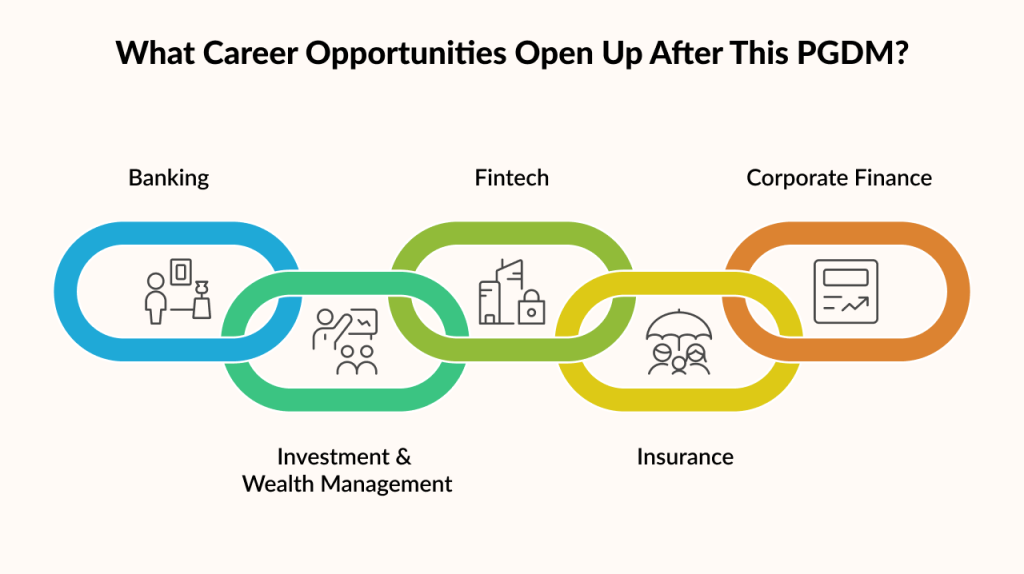
What Career Opportunities Open Up After This PGDM?
Completing this programme positions you for a broad range of roles across the financial sector. Here is a quick overview:
Career Roles After PGDM in Banking and Financial Services
Sector | Roles |
Banking | Branch Manager, Credit Analyst, Relationship Manager |
Investment & Wealth Management | Portfolio Manager, Financial Advisor, Investment Analyst |
Fintech | Product Analyst, Digital Banking Specialist |
Insurance | Underwriter, Risk Analyst |
Corporate Finance | Finance Manager, Treasury Analyst |
The banking and finance course subjects you study at MIT SDE are directly mapped to what employers look for, making you a competitive candidate from day one.
Frequently Asked Questions (FAQs)
1. What subjects are included in a Banking and Financial Services PGDM?
The PGDM covers Managerial Economics, Financial Management, Bank Operations, Fintech and Digital Banking, International Finance, Credit Administration, and electives such as Investment Banking and Behavioural Finance.
2. Is PGDM in Banking and Financial Services a good career option?
Yes. It offers strong career prospects in banking, investment, fintech, and insurance, with industry-aligned learning that prepares you for real roles in a fast-growing sector.
3. What job roles can you get after completing this PGDM?
Graduates can pursue roles such as Credit Analyst, Portfolio Manager, Relationship Manager, Fintech Analyst, Treasury Analyst, and Branch Manager across banks and financial organisations.
4. Is fintech included in the PGDM Banking curriculum?
Yes. Semester IV includes a dedicated subject, Fintech and Digital Banking, covering digital payments, online banking, and how emerging technology is reshaping financial services.