So, you have completed your PGDM HR Management and now you are wondering what comes next. Or perhaps you are a working professional considering whether this qualification is worth the investment. Either way, you are in the right place.
Human resources has grown into one of the most strategic functions in any organisation. Companies today need HR professionals who understand people, processes, and business impact. A PGDM in HR Management opens up a solid range of career paths, from entry-level roles to senior leadership positions. Let us walk through what those opportunities actually look like.
What Does a Career in HR Management Actually Look Like?
Before getting into specific job titles, it helps to understand the broad career trajectory in HR. Most graduates begin with operational or administrative roles and, over time, move into strategic or specialist positions. The HR career path typically follows a progression from executive to manager to business partner to director or CHRO.
What makes HR rewarding is that it touches every part of a business. Whether you enjoy data, communication, compliance, or culture-building, there is a niche for you within this field.
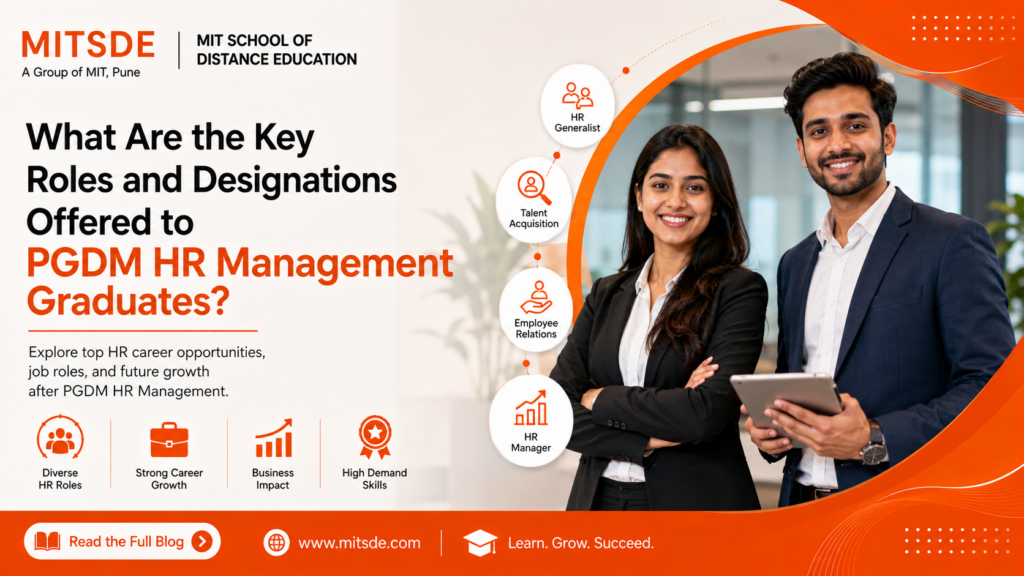
Which Key Roles Are Open to PGDM HR Management Graduates?
Here is a look at some of the most common designations and what they involve:
Job Role | Primary Responsibilities | Typical Experience Required |
HR Executive | Recruitment, onboarding, documentation | 0-2 years |
Talent Acquisition Specialist | End-to-end hiring, sourcing, interviews | 1-3 years |
HR Business Partner (HRBP) | Strategic alignment of HR with business goals | 3-6 years |
Learning & Development Manager | Training programmes, capability building | 4-7 years |
Compensation & Benefits Analyst | Salary benchmarking, payroll strategy | 2-5 years |
HR Manager | Team leadership, policy implementation | 5-8 years |
HR Director / CHRO | Organisation-wide HR strategy, leadership | 10+ years |
How Do PGDM HR Graduates Typically Start Their Careers?
Most fresh graduates begin as HR Executives or Recruitment Coordinators. These roles are entry points that give you hands-on exposure to day-to-day HR operations. You learn to manage employee records, coordinate interviews, handle induction programmes, and support payroll processing.
Within two to three years, many professionals move into specialised roles such as talent acquisition, employee relations, or training and development. This is where the real differentiation begins, and where your PGDM coursework in HR strategy, organisational behaviour, and labour law starts to pay off.
Which Industries Actively Hire PGDM HR Management Graduates?
HR is a universal function, which means your options are broad. Some of the top sectors that hire HR management graduates include:
- IT and Technology companies
- Banking, Financial Services and Insurance (BFSI)
- Manufacturing and FMCG
- Healthcare and Pharmaceuticals
- Retail and E-Commerce
- Consulting and Staffing firms
- Education and EdTech
Graduates who have pursued human resource courses in Mumbai often find strong placement opportunities given the density of large corporates and multinational firms headquartered in the city.
What Are the Senior-Level Designations One Can Aspire To?
If you are playing the long game, HR offers genuinely leadership-level roles. The HR Business Partner (HRBP) designation is highly sought after, as it positions HR professionals as strategic advisors to business units rather than administrative support.
Beyond that, the path leads to HR Director and eventually Chief Human Resources Officer (CHRO), roles that sit at the executive table and influence culture, workforce planning, and organisational design at scale.
For those considering the MBA in human resource management in Mumbai, it is worth knowing that many institutions in the city offer programmes that blend classroom learning with real-world industry exposure, which can accelerate this upward trajectory significantly.
Why is Distance Learning a Viable Option for HR Professionals?
Not everyone can attend full-time on-campus classes, and that is perfectly fine. Working professionals, entrepreneurs, and individuals managing personal commitments are increasingly choosing flexible distance learning formats. MIT School of Distance Education (MIT SDE) offers a PGDM HR Management programme specifically designed for such learners.
The advantage of distance learning in HR is that you can apply what you study immediately in your current workplace. It creates a feedback loop between theory and practice that traditional programmes often miss.
Those exploring human resource courses in Mumbai or looking for an MBA in human resource management in Mumbai with flexible schedules will find that MIT SDE’s programmes are structured to offer both academic rigour and practical relevance.
How Does the HR Career Path Evolve Over Time?
The HR career path is rarely linear, and that is part of what makes it interesting. Some professionals specialise deeply in one area, such as compensation and benefits or organisational development. Others take a generalist route and eventually move into senior HR leadership.
Certifications, networking, and staying updated with HR technology trends such as HRIS platforms, people analytics, and AI-assisted recruitment can all contribute to faster career growth. Your PGDM provides the foundation; what you build on it depends on continuous learning.
Frequently Asked Questions
-
1. What job roles are available after completing a PGDM in HR Management?
Graduates can pursue roles such as HR Executive, Talent Acquisition Specialist, HR Business Partner, Learning and Development Manager, Compensation Analyst, HR Manager, and CHRO across various industries.
-
2. Which industries hire PGDM HR graduates?
PGDM HR graduates are hired across IT, BFSI, healthcare, retail, manufacturing, consulting, and education sectors, with strong demand in metro cities like Mumbai, Pune, and Bengaluru.
-
3. Can PGDM HR graduates become HR Managers?
Yes, with four to seven years of relevant experience and a PGDM in HR Management, graduates can successfully transition into HR Manager roles responsible for policy, team leadership, and strategic HR operations.
-
4. What is the difference between an HR Executive and an HR Business Partner?
An HR Executive handles day-to-day operations like recruitment and documentation. An HR Business Partner works strategically, aligning HR functions with broader business objectives and advising leadership teams.
If you are ready to take the next step in your HR career, MIT School of Distance Education (MIT SDE) offers flexible, industry-aligned programmes designed for learners like you. Visit www.mitsde.com to explore your options.