1. Introduction
In today’s competitive job market, having a single qualification is often not enough. Employers now look for professionals who are not only academically strong but also equipped with practical, industry-ready skills. This is why more students are asking questions like: “Can I pursue two degree at a time?” or “Can we do diploma and degree together?”
The good news is, yes—it’s possible. With new guidelines from the University Grants Commission (UGC) and the All India Council for Technical Education (AICTE), students and working professionals can now pursue two qualifications simultaneously. This could mean combining two degree programs or taking up a degree and diploma simultaneously to gain both academic knowledge and practical expertise.
2. What Does Simultaneous Degree and Diploma Mean?
Traditionally, students had to complete one qualification before starting another. For example, finishing a bachelor’s degree before enrolling in a diploma. But the simultaneous learning model changes that.
It means enrolling in two recognized courses at the same time—either:
- Two degree programs (e.g., MBA.+ Executive MBA.)
- A degree and a diploma together (e.g., Executive MBA + Executive PGDM)
This approach saves time, provides dual learning, and ensures you graduate with more than one qualification—making you more employable in less time.
3. Benefits of Pursuing Degree and Diploma Together
1. Time Efficiency
Instead of spending an extra 2–3 years for a diploma after a degree, you complete both simultaneously. For instance, while pursuing a bachelor’s degree in management, you can also do a diploma in digital marketing, saving years of study time.
2. Skill Enhancement
A degree builds academic and theoretical knowledge, while a diploma adds hands-on, practical training. Together, they make you a more well-rounded professional.
3. Career Flexibility
With 2 degrees at the same time, you gain qualifications that allow you to explore multiple industries. For example, an IT degree with a diploma in data science opens opportunities in both software and analytics fields.
4. Competitive Edge
The job market is crowded. Having dual qualifications helps you stand out to employers and increases your chances of better roles and faster promotions.
5. Cost-Effectiveness
Pursuing both courses together reduces the total duration of study, which also means reduced living expenses, fewer years of tuition fees, and early entry into the workforce.
4. Eligibility & Guidelines
UGC Guidelines
The UGC has approved pursuing two degree programs simultaneously. One of them must be in a flexible mode (online, distance, or evening classes) to avoid timetable conflicts.
AICTE Guidelines
AICTE supports dual learning in management, engineering, and technical education. Institutions under AICTE provide recognized courses that can be paired with diplomas.
Who Can Apply?
- Students looking to save time and build more skills.
- Working professionals wanting to upgrade their careers without pausing their jobs.
Learning Modes
- Offline + Online: Most popular combination.
- Two Online Courses: For maximum flexibility.
- Part-Time + Full-Time: Suitable for working professionals.
5. Which Are the Most Popular Degree + Diploma Combinations?
Here are some of the most in-demand combinations:
- Degree in Management + Diploma in Digital Marketing → Ideal for careers in business, startups, and corporate leadership.
- Degree in Engineering + Diploma in Project Management → Suitable for careers in construction, IT, and industrial projects.
- Degree in IT + Diploma in Data Science/AI → Perfect for tech enthusiasts exploring AI, ML, and data careers.
- Degree in Commerce + Diploma in Finance/Accounting → Great for careers in banking, taxation, and corporate finance.
These combinations not only complement each other but also provide an edge in specialized industries.
6. What Are the Challenges of Doing a Degree and Diploma Together?
While there are many benefits, pursuing dual qualifications does come with some challenges:
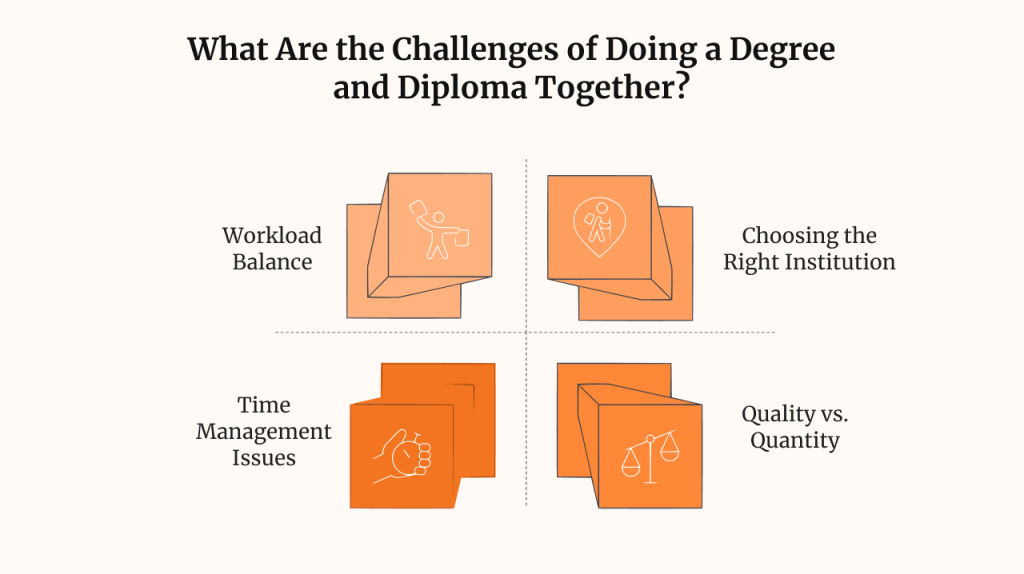
- Time Management Issues: Handling assignments, exams, and projects from two courses can be overwhelming.
- Workload Balance: The pressure of studying two programs requires strong self-discipline.
- Choosing the Right Institution: Not all institutions offer flexible or recognized courses, so research is essential.
- Quality vs. Quantity: Students must ensure they focus on learning outcomes, not just collecting certificates.
7. How Can You Succeed in Dual Learning?
To make the most of degree and diploma simultaneously, follow these strategies:
- Plan Your Schedule Wisely: Use planners or apps to divide study time.
- Choose Complementary Courses: Pick programs that enhance each other (e.g., BBA + Diploma in HR).
- Leverage Online Platforms: Take at least one course in online/distance mode for flexibility.
- Stay Practical: Apply what you learn in real-life projects or internships.
- Avoid Overloading: Don’t chase too many courses—focus on quality and relevance.
8. Why Choose MITSDE for Dual Learning?
If you’re wondering, can we do diploma and degree together, MITSDE (MIT School of Distance Education) offers a smart solution.
- AICTE-approved programs trusted across industries.
- Flexible online learning mode that suits both students and professionals.
- Industry-recognized diplomas and certifications to boost employability.
- Expert faculty and career support to guide you throughout your learning journey.
MITSDE ensures that learners don’t just earn qualifications but also build practical, job-ready skills.
9. Conclusion
The future belongs to multi-skilled professionals. If you’ve ever asked, “Can I pursue two degree at a time?” or wondered “Can we do diploma and degree together?”, the answer is a confident yes.
Pursuing a degree and diploma simultaneously is not just about getting two certificates—it’s about saving time, building a diverse skill set, and staying ahead in a competitive job market. With proper planning, the right institution, and the flexibility of online learning, you can achieve more in less time and fast-track your career growth.