
After completing an Executive PGDM in Business Analytics, professionals can move into high-demand roles such as Analytics Manager, Data Analyst, Business Intelligence Analyst, and Product Analyst. These roles offer strong salary growth, leadership opportunities, and excellent ROI due to rising demand for data-driven decision-making across industries.
What Are the Top Job Roles After Executive PGDM in Business Analytics?
If you’re a mid-level professional wondering about job roles after Executive PGDM in Business Analytics, here are the most promising career paths:
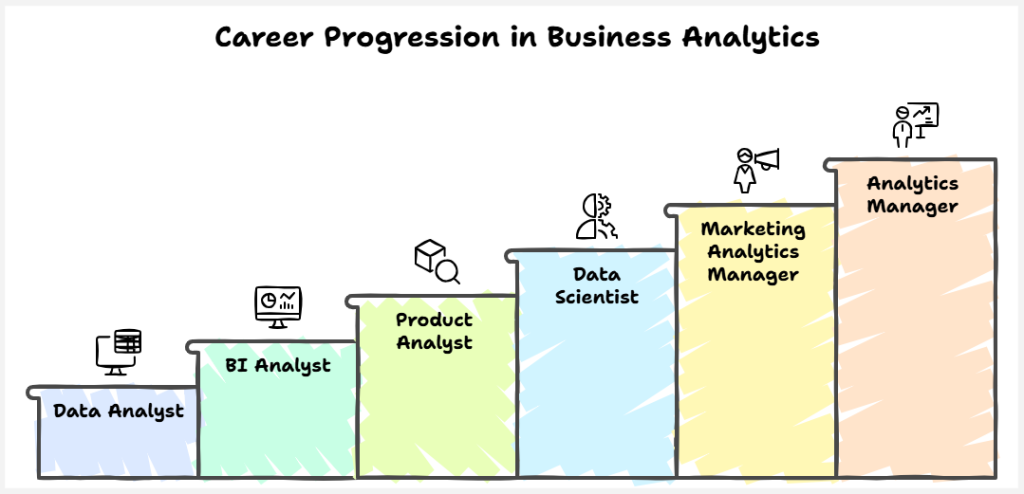
1. Analytics Manager
This is one of the most sought-after analytics manager roles. You will lead teams, design data strategies, and drive business decisions.
- Skills Required: Data visualization, leadership, predictive analytics
- Average Salary (India): ₹15–25 LPA
- Best For: Professionals with prior experience in data or operations
2. Data Analyst
A foundational yet powerful role in business analytics job roles.
- Skills Required: Excel, SQL, Python, data cleaning
- Average Salary: ₹6–12 LPA
- Key Responsibility: Turning raw data into meaningful insights
3. Business Intelligence (BI) Analyst
Focuses on dashboards, reporting, and decision-making tools.
- Skills Required: Power BI, Tableau, SQL
- Average Salary: ₹8–18 LPA
- Outcome: Helps management track KPIs effectively
4. Data Scientist
A high-paying and advanced role for those with strong technical skills.
- Skills Required: Machine learning, Python, statistics
- Average Salary: ₹12–30 LPA
- Why Choose: High demand and future-proof career
5. Product Analyst
Works closely with product and marketing teams to improve user experience.
- Skills Required: A/B testing, data storytelling, SQL
- Average Salary: ₹10–20 LPA
- Best For: Professionals transitioning into tech/product roles
6. Marketing Analytics Manager
Combines marketing knowledge with analytics.
- Skills Required: Google Analytics, campaign tracking, segmentation
- Average Salary: ₹10–22 LPA
- Outcome: Improves ROI on marketing campaigns
Which Skills Are Required for Business Analytics Job Roles?
To succeed in job roles after Executive PGDM in Business Analytics, you need a mix of technical and managerial skills:
🔹 Technical Skills
- Data Analysis (Excel, SQL, Python)
- Data Visualization (Power BI, Tableau)
- Machine Learning Basics
- Statistical Analysis
🔹 Business Skills
- Problem-solving
- Decision-making
- Communication & storytelling
- Domain knowledge (finance, marketing, operations)
👉 The right skill combination directly impacts your PGDM analytics ROI.
How Much Salary Can You Expect After Executive PGDM in Business Analytics?
Salary depends on experience, role, and skillset. Here’s a quick breakdown:
Experience Level | Average Salary |
3–5 years | ₹6–12 LPA |
5–8 years | ₹10–20 LPA |
8+ years | ₹18–30+ LPA |
💡 Insight: Mid-level professionals often see a 40–80% salary hike post completion, making it a strong PGDM analytics ROI opportunity.
Is Executive PGDM in Business Analytics Worth It? (ROI Explained)
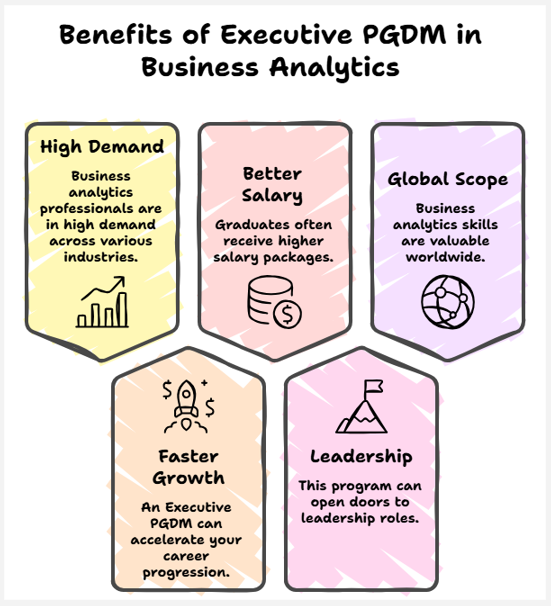
1. High Demand Across Industries
From banking to e-commerce, analytics professionals are needed everywhere.
2. Faster Career Growth
You move from operational roles to strategic decision-making positions.
3. Better Salary Packages
Analytics roles pay significantly higher than traditional roles.
4. Leadership Opportunities
Roles like Analytics Manager open doors to senior positions.
5. Global Career Scope
Data analytics skills are globally relevant.
👉 All these factors contribute to a strong PGDM analytics ROI.
How to Choose the Right Role After PGDM in Analytics?
Ask yourself these questions:
- Do you enjoy working with data or leading teams?
- Are you more technical or business-oriented?
- Do you prefer strategy or execution?
🎯 Tip:
- Choose a Data Scientist if you love coding
- Choose Analytics Manager if you enjoy leadership
- Choose BI Analyst if you prefer visualization
Why Do Mid-Level Professionals Prefer Business Analytics Careers?
- Career switch without starting from scratch
- Higher earning potential
- Industry relevance and job security
- Opportunities in top companies
This makes business analytics job roles ideal for working professionals looking for career growth.
Why Choose MITSDE for Executive PGDM in Business Analytics?
When it comes to maximizing your PGDM analytics ROI, choosing the right institute matters.
Here’s why MITSDE stands out:
- Industry-oriented curriculum designed for working professionals
- Flexible online learning model
- Practical exposure with real-world case studies
- Strong alumni network and career support
- Recognized and trusted institution in management education
🎓 MITSDE helps you bridge the gap between theory and real-world analytics applications—making you job-ready from day one.
FAQs – Job Roles After Executive PGDM in Business Analytics
1. What are the best job roles after Executive PGDM in Business Analytics?
Top roles include Analytics Manager, Data Analyst, BI Analyst, Data Scientist, and Product Analyst.
2. What is the average salary after PGDM in Business Analytics?
Salaries range from ₹6 LPA to ₹30+ LPA depending on experience and skills.
3. Is coding mandatory for business analytics roles?
Not always. Basic SQL and tools like Power BI are enough for many roles, but advanced roles require Python.
4. What is the ROI of Executive PGDM in Business Analytics?
High ROI due to salary growth, career advancement, and industry demand.
5. Can mid-level professionals switch careers through PGDM in Analytics?
Yes, it’s one of the best programs for career transition into data-driven roles.
6. Which industries hire business analytics professionals?
Banking, healthcare, e-commerce, IT, consulting, and marketing industries actively hire analytics professionals.
Conclusion
An Executive PGDM in Business Analytics is more than just a qualification—it’s a gateway to high-paying, future-ready careers. With multiple job roles after Executive PGDM in Business Analytics, strong salary potential, and excellent PGDM analytics ROI, it’s an ideal choice for mid-level professionals looking to level up.
🚀 If you’re ready to transition into high-growth business analytics job roles and step into leadership-driven analytics manager roles, now is the time to act.