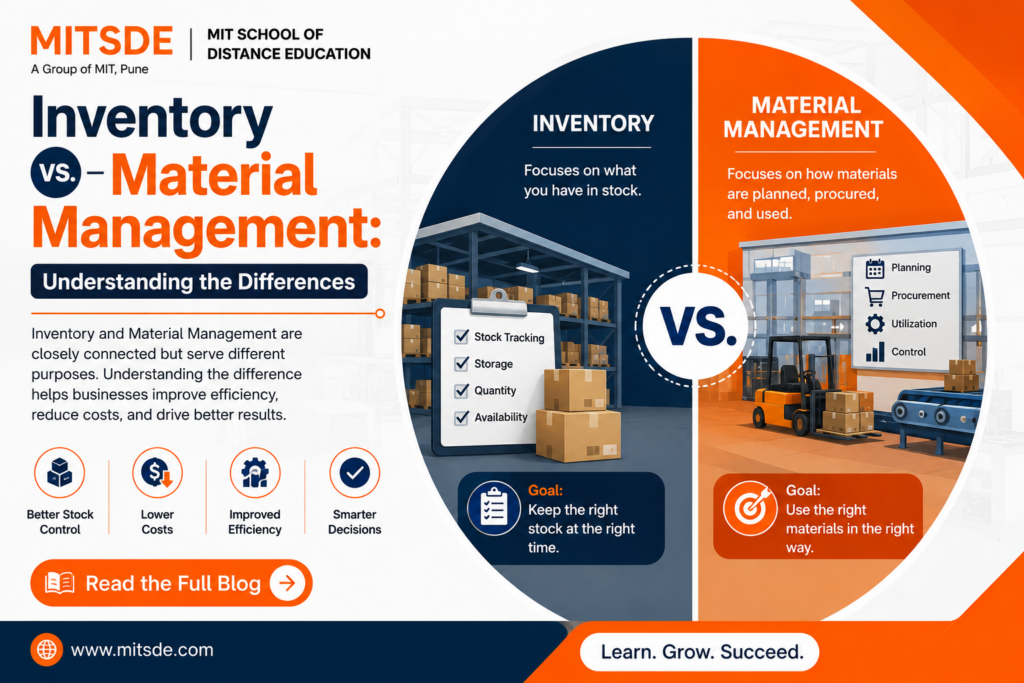
Inventory management focuses narrowly on controlling stock levels — raw materials, work-in-progress, and finished goods — to meet demand without overstocking or understocking. Material management takes a broader view, covering the entire flow of resources: procurement, storage, logistics, and supplier relationships. In short: inventory management is a subset of material management.
Table of Contents
- What is Inventory Management?
- What is Material Management?
- Core Differences
- Why Understanding the Difference Matters
- Benefits of Advanced Education in Material Management
- FAQs
What is Inventory Management?
Inventory management is concerned with controlling stock levels — raw materials, work-in-progress products, and finished commodities — ensuring an organization has the right inventory to meet demand without overstocking or understocking.
Key responsibilities:
- Stock Monitoring — tracking quantity and condition of goods in storage
- Order Fulfillment — ensuring products are available on time for clients or production
- Demand Forecasting — using historical data to predict future stock requirements
- Cost Control — reducing costs of holding and managing inventory
What is Material Management?
Material management takes a more comprehensive view — covering the planning, procurement, handling, and application of materials required for production and operation, ensuring resources flow smoothly from suppliers to manufacturers to distribution.
Key responsibilities:
- Procurement — sourcing and purchasing goods at the best price and quality
- Storage — effective management of warehouses and storage facilities
- Logistics Coordination — ensuring smooth movement of materials
- Supplier Relationship Management — building strong, long-term vendor relationships
Core Differences Between Inventory and Material Management
| Aspect | Inventory Management | Material Management |
|---|---|---|
| Scope | Subcategory focused on stock control | Encompasses procurement, logistics, and supplier relations |
| Objective | Maintain stock levels to meet demand while minimizing costs | Ensure overall material flow supports production and business continuity |
| Responsibility | Quantity and storage | Entire process — sourcing to delivery |
| Nature | More operational — daily stock levels | More strategic — aligns material flows with organizational goals |
Direct answer: Inventory management is operational and stock-focused; material management is strategic and process-wide, encompassing inventory management as one of its components.
Why Understanding the Difference Matters
Businesses frequently face inefficiencies from failing to clearly separate these two functions. Poor material planning can result in stockouts, while over-reliance on inventory management alone can raise holding costs unnecessarily.
Advanced education — such as a PGDM in Material Management — helps professionals close these gaps, streamline processes, and improve overall operational efficiency.
Benefits of Advanced Education in Material Management
Enrolling in a PGDM in Material Management provides:
- Improved Career Opportunities — roles like supply chain manager, procurement specialist, and logistics coordinator
- Strategic Insights — training in optimizing both material and inventory flows
- Technical Proficiency — hands-on experience with modern material/inventory management tools
- Industry Relevance — curriculum aligned with current real-world industry needs
Conclusion
Material management and inventory management are two complementary sides of the same coin. Inventory management focuses on stock levels, while material management ensures the smooth movement of resources across the company. A PGDM course in Material Management teaches the knowledge and skills required to succeed in today’s competitive supply chain and logistics environment.
FAQ's
-
1. Is inventory management the same as material management?
No. Inventory management is a subset of material management, focused specifically on stock control, while material management covers the entire resource flow — procurement, storage, logistics, and supplier relations.
-
2. Which is more strategic — inventory or material management?
Material management is more strategic, aligning material flows with organizational goals, while inventory management is more operational, focused on day-to-day stock levels.
-
3. What career roles are available after studying material management?
Supply chain manager, procurement specialist, and logistics coordinator are among the most common roles for professionals with specialized material management training.
-
4. Why do businesses need both inventory and material management?
Because they serve complementary functions — inventory management prevents stockouts/overstocking, while material management ensures the smooth flow of resources across the entire business.
-
5. What does a PGDM in Material Management cover?
It covers procurement, storage, logistics coordination, supplier relationship management, and strategic material/inventory flow optimization.
-
6. Can poor material planning cause stockouts?
Yes — poor material planning is a common cause of stockouts, while excessive reliance on inventory management alone can raise unnecessary holding costs.
Author
Ranjula Sharma
Ranjula Sharma is an SEO and content marketing specialist passionate about creating informative, reader-friendly content on higher education, online learning, and career development. She focuses on making complex topics simple and actionable.