In today’s competitive world, upskilling is essential to stay ahead.
If you’re ready to grow without hitting pause on your career, understanding the difference between a Dual Degree Course and a double major is the first step toward choosing the right academic path.
What Is a Dual Degree Course?
A Dual Degree Course (or Dual Degree Program) lets you earn two separate academic degrees—often in different fields—by studying concurrently at the same or partner universities. This can save time compared to completing two programs sequentially and gives you a competitive edge in the job market.
Key Highlights
- Two Degrees, One Program: You receive two distinct diplomas, such as a Bachelor of Arts and a Bachelor of Science, or even a Bachelor’s plus a Master’s.
- Concurrent or Overlapping Study: Finish both degrees faster than if pursued separately.
- Broader Knowledge & Skills: Gain deep expertise in two areas, making you highly versatile.
- Global Exposure: Many Dual Degree Programs are offered through collaborations between universities, expanding your professional network.
Advantages of a Dual Degree
- Broader Skill Set: Build mastery in two diverse domains.
- Enhanced Career Prospects: Two qualifications open doors to multiple industries.
- Time & Cost Efficiency: Faster and often more affordable than earning degrees sequentially.
- Personal Growth: Demands discipline, multitasking, and adaptability.
- Specialization: Combine two niche fields to become uniquely marketable.
What Is a Double Major?
A double major lets you earn one degree with two areas of specialization by completing the required coursework for both. Your diploma reflects a single degree, but your transcript shows both majors.
Key Highlights
- One Degree, Two Specialties: For example, a B.A. with majors in Business and Psychology.
- Unified Framework: Typically takes the same time as a single major.
- Flexibility: Choose related or unrelated subjects to suit your interests.
Benefits
- Broader Perspective: Explore multiple interests within one program.
- Career Flexibility: Gain an interdisciplinary skill set attractive to employers.
- Cost-Effective: Lower investment compared to a Dual Degree Program.
Dual Degree Program vs. Double Major: The Core Differences
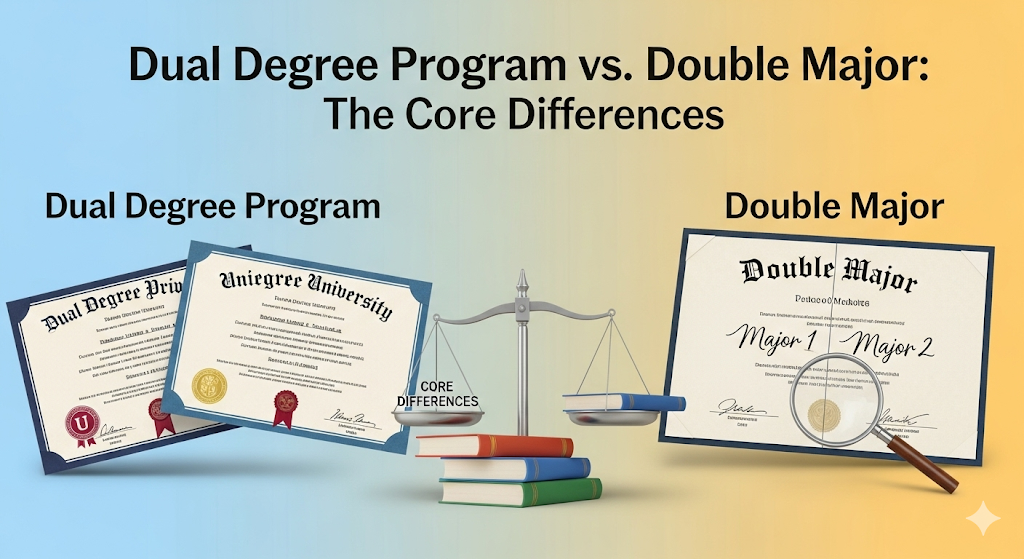
Aspect | Dual Degree Program | Double Major |
Outcome | Two distinct degrees (e.g., B.Tech & M.Tech) | One degree with two majors |
Duration & Credits | Typically longer; must meet both degree requirements | Similar to a standard single degree |
Focus | Deep specialization in two fields | Broader education across two areas |
Career Impact | Opens diverse, high-paying roles across industries | Enhances marketability with a wide skill set |
Cost | Higher due to extended study | More budget-friendly |
Bottom line: A Dual Degree Course offers depth and two official qualifications; a double major provides breadth within one degree.
MITSDE’s Unique Edge: Dual Specialization
Why choose between the two when you can enjoy the best of both worlds?
MIT School of Distance Education (MITSDE) offers a flagship Dual Specialization program—PGDM Executive + Executive MBA—designed for working professionals who want maximum career impact.
Program Highlights
- Two Prestigious Credentials: AICTE-approved PGDM Executive and UGC-recognized Executive MBA.
- Industry Collaboration: EMBA curriculum developed with HCL Technologies for real-world relevance.
- Flexible Blended Learning: Balance work and study with an online–offline mix.
- Career-Aligned Specializations: Choose one focus—or two—to match market demand.
- Affordable Investment: Competitive fees tailored for professionals.
This Dual Degree Program equips you with cutting-edge business acumen, strategic leadership skills, and live-project experience. Whether you aim to specialize deeply or diversify, MITSDE lets you customize: for example, Chief Digital Marketing Strategist in the PGDM Executive and Business Analytics & AI in the EMBA.
Final Thoughts
When deciding between a Dual Degree Course and a double major, consider career goals, time, cost, and desired specialization. If you seek in-depth expertise, wider career opportunities, and the credibility of two distinct degrees, a Dual Degree Program is the smarter investment.
And if you’re looking for the leading Dual Degree Institute in Pune, MITSDE delivers a future-ready path with its Dual Specialization PGDM Executive + EMBA.
Explore the program here and take the next step toward a truly versatile career.