For professionals looking to advance, choosing the right PGDM in banking and finance colleges is a pivotal decision. As the world of finance goes through digital transformation, choosing a course that helps you cover the nuances of AI and data is extremely important. A key factor in this choice is the curriculum. The curriculum of your chosen course must be detailed and comprehensive enough to cover traditional banking fundamentals while remaining agile enough to include modern FinTech.
At MIT School of Distance Education (MIT SDE), our PGDM in Banking and Financial Services is designed to offer this balance. Whether you are pursuing your PGDM Banking and Financial Services in Bangalore’s tech-driven environment or looking for a PGDM Banking and Financial Services in Kolkata’s established commercial hub, our online programme ensures you stay ahead of the curve.
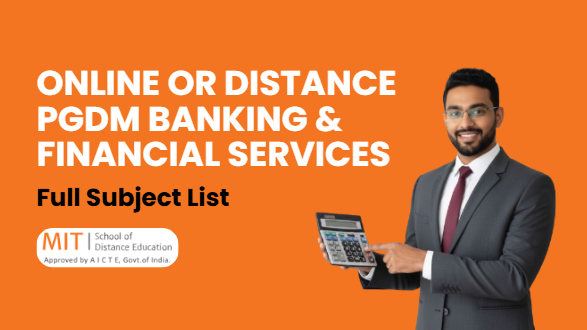
Courses Covered in Online/Distance PGDM Banking & Financial Services
Below is the comprehensive, semester-wise breakdown of the subjects covered in the curriculum.
Semester 1 – Building a Managerial Foundation
The first semester focuses on the core concepts of business management. Before specialising in finance, students learn and understand the broader business environment and the legal frameworks that govern it.
- Managerial Economics – Analysing market trends and economic theories.
- Principles of Management – The fundamentals of organisational hierarchy and leadership.
- Business Communication – Mastering professional correspondence and corporate reporting.
- Legal & Business Environment – Understanding the laws governing the Indian financial sector.
- Accounting for Managers – The basics of financial recording and bookkeeping.
Semester 2 – Financial Analysis and Research
In the second semester, the focus shifts toward analytical skills needed to thrive in the world of finance. Students learn to interpret data and understand the mechanics of the broader financial markets.
- Financial Management – Managing an organisation’s capital and investment strategies.
- Financial Markets & Services – Insights into the stock market, insurance, and mutual funds.
- Financial Reporting, Statements, and Analysis – Deep-diving into balance sheets and P&L statements.
- Research Methodology and Management Decision – Using data to drive business strategies.
- Management Intelligence System (MIS) – Leveraging technology for data-driven management.
Semester 3 – Core Banking Operations and Strategy
This semester is the heart of the PGDM in banking and financial services. It moves away from general management and dives deep into the specific operations of a banking institution.
- Bank Operations Management – Detailed study of retail and corporate banking workflows.
- Credit Administration – Learning the processes of loan appraisal and credit risk management.
- Strategic Management in Banking & Financial Services – Formulating long-term goals for financial institutions.
- Organisational Behaviour – Understanding human dynamics within a corporate structure.
- Project Work (Phase 1) – Initial application of theoretical knowledge to real-world scenarios.
Semester 4 – Global Finance and Digital Transformation
The final phase of the programme focuses on the future of finance, including international trade and the digital revolution.
- FinTech and Digital Banking – Exploring blockchain, digital wallets, and AI-driven banking.
- International Finance – Navigating foreign exchange (Forex) and global trade finance.
- Merchant Banking and Financial Services – Understanding IPOs, underwriting, and advisory roles.
- Specialised Electives – Students can tailor their degree by choosing two electives from:
- Investment Banking
- Behavioural Finance
- Security Analysis and Portfolio Management
- Marketing of Financial Services
Conclusion
A PGDM in banking and financial services can bethe force behind your career acceleration. At MIT SDE, our curriculum acts as a comprehensive toolkit for the modern financier. By covering everything from traditional credit administration to the latest in FinTech, the curriculum prepares you for diverse roles across the industry.
Whether you are aiming for a role in a leading MNC or a disruptive startup, this programme provides the academic rigour and practical insight required to succeed in today’s competitive financial landscape. So, get in touch with us today to learn more about our program!