An online MBA in finance—also known as an MBA finance degree online is a two-year postgraduate program designed to build advanced skills in financial management, investment strategies, risk assessment, corporate finance, and capital markets. Delivered through a flexible online format, this MBA finance correspondence course is ideal for students and working professionals who want career growth without pausing their jobs. It offers affordable fees, industry-aligned subjects, and strong job prospects in banking, fintech, consulting, and corporate finance.
What Is an Online MBA in Finance?
An online MBA in Finance is a postgraduate program that trains learners in financial planning, budgeting, corporate finance, investment management, and global financial markets. Unlike regular MBA programs, the MBA in finance online course allows students to study anytime, anywhere, making it highly suitable for working professionals and graduates seeking flexibility.
According to the Graduate Management Admission Council (GMAC) 2024 report, over 92% of employers worldwide plan to hire MBA graduates, with finance roles among the top five in demand. This shows the growing relevance of a specialized finance MBA in today’s competitive market.
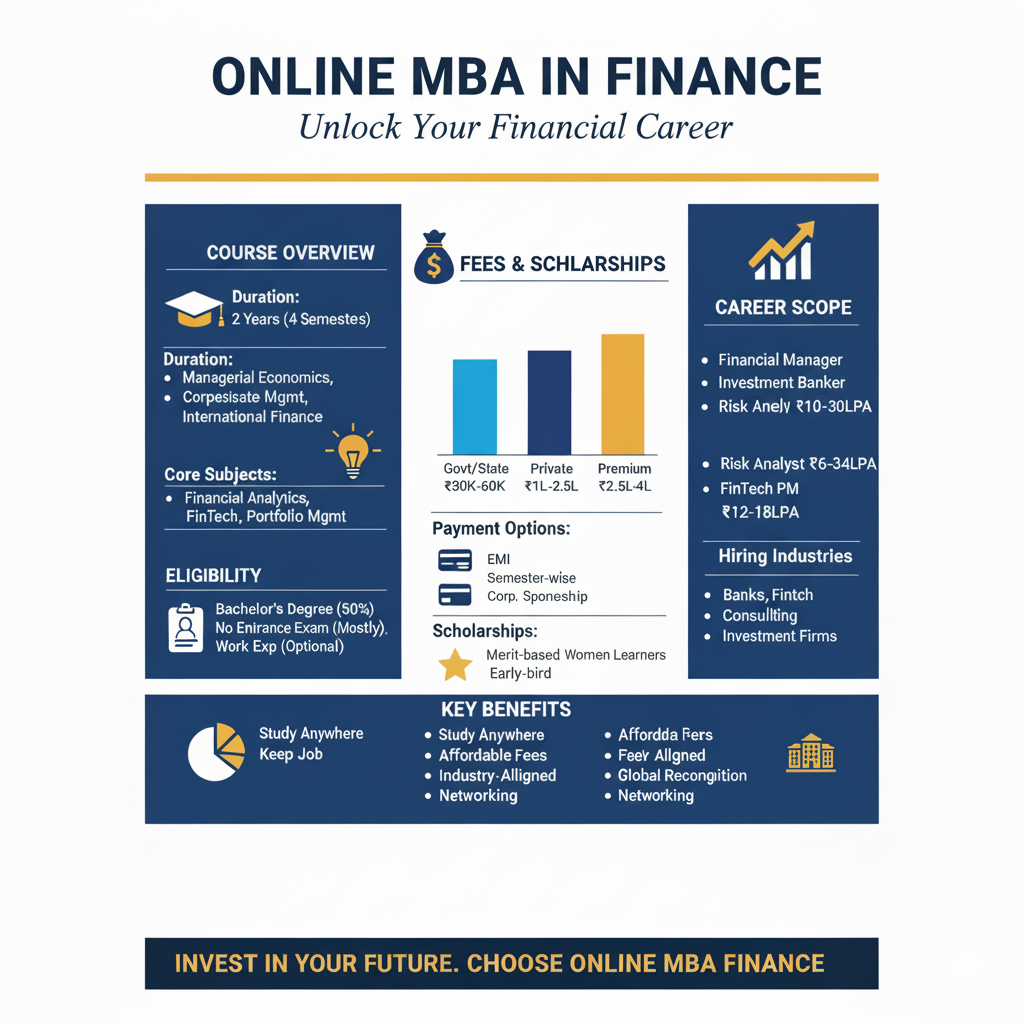
Course Duration & Structure
📌 Course Duration
- Total Duration: 2 years
- Structure: 4 semesters (6 months each)
📌 What You Learn (Core Subjects)
Semester | Core Subjects |
Semester 1 | Managerial Economics, Financial Accounting, Organizational Behavior, Business Communication |
Semester 2 | Corporate Finance, Marketing Management, Quantitative Techniques, Business Law |
Semester 3 | Investment Management, Financial Markets & Institutions, Risk Management, Strategic Management |
Semester 4 | International Finance, Mergers & Acquisitions, Derivatives, Project Work/Finance Dissertation |
Electives Offered
Most universities offer specialized electives such as:
- Equity Research
- Financial Analytics
- Wealth Management & Financial Planning
- FinTech & Digital Payments
- Treasury Management
- Credit Risk Modelling
- Portfolio Management
Electives help you tailor your MBA finance degree online based on your industry goals.
Eligibility Criteria
You can enroll in a distance MBA in finance or MBA finance correspondence course if you meet the following eligibility:
✔ Educational Qualification
- A bachelor’s degree (any stream) from a recognized university
- Minimum 50% marks (varies by institution)
✔ Work Experience (Preferred, Not Mandatory)
- Some institutes prefer 1–2 years of professional experience
- Adds value for working professionals aiming for senior roles
✔ No Entrance Exams for Most Online Programs
Some universities may require:
- CAT/MAT/XAT/CMAT (optional)
- Personal interview or screening in selective institutes
Fees & Scholarship Options
📌 Typical Fee Range for Online MBA in Finance
Institute Type | Fee Range (2 Years) |
Government/State Universities | ₹30,000 – ₹60,000 |
Private Universities | ₹1,00,000 – ₹2,50,000 |
Premium Ed-Tech/Institutes | ₹2,50,000 – ₹4,00,000 |
📌 Payment Flexibility
- Semester-wise payment
- EMI options (0-cost EMIs in some institutes)
- Corporate sponsorship for employees
📌 Scholarships Available
- Merit-based scholarships
- Scholarships for women learners
- Early-bird discounts
- Government schemes (varies by state)
Why Choose an Online MBA in Finance? (Benefits)
The mba in finance online course is ideal if you want quality education with flexibility.
⭐ Key Benefits
- Study from anywhere—no relocation needed
- Continue your job while earning your degree
- Live online classes, recorded lectures, and LMS access
- Affordable compared to full-time MBA programs
- Industry-focused subjects aligned with job market needs
- Globally recognized UGC-DEB approved programs
- Networking opportunities with peers and faculty
🎯 Why Working Professionals Prefer It
A report by Coursera (2024) shows that 72% of working learners choose online programs to balance education and work schedules. Online MBA structures are built for real-world flexibility, making them ideal for career upskilling.
Career Scope After an Online MBA in Finance
Finance roles continue to rank among the highest-paying managerial careers in India. According to Naukri and AmbitionBox (2024 data), average salary ranges for MBA-finance professionals are:
Top Career Roles & Salary Ranges
Role | Average Salary (per year) |
₹8 LPA – ₹20 LPA | |
Investment Banker | ₹10 LPA – ₹30 LPA |
Risk Analyst | ₹6 LPA – ₹14 LPA |
Corporate Finance Manager | ₹9 LPA – ₹22 LPA |
Portfolio Manager | ₹12 LPA – ₹35 LPA |
Equity Research Analyst | ₹5 LPA – ₹12 LPA |
Wealth Manager | ₹4 LPA – ₹15 LPA |
Credit Analyst | ₹6 LPA – ₹18 LPA |
FinTech Product Manager | ₹12 LPA – ₹28 LPA |
📌 Industries Hiring Finance MBA Graduates
- Banks (Private & Public)
- NBFCs
- FinTech companies
- Investment firms
- Corporate financial departments
- Consulting firms
- Insurance & risk management companies
Real-World Insights & Expert Opinions
Finance experts emphasize the growing demand for analytical skills and strategic financial decision-making.
“Digital finance and analytics have transformed how organizations make investment decisions. MBA finance graduates with data skills are in high demand today.”
— Dr. R. Narayan, Finance Professor & Industry Consultant
A 2024 Deloitte report highlights:
- 32% growth in demand for finance professionals with digital and analytical skills
- Rising opportunities in FinTech, risk analytics, and investment advisory
FAQs About Online MBA in Finance
1. Is an MBA finance degree online valid?
Yes, as long as it is approved by UGC-DEB, it is fully valid for jobs and higher education.
2. Can I do a distance MBA in finance without work experience?
Absolutely. Work experience is optional, though helpful.
3. What is the average starting salary after an online MBA in Finance?
Freshers typically earn ₹4 LPA – ₹7 LPA, depending on skills and institute reputation.
4. Are online MBA programs accepted globally?
Yes, many online MBAs are recognized internationally, especially from accredited universities.
5. What skills do I need for this course?
- Analytical thinking
- Financial reasoning
- Excel and financial modelling
- Understanding of markets
Final Advice for Students
If you want a flexible, affordable, and future-oriented management degree, an MBA in finance online course is one of the best options available. It allows you to learn at your own pace, build advanced financial skills, and unlock high-paying career opportunities—all without leaving your job.
Before enrolling, consider:
- Accreditation of the university
- Course curriculum & electives
- Placement support
- Fee structure and EMI options
- Reviews from alumni
With the growing digital finance ecosystem, now is the right time to invest in a distance MBA in finance or MBA finance correspondence course and take your career to the next level.