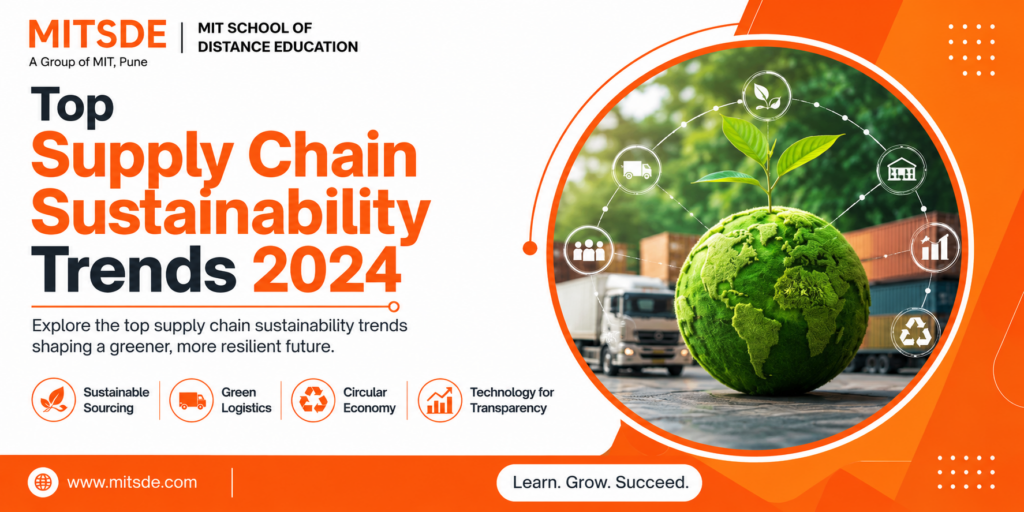
The top supply chain sustainability trends are: circular economy integration, green logistics, digital twins, renewable energy adoption, supply chain transparency (via blockchain), and resilience through localised sourcing. Together, these trends are redefining how businesses design, monitor, and future-proof their supply chains against environmental and economic risk.
Table of Contents
- Circular Economy Integration
- Green Logistics Take Centre Stage
- Digital Twins for Enhanced Visibility
- Renewable Energy Adoption
- Supply Chain Transparency
- Resilience Through Localised Sourcing
- How to Build a Career in Sustainable Supply Chain
- FAQs
Circular Economy Integration
The circular economy model focuses on reducing waste and keeping resources in use for as long as possible — designing products with recycling in mind and minimizing waste at every stage. Businesses are increasingly adopting circular practices because staying relevant now depends on it.
Green Logistics Take Centre Stage
Green logistics means using eco-friendly transportation, optimizing routes to reduce emissions, and adopting sustainable packaging. Companies are realizing that going green isn’t just good for the planet — it’s good for business, cutting costs while improving brand reputation.
Digital Twins for Enhanced Visibility
A digital twin is a virtual replica of a physical supply chain, enabling real-time monitoring, analysis, and prediction of supply chain activities. This gives businesses a virtual copy of their entire supply chain to optimize operations and respond swiftly to disruptions.
Renewable Energy Adoption
From solar panels to wind turbines, businesses are shifting toward sustainable energy sources — not just for environmental reasons, but to future-proof operations against energy price volatility. Understanding how renewable energy fits into the supply chain puzzle is essential for any aspiring supply chain professional.
Supply Chain Transparency
Consumers increasingly want to know where their products come from, how they’re made, and their environmental impact. This has made supply chain transparency a top priority, with blockchain technology playing a significant role in providing an auditable record of every transaction for consumers and stakeholders.
Resilience Through Localised Sourcing
Global disruptions exposed the risks of over-relying on single-source suppliers. In response, companies are shifting toward localised sourcing — reducing dependency on a single source, building more resilient supply chains, and contributing to local economies.
How to Build a Career in Sustainable Supply Chain
Staying current on these trends increasingly requires formal upskilling. A PG Diploma in Supply Chain Management equips learners with the skills needed to thrive in this evolving landscape.
MITSDE’s PG Diploma in Supply Chain Management offers:
| Feature | What It Delivers |
|---|---|
| Comprehensive Curriculum | Covers fundamentals to advanced concepts like sustainable supply chain practices |
| Industry-Relevant Projects | Hands-on exposure to real-world supply chain tactics |
| Expert Faculty Guidance | Practical insights from faculty with extensive industry experience |
| Networking Opportunities | Connections with industry professionals, alumni, and peers |
| Focus on Sustainability | Dedicated modules on sustainable supply chain management |
FAQ's
-
1. What are the top supply chain sustainability trends?
Circular economy integration, green logistics, digital twins, renewable energy adoption, supply chain transparency via blockchain, and resilience through localised sourcing.
-
2. What is a circular economy in supply chain management?
It's a model focused on reducing waste and reusing resources for as long as possible, with products designed for recyclability from the start.
-
3. What is a digital twin in supply chain management?
A digital twin is a virtual replica of a physical supply chain used for real-time monitoring, analysis, and prediction of supply chain performance.
-
4. Why is supply chain transparency important?
Consumers increasingly demand visibility into product origin and environmental impact — blockchain technology helps companies provide an auditable, transparent record.
-
5. How can I build a career in sustainable supply chain management?
A PG Diploma in Supply Chain Management, such as the one offered by MITSDE, builds both foundational and sustainability-focused skills needed for this career path.
-
6. Why are companies shifting to localised sourcing?
Localised sourcing reduces dependency on single suppliers, builds resilience against global disruptions, and supports local economies.
Swati Karande
Swati Karande is an SEO and digital marketing professional with over 11 years of experience in search optimization, content strategy, and online branding. She writes on education, career growth, and digital marketing trends.
View LinkedIn Profile →