
Mumbai is India’s financial capital, and that single fact shapes almost everything about the Business Analyst (BA) profession in the city. Banks, insurers, asset managers, IT services giants, e-commerce firms, and a fast-growing fintech and consulting ecosystem all compete for professionals who can translate business problems into technical solutions and translate data into decisions. That professional is the Business Analyst.
If you are a fresh graduate wondering where to start, a commerce or engineering student trying to decide between multiple career tracks, or a working professional planning a mid-career switch, the question you are really asking is: which skills are needed to become a Business Analyst in Mumbai?
This guide answers that question in full technical skills, soft skills, tools, certifications, salary bands, career roadmap, and the mistakes that slow candidates down. It is written to be useful whether you read it in a browser, hear it summarized by an AI assistant, or skim it for a quick decision.
Key Takeaways
- A Business Analyst bridges business needs and technical solutions using data, documentation, and stakeholder communication.
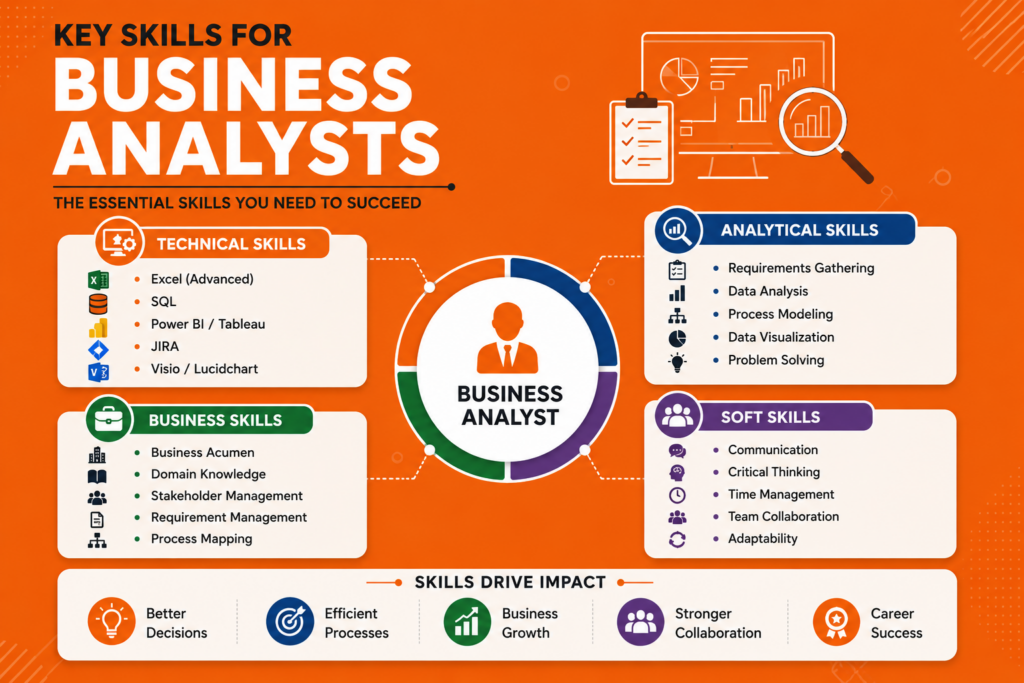
- Core skill groups: analytical skills, technical/data skills, domain knowledge, communication, and business acumen.
- Must-know tools typically include Excel, SQL, Power BI or Tableau, JIRA/Confluence, and basic process-modeling notations (BPMN/UML).
- Coding is helpful but not mandatory for most BA roles; SQL and data literacy matter more than software development skills.
- Mumbai’s BA demand is concentrated in BFSI (banking, financial services, insurance), IT services, e-commerce, consulting, and fintech.
- Certifications (CBAP, ECBA, CCBA, PMI-PBA) and a structured Business Analytics program can significantly shorten the learning curve.
- AI literacy understanding how generative AI, automation, and predictive analytics affect business processes is becoming a baseline expectation, not a bonus skill.
- Career growth path: Junior BA → Business Analyst → Senior BA → Lead BA/Product Owner → BA Manager → Head of Business Analysis/Product.
- Structured, flexible learning (like MITSDE’s Business Analytics programs) helps working professionals build these skills without quitting their jobs.
What Is a Business Analyst?
A Business Analyst is a professional who identifies business problems, gathers and documents requirements, analyzes data and processes, and works with stakeholders and technical teams to design solutions that improve efficiency, revenue, or customer experience.
The role sits at the intersection of business strategy, data, and technology. A BA doesn’t necessarily write production code or build financial models from scratch, but they must understand enough of both worlds to ask the right questions, interpret data correctly, and communicate requirements precisely enough that developers, data teams, or operations staff can act on them.
In practice, the job title covers several flavors:
- IT Business Analyst works closely with software development or ERP/CRM implementation teams.
- Data/Business Analytics Analyst focuses heavily on dashboards, metrics, and predictive insights.
- Process/Operations Business Analyst focuses on workflow optimization, cost reduction, and process re-engineering.
- Product Business Analyst supports product managers with requirement definition and prioritization.
- Domain-specific BA (Banking BA, Insurance BA, Healthcare BA) combines core BA skills with deep sector knowledge.
Who Can Become a Business Analyst?
Almost anyone with strong analytical and communication skills can enter this field, regardless of their original degree. In Mumbai, BAs commonly come from these backgrounds:
- Commerce graduates (BCom, BAF, BBI) have a strong foundation in finance and accounting, useful for BFSI-focused BA roles.
- Engineering graduates are natural fit for IT and process-heavy BA roles due to logical and technical grounding.
- MBA graduates bring strategic and stakeholder-management skills, often move faster into senior BA or BA-to-product-manager tracks.
- IT professionals (developers, QA, support) already understand systems and can pivot into technical BA roles with requirement-gathering and documentation training.
- Career switchers from operations, sales, or customer service bring domain and process knowledge that many BAs lack.
There is no single “correct” starting degree. What matters far more is building the specific skill set outlined in this guide.
Mumbai is India’s financial capital, and that single fact shapes almost everything about the Business Analyst (BA) profession in the city. Banks, insurers, asset managers, IT services giants, e-commerce firms, and a fast-growing fintech and consulting ecosystem all compete for professionals who can translate business problems into technical solutions and translate data into decisions. That professional is the Business Analyst.
If you are a fresh graduate wondering where to start, a commerce or engineering student trying to decide between multiple career tracks, or a working professional planning a mid-career switch, the question you are really asking is: which skills are needed to become a Business Analyst in Mumbai?
This guide answers that question in full technical skills, soft skills, tools, certifications, salary bands, career roadmap, and the mistakes that slow candidates down. It is written to be useful whether you read it in a browser, hear it summarized by an AI assistant, or skim it for a quick decision.
Key Takeaways
- A Business Analyst bridges business needs and technical solutions using data, documentation, and stakeholder communication.
- Core skill groups: analytical skills, technical/data skills, domain knowledge, communication, and business acumen.
- Must-know tools typically include Excel, SQL, Power BI or Tableau, JIRA/Confluence, and basic process-modeling notations (BPMN/UML).
- Coding is helpful but not mandatory for most BA roles; SQL and data literacy matter more than software development skills.
- Mumbai’s BA demand is concentrated in BFSI (banking, financial services, insurance), IT services, e-commerce, consulting, and fintech.
- Certifications (CBAP, ECBA, CCBA, PMI-PBA) and a structured Business Analytics program can significantly shorten the learning curve.
- AI literacy understanding how generative AI, automation, and predictive analytics affect business processes is becoming a baseline expectation, not a bonus skill.
- Career growth path: Junior BA → Business Analyst → Senior BA → Lead BA/Product Owner → BA Manager → Head of Business Analysis/Product.
- Structured, flexible learning (like MITSDE’s Business Analytics programs) helps working professionals build these skills without quitting their jobs.
What Is a Business Analyst?
A Business Analyst is a professional who identifies business problems, gathers and documents requirements, analyzes data and processes, and works with stakeholders and technical teams to design solutions that improve efficiency, revenue, or customer experience.
The role sits at the intersection of business strategy, data, and technology. A BA doesn’t necessarily write production code or build financial models from scratch, but they must understand enough of both worlds to ask the right questions, interpret data correctly, and communicate requirements precisely enough that developers, data teams, or operations staff can act on them.
In practice, the job title covers several flavors:
- IT Business Analyst works closely with software development or ERP/CRM implementation teams.
- Data/Business Analytics Analyst focuses heavily on dashboards, metrics, and predictive insights.
- Process/Operations Business Analyst focuses on workflow optimization, cost reduction, and process re-engineering.
- Product Business Analyst supports product managers with requirement definition and prioritization.
- Domain-specific BA (Banking BA, Insurance BA, Healthcare BA) combines core BA skills with deep sector knowledge.
Who Can Become a Business Analyst?
Almost anyone with strong analytical and communication skills can enter this field, regardless of their original degree. In Mumbai, BAs commonly come from these backgrounds:
- Commerce graduates (BCom, BAF, BBI) have a strong foundation in finance and accounting, useful for BFSI-focused BA roles.
- Engineering graduates are natural fit for IT and process-heavy BA roles due to logical and technical grounding.
- MBA graduates bring strategic and stakeholder-management skills, often move faster into senior BA or BA-to-product-manager tracks.
- IT professionals (developers, QA, support) already understand systems and can pivot into technical BA roles with requirement-gathering and documentation training.
- Career switchers from operations, sales, or customer service bring domain and process knowledge that many BAs lack.
There is no single “correct” starting degree. What matters far more is building the specific skill set outlined in this guide.
Why Mumbai Is a Hub for Business Analysts
Mumbai concentrates a disproportionate share of India’s financial and corporate headquarters activity, and that drives sustained demand for BAs across several categories:
- BFSI corridor: Mumbai hosts the headquarters or major regional offices of most large Indian banks, insurance companies, mutual funds, and NBFCs, along with the Bombay Stock Exchange and National Stock Exchange ecosystem. This creates constant demand for BAs who understand financial products, regulatory reporting, and risk processes.
- IT and consulting hubs: Areas like BKC, Powai, Andheri, and Thane host large offices of global IT services and consulting firms that run BA-heavy digital transformation projects.
- E-commerce and fintech growth: Mumbai-based and Mumbai-serving fintech, insurtech, and e-commerce companies need BAs to define product requirements, analyze customer behavior, and manage rapid iteration cycles.
- Corporate density: A large share of Fortune 500 India offices and major Indian conglomerates are headquartered in and around Mumbai, giving BAs unusually broad industry exposure without needing to relocate.
This combination of finance, technology, and corporate concentration is why Mumbai is consistently one of the top Indian cities for Business Analyst hiring volume and salary competitiveness.
Industry Demand and Market Trends
Business analysis has moved from a “nice to have” support function to a core enabler of digital transformation. A few trends define the Mumbai market specifically:
- Digital transformation projects in banking and insurance (core banking migrations, claims automation, UPI/payments innovation) continue to generate strong BA hiring.
- Data-driven decision-making has pushed BA job descriptions to increasingly overlap with data analyst responsibilities dashboarding, KPI tracking, and predictive insight generation are now common tasks.
- Agile delivery models dominate IT and product organizations, so BAs are expected to work comfortably in Scrum teams, write user stories, and manage backlogs alongside Product Owners.
- Regulatory and compliance complexity in BFSI (RBI guidelines, SEBI regulations, data protection requirements) keeps demand high for BAs who can translate compliance requirements into system and process changes.
- Hybrid and remote-hybrid roles have expanded the applicant pool, making differentiated skills (tools, certifications, domain depth) more important for standing out.
AI’s Impact on Business Analysis
Artificial intelligence is not replacing Business Analysts, it is changing what “good” looks like. BAs are now expected to use AI tools for faster requirement drafting, data summarization, and process mapping, while also understanding how AI/ML changes the business processes they document.
Practical implications:
- BAs increasingly draft first versions of user stories, process documents, and meeting summaries using generative AI tools, then refine them, speeding up documentation cycles.
- Predictive and prescriptive analytics are being embedded into everyday business processes (credit scoring, churn prediction, fraud detection), so BAs analyzing these processes need at least a working understanding of how ML models are trained, validated, and monitored.
- Automation (RPA) is reshaping operational processes BAs are often the ones identifying which processes are automatable and documenting the “as-is” and “to-be” states.
- AI literacy knowing what generative AI and analytics tools can and cannot do reliably is becoming a baseline expectation in BA job descriptions, not a specialized add-on.
This does not mean every BA must become a data scientist. It means BAs who ignore AI and automation trends will find their skill set aging faster than those who build even a foundational understanding of these tools.
The Complete Business Analyst Skills Roadmap
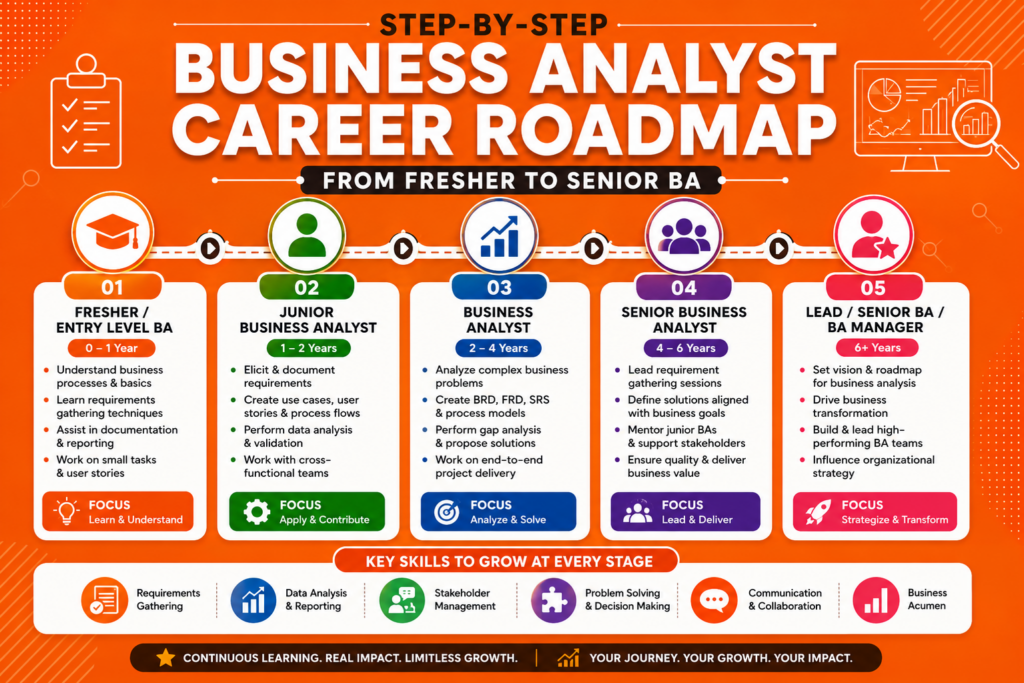
The skills needed to become a Business Analyst in Mumbai fall into six groups: analytical skills, technical/data skills, business and domain knowledge, communication skills, tools proficiency, and increasingly, AI literacy. No single skill guarantees a job; it is the combination that employers screen for.
1. Analytical Skills
Analytical thinking is the foundation of the role of the ability to break down a vague business problem into a structured, testable set of questions and hypotheses.
- Root-cause analysis (e.g., using the “5 Whys” or fishbone diagrams)
- Gap analysis (comparing current “as-is” state to desired “to-be” state)
- SWOT analysis (Strengths, Weaknesses, Opportunities, Threats) for strategic evaluation
- PESTLE analysis (Political, Economic, Social, Technological, Legal, Environmental) for external-factor assessment
- Cost-benefit analysis for prioritizing solutions
- Risk analysis and mitigation planning
2. Technical and Data Skills
- SQL querying and joining relational databases to extract and validate data; one of the most consistently requested BA skills in Mumbai job postings.
- Microsoft Excel pivot tables, VLOOKUP/XLOOKUP, conditional formatting, what-if analysis; still the single most-used BA tool globally.
- Data visualization presenting findings clearly using charts, dashboards, and summary tables rather than raw numbers.
- Basic statistics understanding averages, trends, correlation versus causation, and sampling, enough to sanity-check data provided by analytics teams.
- Python or R (optional but valuable) increasingly useful for BAs working closely with data science or advanced analytics teams, though not mandatory for most roles.
- Database and system literacy understanding how ERP (SAP), CRM (Salesforce), and core banking systems store and move data.
3. Business Process and Documentation Skills
- Business Process Modeling (BPMN) is a standardized way to diagram workflows so both business and technical stakeholders understand them the same way.
- UML (Unified Modeling Language) used for system-level diagrams (use case diagrams, sequence diagrams) in IT-heavy BA roles.
- Requirement gathering techniques like interviews, workshops, surveys, and observation to extract accurate, complete requirements.
- Requirement documentation writing Business Requirement Documents (BRD), Functional Requirement Documents (FRD), and user stories that are clear, testable, and unambiguous.
- Wireframing creates low-fidelity mockups of screens or workflows to validate ideas before development begins.
4. Soft Skills and Communication
- Stakeholder management identifies who has influence, who has interest, and how to keep both groups aligned throughout a project.
- Active listening extracting the real business need, which stakeholders often struggle to articulate directly.
- Negotiation and conflict resolution reconciling competing priorities among departments.
- Presentation skills communicating findings to both technical teams and senior leadership in the appropriate level of detail for each audience.
- Written communication: the ability to write requirement documents that eliminate ambiguity.
5. Business and Domain Skills
- Financial literacy is especially important for BFSI-focused roles; understanding P&L statements, balance sheets, and basic financial ratios.
- Industry/domain knowledge banking, insurance, retail, healthcare, or manufacturing processes relevant to the sector you target.
- Regulatory awareness for BFSI roles, familiarity with RBI and SEBI frameworks and data protection expectations.
- Business strategy fundamentals understand how a company makes money, so recommendations align with actual business goals.
6. Agile and Project Delivery Skills
- Agile and Scrum fundamentals sprints, backlogs, retrospectives, and the BA’s role in each.
- User story writing the “As a [user], I want [goal], so that [reason]” format, plus acceptance criteria.
- Backlog grooming and prioritization techniques like MoSCoW (Must have, Should have, Could have, Won’t have).
Is Coding Necessary to Become a Business Analyst?
No coding is not mandatory for most Business Analyst roles, but SQL and data literacy are strongly recommended. Most BA job descriptions in Mumbai list SQL as a preferred or required skill, while full programming languages like Python or Java are listed as “good to have,” mainly for BAs working in data-heavy or IT-implementation-heavy environments.
If you are choosing where to invest limited learning time:
- Prioritize SQL first; it directly affects your ability to independently verify data rather than depending on developers or analysts.
- Learn Excel deeply most day-to-day BA work still happens in spreadsheets.
- Add Power BI or Tableau for dashboarding, since stakeholders increasingly expect visual reporting rather than static tables.
- Treat Python as an advantage, not a requirement, unless you are specifically targeting data-analytics-heavy BA roles.
Can a Commerce Student Become a Business Analyst?
Yes. Commerce graduates are well-positioned for Business Analyst roles, especially in Mumbai’s BFSI sector, because they already understand financial statements, accounting principles, and business fundamentals. The main gap to close is typically technical and tools proficiency SQL, Excel at an advanced level, and a data visualization tool plus structured exposure to requirement-gathering and documentation frameworks (BRD/FRD writing, BPMN).
A short, structured Business Analytics certification , degree and diploma program is often the fastest way for commerce graduates to close this gap without going back to a full-time degree.
Can Freshers Become Business Analysts?
Yes, but freshers typically need to demonstrate skills through certifications, internships, or projects, since most BA roles expect at least foundational tool proficiency and communication skills on day one. Fresh graduates who complete a structured program covering SQL, Excel, a BI tool, and requirement documentation and who can show a portfolio project (even a self-directed one, like analyzing a public dataset and writing a mock BRD) are considerably more competitive than those relying on a degree alone.
Can Working Professionals Switch Into Business Analysis?
Yes working professionals from operations, IT support, finance, sales, or customer service backgrounds often make strong BA candidates because they already understand at least one business domain deeply.
The typical path is:
- Identify which of your existing skills already overlap with BA requirements (domain knowledge, stakeholder communication, process understanding).
- Fill technical gaps through a part-time or online Business Analytics program that doesn’t require quitting your job.
- Look for an internal transfer opportunity first many companies prefer promoting BA talent from within operations or support teams before hiring externally.
- Build a certification (CBAP/ECBA/PMI-PBA or a recognized Business Analytics diploma) to formally validate the transition on your resume.
Which Tools Should a Business Analyst Learn?
Category | Tools | Purpose |
Spreadsheets | Microsoft Excel, Google Sheets | Data cleaning, pivot analysis, quick modeling |
Querying | SQL | Extracting and validating data directly from databases |
Data Visualization | Power BI, Tableau | Building dashboards and stakeholder-ready reports |
Process Modeling | Lucidchart, Visio, draw.io | BPMN and workflow diagrams |
Project/Agile Management | JIRA, Confluence, Azure DevOps | Backlog management, documentation, sprint tracking |
Wireframing | Balsamiq, Figma | Low-fidelity UI mockups for requirement validation |
Enterprise Systems | SAP, Salesforce | Understanding how ERP/CRM systems structure business data |
Statistical/Advanced Analytics | Python, R (optional) | Deeper data analysis for analytics-heavy BA roles |
AI-assisted Productivity | Generative AI writing/summarization tools | Drafting documentation, summarizing meetings, structuring requirements faster |
Which Certifications Are Valuable for Business Analysts?
- ECBA (Entry Certificate in Business Analysis) IIBA’s entry-level certification, suited for freshers and early-career professionals.
- CCBA (Certification of Capability in Business Analysis) for professionals with a few years of BA experience.
- CBAP (Certified Business Analysis Professional) the most recognized advanced certification, generally pursued after 5+ years of BA experience.
- PMI-PBA (Professional in Business Analysis) PMI’s certification, useful for BAs working closely with project management frameworks.
- Agile-specific certifications (e.g., in Scrum or Agile business analysis) are valuable given how dominant Agile delivery has become.
- Structured Business Analytics diploma/certificate programs useful for building the full skill stack (tools + frameworks + domain knowledge) in one sequence, especially for career switchers and those without a strong technical background.
Business Analyst Career Roadmap
- Build foundational skills Excel, SQL, communication, basic process-modeling concepts.
- Getting certified or completing a structured program validates your skill set to employers, especially without prior BA job titles.
- Gaining entry-level or internship experience Junior BA, BA Trainee, or a hybrid role (e.g., BA + QA, BA + Ops) is a common entry point.
- Specialize choose a domain (BFSI, IT, retail, healthcare) or a track (data-heavy vs. process-heavy vs. product-BA).
- Move to mid-level BA roles take ownership of end-to-end requirement cycles, mentor juniors, and work directly with senior stakeholders.
- Advance to Senior BA / Lead BA / Product Owner own strategy-level input, manage multiple stakeholders and cross-functional teams.
- Move into BA management or product leadership BA Manager, Head of Business Analysis, or transition fully into Product Management.
Business Analyst Salary in Mumbai
Compensation varies significantly by experience, industry, and company type. The ranges below are broad, indicative bands based on general industry patterns as of the mid-2020s always cross-check current numbers against live job postings and salary-benchmarking platforms before making decisions, since compensation shifts with market conditions.
Salary by Experience Level
Experience Level | Approx. Annual Salary Range (INR) |
Fresher / 0–1 years | ₹4–7 LPA |
1–3 years | ₹6–10 LPA |
3–6 years | ₹9–16 LPA |
6–10 years | ₹14–25 LPA |
10+ years (Senior/Lead) | ₹22 LPA and above |
Salary by Industry
Industry | Relative Pay Positioning |
BFSI (Banking, Insurance, Asset Management) | Generally strong, especially with regulatory/product domain depth |
IT Services & Consulting | Competitive, often with faster promotion cycles |
E-commerce & Fintech | Strong at mid-to-senior levels, especially with data/product skills |
Manufacturing & Retail | Moderate, but growing due to digital transformation initiatives |
Salary by Company Type
- Global capability centers (GCCs) and MNCs in Mumbai/BKC/Powai typically offer higher base pay and structured career ladders.
- Large Indian IT services firms offer strong volume of openings and steady, if slower, growth.
- Startups and fintechs may offer higher variable pay or equity but with more role ambiguity.
- Domestic BFSI majors offer strong job security and clear domain specialization paths.
Business Analyst Job Roles in Mumbai
- Junior Business Analyst / BA Trainee
- IT Business Analyst
- Data/Business Analytics Analyst
- Process Analyst / Operations Business Analyst
- Product Business Analyst
- Banking/Insurance Business Analyst
- Business Systems Analyst
- Senior Business Analyst
- Lead Business Analyst / Business Analysis Manager
Future Scope of Business Analysts (2026–2035)
The Business Analyst role is expected to keep evolving rather than disappearing, largely because the core function translating business needs into actionable solutions is not something AI can fully automate; it requires judgment, stakeholder trust, and contextual understanding.
Expected shifts over the next decade:
- Deeper data fluency will become standard, blurring some lines between BA and data analyst roles.
- AI-augmented documentation will speed up routine tasks (drafting BRDs, summarizing stakeholder interviews), freeing BAs to spend more time on strategic analysis and stakeholder alignment.
- Domain specialization will matter more generalist BAs will face more competition than BAs with deep BFSI, healthcare, or supply-chain expertise.
- Product-oriented BA roles will grow as more companies adopt product-led operating models, increasing overlap between BA and Product Owner/Product Manager career tracks.
Business Analyst vs Data Analyst
Aspect | Business Analyst | Data Analyst |
Primary focus | Business processes, requirements, stakeholder alignment | Data extraction, statistical analysis, reporting |
Core tools | Excel, SQL, BPMN, JIRA, Power BI/Tableau | SQL, Python/R, Power BI/Tableau, statistical tools |
Output | Requirement documents, process maps, recommendations | Reports, models, dashboards, predictive insights |
Stakeholder interaction | High frequent business-side engagement | Moderate often works through BAs or product teams |
Coding depth | Low to moderate | Moderate to high |
Business Analyst vs Product Manager
Aspect | Business Analyst | Product Manager |
Scope | Requirement analysis for a project or process | End-to-end ownership of a product’s vision and roadmap |
Decision authority | Recommends and documents | Owns prioritization and final decisions |
Time horizon | Often project-based | Ongoing, strategic, long-term |
Common career link | Frequently a stepping stone into Product Management |
Business Analyst vs Project Manager
Aspect | Business Analyst | Project Manager |
Primary responsibility | What needs to be built and why | How and when it gets delivered |
Key skills | Requirement gathering, analysis, documentation | Scheduling, budgeting, risk and resource management |
Tools | BPMN, SQL, Excel, Power BI | Gantt charts, MS Project, JIRA (delivery tracking) |
Common Mistakes Aspiring Business Analysts Make
- Focusing only on certifications without building hands-on tool proficiency (SQL, Excel, BI tools).
- Treating documentation as a checkbox exercise instead of a precision communication tool.
- Ignoring domain knowledge and assuming generic BA skills are enough for specialized industries like BFSI.
- Avoiding stakeholder-facing practice, which is often the actual differentiator in interviews and on the job.
- Underestimating the importance of data visualization presenting raw tables instead of clear, decision-ready visuals.
- Not keeping up with AI and automation trends affecting the processes they analyze.
Success Tips for Aspiring Business Analysts
- Build a portfolio project: pick a public dataset, write a mock BRD, and create a simple Power BI dashboard around it.
- Practice writing user stories and acceptance criteria is one of the most commonly tested interview skills.
- Learn to ask “why” before “how” the best BAs diagnose root causes before proposing solutions.
- Specialize early in one domain relevant to Mumbai’s job market (BFSI is the deepest pool).
- Treat stakeholder communication as a skill to rehearse, not a soft skill you either “have or don’t.”
Real-World Case Study: Process Improvement in a Mumbai BFSI Firm
Consider a composite, illustrative scenario common in Mumbai’s BFSI sector: a mid-sized NBFC’s loan-approval process was taking significantly longer than industry benchmarks due to manual document verification steps split across multiple teams.
A Business Analyst engaged to address this would typically:
- Conduct stakeholder interviews across credit, operations, and compliance teams to map the “as-is” process using BPMN.
- Use SQL to pull processing-time data across loan stages and identify the specific bottleneck stage.
- Present findings via a simple Power BI dashboard showing where time was being lost.
- Propose a “to-be” process with parallel verification steps and a define set of automation candidates for RPA.
- Write the BRD/FRD for the recommended system changes and work with IT teams through delivery, using Agile ceremonies to track progress.
This kind of project illustrates why the BA skill set is genuinely cross-functional: process mapping, data querying, visualization, documentation, and stakeholder management all show up in a single realistic assignment.
Employer Expectations From Business Analysts in 2026
- Comfort working directly with data (SQL queries, not just requesting reports from analysts).
- Ability to produce clear, unambiguous requirement documents without excessive back-and-forth.
- Working knowledge of Agile ceremonies and terminology.
- Basic understanding of AI/automation capabilities relevant to their industry.
- Demonstrated domain knowledge relevant to the hiring company’s sector.
- Strong verbal and written communication, since BAs are frequently the primary interface between business and technology teams.
AI Tools Every Business Analyst Should Learn
- Generative AI writing assistants for drafting BRDs, user stories, and meeting summaries faster.
- AI-powered data visualization features within Power BI/Tableau for auto-generating chart suggestions and narrative insights.
- Process mining tools for automatically reconstructing “as-is” workflows from system logs rather than manual observation alone.
- AI-assisted meeting transcription and summarization tools to reduce time spent on note-taking during stakeholder interviews.
How to Choose the Right Business Analyst Program
When evaluating a Business Analyst or Business Analytics course, check for:
- Coverage of both technical tools and business frameworks a good program teaches SQL/Excel/BI tools alongside BRD writing, BPMN, and stakeholder management, not just one side.
- Flexibility for working professionals online or hybrid formats that don’t require quitting your job.
- Industry-relevant curriculum especially BFSI and IT case studies if you’re targeting Mumbai’s dominant hiring sectors.
- Certification value recognized by employers, ideally aligned with or complementary to IIBA/PMI frameworks.
- Career support placement assistance, resume support, and interview preparation, particularly important for career switchers and freshers.
- Practical/project-based learning capstone projects or case studies you can showcase in interviews.
Why Choose MITSDE for Your Business Analyst Career
MIT School of Distance Education (MITSDE) is positioned to help exactly the audience this guide is written for fresh graduates, working professionals, and career switchers in and around Mumbai to build the specific skill combination employers screen for.
- Flexible, distance/online learning formats that let working professionals build BA and Business Analytics skills without pausing their careers.
- Industry-relevant curriculum spanning core business, analytics, and management fundamentals, designed to map onto real employer expectations rather than purely academic theory.
- Structured career support, helping students translate coursework into resume-ready, interview-ready skills.
- A recognized institutional background, giving your certification credibility with Mumbai-based employers across BFSI, IT, and corporate sectors.
- Programs that complement a Business Analyst career path, including Business Analytics, Online MBA, and related management programs that build both the technical and strategic sides of the role.
If you are serious about entering or advancing in business analysis, pairing this skills roadmap with a structured program is the fastest way to close the gap between “I understand what’s needed” and “I am job-ready.”
Admission Process
While specific intake dates, fees, and eligibility criteria change periodically, the general admission process for MITSDE programs typically follows this pattern:
- Review program eligibility (typically a recognized bachelor’s degree; some programs have minimum work-experience criteria).
- Submit an online application with academic and professional details.
- Complete any required counseling or admission interaction.
- Receive an offer and complete fee payment/registration.
- Begin coursework through the program’s online/distance learning platform.
Always verify the current admission process, eligibility, fees, and intake dates directly on MITSDE’s official admissions page, since these details are updated periodically.
Myths vs Facts About Becoming a Business Analyst
Myth | Fact |
You must know how to code | SQL and data literacy matter far more than programming for most BA roles |
Only engineers or MBAs can become BAs | Commerce graduates, IT professionals, and career switchers all succeed in this field |
Business Analysts only write documents | BAs also analyze data, build dashboards, and directly influence business decisions |
AI will replace Business Analysts | AI changes BA tools and speeds up documentation, but stakeholder judgment remains human-led |
Certifications alone guarantee a job | Certifications validate skills, but hands-on tool proficiency and communication ability are what actually get you hired |
Pros and Cons of a Business Analyst Career
Pros
- Cross-industry demand skills transfer across BFSI, IT, retail, and healthcare.
- Strong career progression into Product Management, Program Management, or BA leadership.
- Does not strictly require a coding background.
- High visibility with senior stakeholders early in their career.
Cons
- Requires constant context-switching between business and technical teams, which can be demanding.
- Documentation-heavy work can feel repetitive without strong process/tooling discipline.
- Domain specialization is increasingly expected, requiring ongoing learning.
- Can face role ambiguity in smaller companies where BA responsibilities overlap with PM or QA roles.
Checklist: Are You Ready to Become a Business Analyst?
- I can build a pivot table and use VLOOKUP/XLOOKUP confidently in Excel.
- I can write and understand basic SQL queries (SELECT, JOIN, GROUP BY).
- I have used or can learn Power BI or Tableau for dashboarding.
- I understand BPMN or basic process-mapping notation.
- I can write a clear Business Requirement Document or user story.
- I am comfortable interviewing stakeholders and documenting their needs accurately.
- I understand Agile/Scrum basics (sprints, backlogs, user stories).
- I have at least foundational domain knowledge in one target industry (BFSI, IT, retail, etc.).
- I follow AI and automation trends relevant to business processes.
- I have (or am pursuing) a certification or structured program to validate these skills.
Final Summary
Becoming a Business Analyst in Mumbai does not require a single “correct” degree or a coding background it requires a deliberate combination of analytical thinking, technical/data skills (especially SQL and Excel), process-documentation ability, stakeholder communication, and growing AI literacy. Mumbai’s concentration of BFSI, IT services, consulting, and fintech employers makes it one of India’s strongest markets for this career, provided candidates build the right skill stack and can demonstrate it through certifications, projects, or a structured Business Analytics program.
Ready to build these skills systematically?
Explore MITSDE’s Business Analytics and management programs designed with flexible, online learning for working professionals, industry-relevant curriculum, and structured career support to move from understanding what’s needed to becoming genuinely job-ready as a Business Analyst in Mumbai.
FAQ's
-
1. What is a Business Analyst?
A Business Analyst identifies business problems, gathers requirements, and works with stakeholders and technical teams to design and implement effective solutions.
-
2. Which skills are needed to become a Business Analyst in Mumbai?
Analytical thinking, SQL, Excel, data visualization (Power BI/Tableau), requirement documentation, BPMN/UML, stakeholder communication, and Agile fundamentals.
-
3. Is coding mandatory for a Business Analyst?
No. SQL and data literacy are far more important than full programming skills for most BA roles.
-
4. Can a commerce graduate become a Business Analyst?
Yes, especially in BFSI-focused roles, since commerce graduates already understand financial statements and business fundamentals.
-
5. Can engineering graduates become Business Analysts?
Yes, and they often transition smoothly into IT-focused or technical BA roles due to their systems and logic background.
-
6. Do I need an MBA to become a Business Analyst?
No, an MBA is not mandatory, though it can accelerate progression into senior or strategic BA roles.
-
7. Can freshers get Business Analyst jobs in Mumbai?
Yes, particularly with certifications, internships, or portfolio projects that demonstrate tool proficiency and communication skills.
-
8. What is the average Business Analyst salary in Mumbai for freshers?
Indicative ranges are roughly ₹4–7 LPA for freshers, though this varies by company and sector. Always check current listings.
-
9. What is the salary for an experienced Business Analyst in Mumbai?
Senior BAs with 10+ years of experience can indicatively earn ₹22 LPA and above, depending on industry and company type.
-
10. Which industries hire the most Business Analysts in Mumbai?
BFSI, IT services and consulting, e-commerce, and fintech are the largest hiring sectors.
MITSDE
This guide was developed by the MITSDE Career Guidance content team, drawing on general industry patterns in Mumbai’s BFSI, IT, and consulting sectors. Salary figures and market statistics are presented as indicative ranges for planning purposes; readers and the publishing team should verify current figures against live job postings, IIBA/PMI certification pages, and government sources (RBI, SEBI) before publication and periodically thereafter, as this is a fast-moving job market.
View LinkedIn Profile →Related Posts
Why Master Business Analytics for Project Management Success