Choosing between an Executive MBA in Operations and Supply Chain Management can shape your career direction for years. Both fields are in high demand, offer strong salaries, and create leadership opportunities. The right choice depends on whether you enjoy managing internal business processes or handling end-to-end logistics, sourcing, and global movement of goods.
Many professionals get confused between two popular specializations:
- Executive MBA in Operations Management
- Executive MBA in Supply Chain Management
Both are connected, but they focus on different career paths. One manages how a business runs internally, while the other focuses on how products move from suppliers to customers.
If you’re wondering which is better, this guide will help you compare both options clearly.
What is Operations Management?
Operations Management is the process of planning, organizing, and improving the systems that produce goods or services.
It focuses on:
- Productivity improvement
- Quality management
- Resource planning
- Cost control
- Process optimization
- Workforce efficiency
In simple words, operations management ensures that a company runs smoothly every day.
Example:
A manufacturing plant manager improving machine output and reducing downtime is working in operations management.
What is Supply Chain Management?
Supply Chain Management (SCM) handles the movement of products, services, and information from raw material suppliers to final customers.
It includes:
- Procurement
- Vendor management
- Inventory control
- Warehousing
- Transportation
- Logistics
- Demand forecasting
In simple words, SCM ensures the right product reaches the right place at the right time.
Example:
An e-commerce company delivering products across India efficiently uses supply chain management.
Executive MBA in Operations: Overview
An executive MBA in operations is designed for working professionals who want leadership roles in production, quality, process excellence, and business operations.
Core Subjects
- Operations Strategy
- Lean Management
- Six Sigma
- Project Management
- Quality Control
- Business Analytics
- Capacity Planning
Best For:
- Manufacturing professionals
- Plant supervisors
- Project managers
- Process improvement managers
- Service industry managers
Executive MBA in Supply Chain Management: Overview
This specialization focuses on end-to-end logistics and supply network management.
Core Subjects
- Procurement Strategy
- Logistics Management
- Warehouse Operations
- Inventory Systems
- Global Supply Chain
- Demand Forecasting
- Vendor Negotiation
Best For:
- Logistics professionals
- Procurement executives
- Warehouse managers
- Retail operations managers
- Import/export professionals
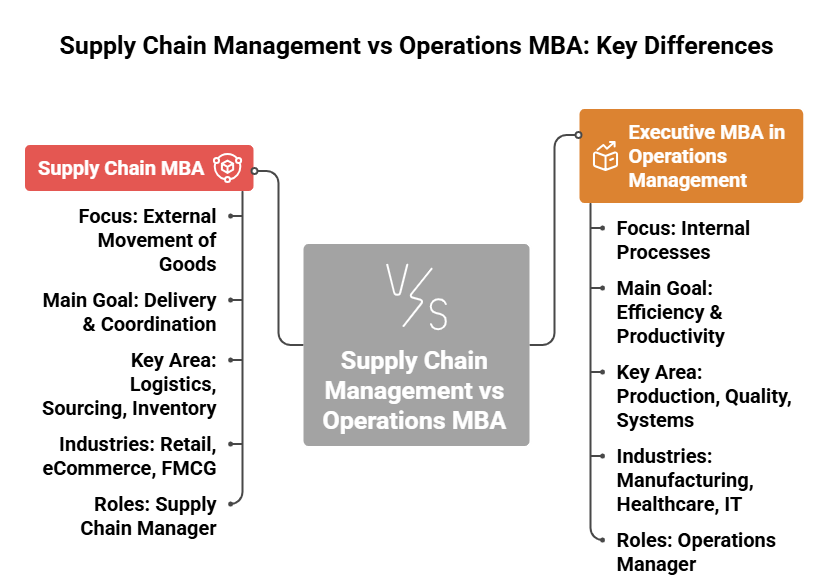
Supply Chain Management vs Operations MBA: Key Differences
Factor | Executive MBA in Operations Management | Supply Chain MBA |
Focus | Internal processes | External movement of goods |
Main Goal | Efficiency & productivity | Delivery & coordination |
Key Area | Production, quality, systems | Logistics, sourcing, inventory |
Industries | Manufacturing, healthcare, IT | Retail, eCommerce, FMCG |
Roles | Operations Manager | Supply Chain Manager |
Which Has Better Career Scope?
Executive MBA in Operations
Growing demand in:
- Manufacturing
- Healthcare
- IT services
- Banking operations
- Hospitality
- Construction
Popular Roles:
- Operations Manager
- Plant Manager
- Process Excellence Head
- Quality Manager
- Business Operations Lead
Supply Chain Management MBA
Huge demand in:
- eCommerce
- Retail
- Automobile
- FMCG
- Export businesses
- Logistics companies
Popular Roles:
- Supply Chain Manager
- Logistics Head
- Procurement Manager
- Warehouse Director
- Vendor Operations Manager
Salary Comparison
(Varies by company, city, experience)
Executive MBA in Operations Management
- Mid-level: ₹8–15 LPA
- Senior roles: ₹18–30+ LPA
Supply Chain Management
- Mid-level: ₹7–14 LPA
- Senior roles: ₹16–28+ LPA
With global experience or in large companies, salaries can rise significantly.
Latest Industry Trends (2026)
Operations Trends
- AI-based process automation
- Smart factories
- Lean digital systems
- Predictive maintenance
- Robotics in production
Supply Chain Trends
- Real-time tracking
- Sustainable logistics
- AI demand forecasting
- Warehouse automation
- Blockchain in sourcing
Both careers are future-ready.
Which One Should You Choose?
Choose the Executive MBA in Operations If You:
- Enjoy improving processes
- Like solving efficiency problems
- Work in manufacturing or services
- Want leadership in internal operations
- Prefer people + systems management
Choose Supply Chain Management If You:
- Enjoy logistics and planning
- Like vendor coordination
- Want global business exposure
- Prefer dynamic, fast-moving roles
- Work in retail, eCommerce, logistics
Step-by-Step Guide to Decide
1. Review Your Current Experience
What role are you already playing?
- Factory/process/service operations → Operations
- Procurement/logistics/warehouse → Supply Chain
2. Think About Your Interest
Do you enjoy:
- Internal efficiency? → Operations
- Product movement and planning? → Supply Chain
3. Check Industry Demand
Choose the specialization matching your target industry.
4. Evaluate Long-Term Goal
Want COO-style leadership? Operations can help.
Want global logistics leadership? Supply Chain is strong.
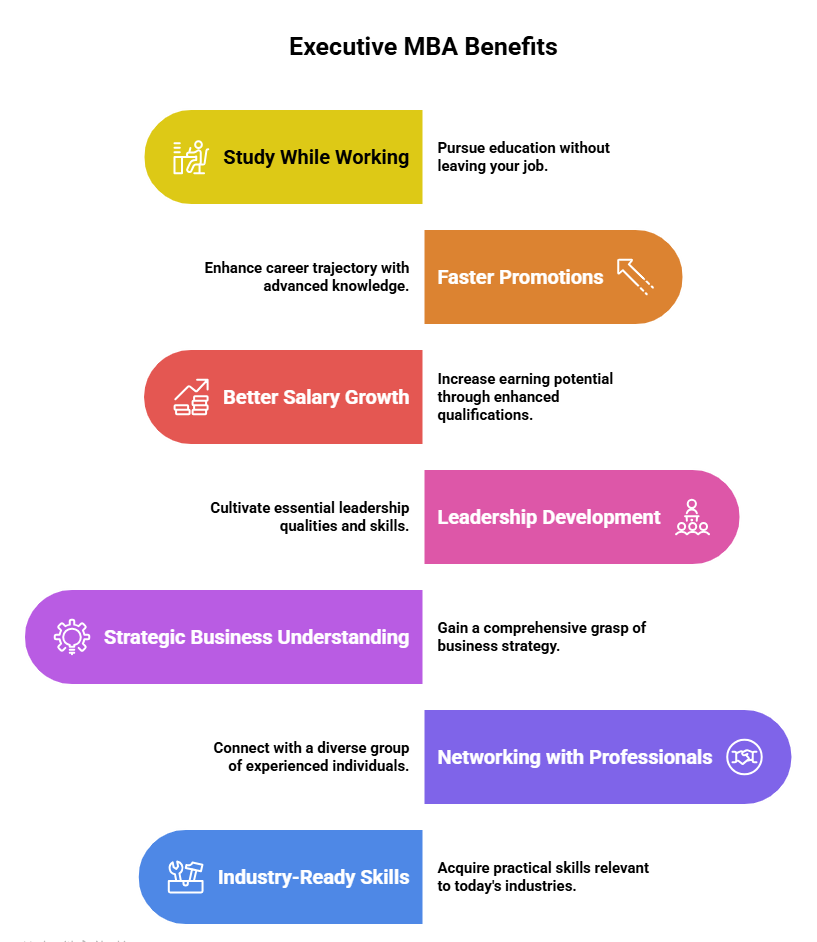
Benefits of Executive MBA for Working Professionals
- Study while working
- Faster promotions
- Better salary growth
- Leadership development
- Strategic business understanding
- Networking with professionals
- Industry-ready skills
FAQs
1. Is an executive MBA in operations good for engineers?
Yes, especially for mechanical, civil, electrical, and production engineers aiming for management roles.
2. Which is better: supply chain management vs operations mba?
Neither is universally better. It depends on your career goal and current experience.
3. Can I switch industries after these programs?
Yes. Many professionals move from technical roles to management roles after completing an Executive MBA.
4. Is supply chain management in demand?
Yes. e-commerce, retail, and manufacturing have created strong demand globally.
5. Is operations management a good career in 2026?
Absolutely. Companies need experts who can improve productivity and reduce costs.
6. Which has a higher salary?
Both can offer high salaries. Senior leadership roles matter more than specialization alone.
7. Can working professionals study online?
Yes. Many institutes now offer flexible online Executive MBA programs.
Final Verdict: Which Is Better?
If you want to lead teams, improve processes, and run business systems efficiently, choose an executive MBA in operations.
If you want to manage logistics, sourcing, vendors, and product flow across markets, choose Supply Chain Management.
The best choice is the one aligned with your current experience and future ambition.
Action Tip: List your current skills, desired role, and preferred industry before enrolling. That simple exercise can make the right decision clear.