
A PGDM in Finance opens doors to high-growth careers in banking, financial services, investment management, fintech, and corporate finance. With the BFSI sector expanding rapidly, pgdm finance jobs offer strong career stability and competitive finance salary in India, even for early professionals.
What is a PGDM Finance?
PGDM Finance is a professional management program that builds expertise in financial analysis, banking operations, investment strategies, risk management, and corporate finance—preparing candidates for leadership roles in the finance domain.
Overview: Why PGDM Finance Is a Smart Career Move
Finance remains one of the most resilient and rewarding career paths in India. From traditional banking to emerging fintech and analytics-driven roles, organizations today need finance professionals who understand numbers and business strategy.
A PGDM in Finance bridges this gap. It combines practical financial skills with managerial decision-making, making graduates job-ready for diverse roles in the BFSI sector. With India’s growing economy, digital banking expansion, and increased focus on compliance and risk, the career scope after PGDM Finance continues to rise.
Key Modules / Topics Covered in PGDM Finance
A well-designed PGDM Finance program focuses on industry-relevant subjects such as:
- Financial Accounting & Analysis
- Corporate Finance & Strategic Financial Management
- Banking & Insurance Management
- Investment Analysis & Portfolio Management
- Risk Management & Derivatives
- Financial Markets & Instruments
- Taxation & Regulatory Framework
- Financial Modelling & Excel-based Analysis
- Fintech, Digital Banking & Financial Analytics
These modules prepare students for real-world financial challenges across sectors.
Benefits & Advantages of PGDM Finance
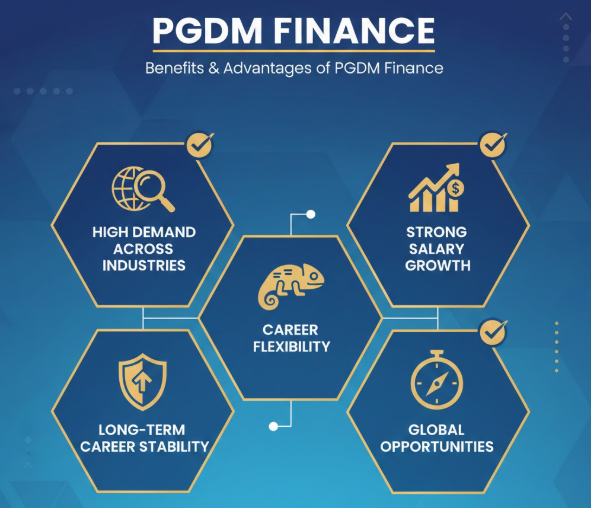
✔ High Demand Across Industries
Finance professionals are required in banks, NBFCs, insurance firms, fintech startups, consulting companies, and corporates.
✔ Strong Salary Growth
Compared to many other management specializations, finance salary in India grows faster with experience and skill upgrades.
✔ Career Flexibility
PGDM Finance graduates can switch between banking, investments, corporate finance, analytics, and advisory roles.
✔ Long-Term Career Stability
Finance roles are essential for business survival, making them relatively recession-resistant.
✔ Global Opportunities
Finance skills are transferable across geographies, especially in accounting, risk, and investment roles.
Eligibility Criteria
The eligibility for PGDM Finance generally includes:
- Graduation in any discipline from a recognized university
- Basic understanding of mathematics or business concepts is helpful
- Suitable for fresh graduates, working professionals, and career switchers
No strict commerce background is mandatory, making it accessible to diverse learners.
Fees Structure
The fees for PGDM Finance vary based on institute type and delivery mode.
- Online/Distance PGDM Finance: More affordable and flexible
- On-campus PGDM Finance: Higher cost due to infrastructure and residency
Institutes like MITSDE offer cost-effective PGDM programs designed for working professionals without compromising academic quality.
Duration of PGDM Finance
- Typically 15–24 months
- Flexible learning options for professionals
- Self-paced online modules with structured academic support
This allows learners to upskill while continuing their job.
Career Scope After PGDM Finance: Jobs & Salaries in India
🔹 Top PGDM Finance Jobs in India
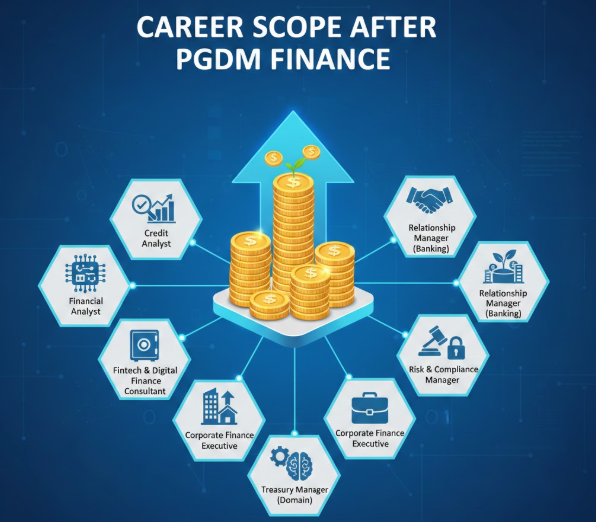
Some of the most popular and high-demand roles include:
- Financial Analyst
- Credit Analyst
- Relationship Manager (Banking)
- Investment Advisor
- Risk & Compliance Manager
- Corporate Finance Executive
- Portfolio Manager
- Business Analyst (Finance Domain)
- Treasury Manager
- Fintech & Digital Finance Consultant
These roles are available across banks, NBFCs, insurance firms, fintech companies, and large corporates.
🔹 Finance Salary in India (Indicative Range)
Role | Average Salary (₹ per annum) |
Financial Analyst | ₹4 – 7 LPA |
Banking Relationship Manager | ₹5 – 8 LPA |
Credit Analyst | ₹6 – 10 LPA |
Risk Manager | ₹8 – 14 LPA |
Investment Analyst | ₹7 – 12 LPA |
Corporate Finance Manager | ₹10 – 18 LPA |
With experience, certifications, and performance, salaries grow significantly—especially in metro cities and BFSI hubs.
Why Choose MITSDE for PGDM Finance?
MIT School of Distance Education (MITSDE) is a trusted name in professional management education, especially for finance aspirants seeking flexibility and industry relevance.
What Makes MITSDE Stand Out?
- Industry-oriented finance curriculum
- Designed for working professionals and job seekers
- Flexible online learning model
- Experienced faculty with corporate exposure
- Strong focus on practical finance skills
- Recognized certification with career credibility
MITSDE helps learners gain clarity, confidence, and competence to succeed in competitive pgdm finance jobs.
Conclusion Summary
A PGDM in Finance is not just a qualification—it’s a long-term career investment. With expanding opportunities in the BFSI sector, attractive salary packages, and diverse job roles, the career scope after PGDM Finance remains strong in India. For professionals seeking growth, stability, and leadership roles, PGDM Finance is a smart and future-ready choice—especially when pursued from a reputed institute like MITSDE.
FAQs: Career Scope After PGDM Finance
1. What are the best jobs after PGDM Finance?
Ans. Financial Analyst, Banking Manager, Risk Analyst, Investment Advisor, and Corporate Finance roles.
2. What is the average finance salary in India after PGDM?
Ans. Freshers earn ₹4–7 LPA, while experienced professionals can earn ₹10–18 LPA or more.
3. Is PGDM Finance good for non-commerce students?
Ans. Yes, with proper training, non-commerce graduates can succeed in finance roles.
4. Does PGDM Finance have scope in the BFSI sector?
Ans. Absolutely. BFSI is the biggest recruiter of PGDM Finance graduates.
5. Can working professionals pursue PGDM Finance?
Ans. Yes, especially through flexible online programs like those offered by MITSDE.
6. Is PGDM Finance better than MBA Finance?
Ans. Both are valuable, but PGDM focuses more on industry-ready skills and practical exposure.
7. Are finance jobs future-proof in India?
Ans. Yes, finance roles evolve with technology but remain essential across industries.
8. Why choose MITSDE for PGDM Finance?
Ans. For flexibility, industry-aligned curriculum, affordability, and professional credibility.