For working professionals, understanding modern Supply Chain Management is becoming an important career advantage. Companies now use AI, cloud platforms, IoT sensors, analytics, robotics and logistics software to make supply chains faster, more accurate and resilient.
Supply chain tools help businesses forecast demand, manage inventory, track shipments, automate warehouses and improve supplier relationships. Learning these technologies through an industry-relevant curriculum can help professionals build practical skills while maintaining a job + study balance.
What Is Supply Chain Management Technology?
Supply chain management technology refers to digital systems and tools used to plan, execute, monitor and improve the movement of products, information and money from suppliers to customers.
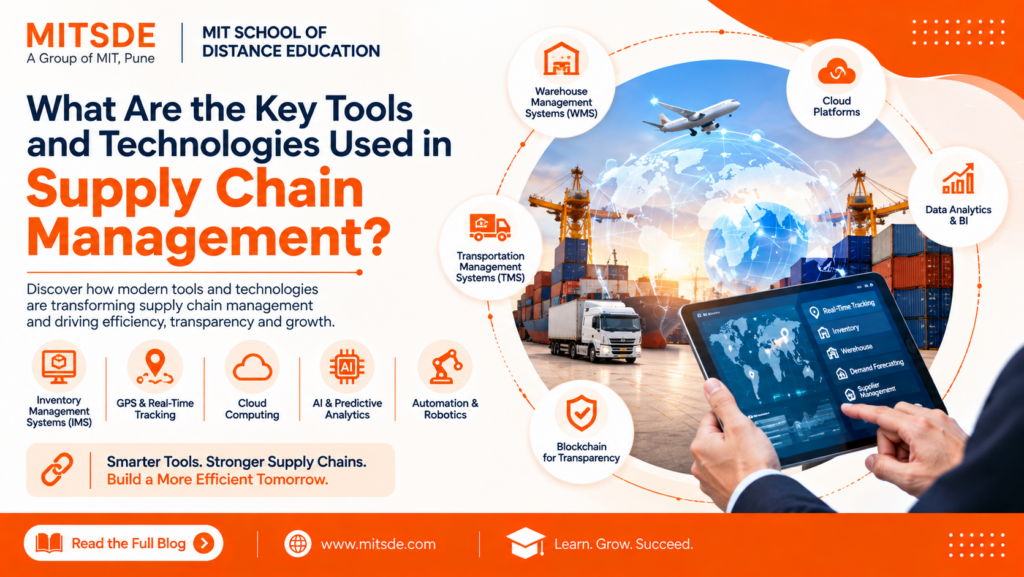
Common technologies include:
- Enterprise Resource Planning (ERP)
- Warehouse Management Systems (WMS)
- Transportation Management Systems (TMS)
- Artificial Intelligence (AI) and Machine Learning (ML)
- Internet of Things (IoT)
- Cloud computing
- Data analytics and business intelligence
- Robotics and automation
- Blockchain
- Digital twins
IBM notes that AI and machine learning are increasingly used for demand forecasting, inventory management, route optimisation and identifying supply chain bottlenecks.
Why Are Supply Chain Tools Important?
Modern supply chains generate huge amounts of operational data. Manual spreadsheets and disconnected systems can make it difficult to respond quickly to demand changes or delivery problems.
Modern supply chain tools provide:
- Real-time visibility
- Better demand forecasting
- Faster decision-making
- Automated inventory tracking
- Improved warehouse efficiency
- Lower operational errors
- Better shipment tracking
- Improved customer service
For example, AI can analyse historical and real-time information to identify potential shortages, optimise routes and support inventory decisions.
What Are the Key Tools and Technologies in Supply Chain Management?
1. Enterprise Resource Planning (ERP)
ERP systems connect functions such as procurement, finance, inventory, manufacturing and sales in one platform.
Popular ERP ecosystems include SAP, Oracle and Microsoft Dynamics. For supply chain professionals, ERP knowledge is useful because it provides a central view of business operations.
2. Warehouse Management Systems (WMS)
A WMS manages warehouse activities such as:
- Receiving goods
- Put-away
- Picking and packing
- Inventory tracking
- Stock movement
- Dispatch
Modern warehouses can combine WMS platforms with barcode scanners, RFID, robotics and automated storage systems.
3. Transportation Management Systems (TMS)
TMS platforms help companies plan and manage transportation.
They can support:
- Route planning
- Carrier selection
- Shipment tracking
- Freight management
- Delivery scheduling
- Transportation cost analysis
This makes logistics software particularly valuable for logistics managers, transport planners and supply chain analysts.
4. Artificial Intelligence and Machine Learning
AI is one of the fastest-growing technologies in supply chain management.
It can help companies:
- Forecast customer demand
- Predict supply disruptions
- Optimise delivery routes
- Identify inventory risks
- Analyse supplier performance
- Automate repetitive decisions
DHL’s Logistics Trend Radar 7.0 identified AI as one of the major technology trends shaping logistics, alongside areas such as robotics, IoT and sustainability.
5. Internet of Things (IoT)
IoT devices use connected sensors to collect real-time information about products, vehicles, equipment and warehouses.
For example, sensors can monitor:
- Product location
- Temperature
- Vehicle condition
- Warehouse conditions
- Inventory movement
This helps supply chain teams identify problems before they become major disruptions.
6. Cloud Computing and Data Analytics
Cloud platforms allow supply chain data to be accessed across locations and departments.
Analytics tools turn this data into useful insights such as:
- Demand trends
- Inventory turnover
- Supplier performance
- Delivery performance
- Logistics costs
Cloud-based systems also support collaboration between suppliers, manufacturers, distributors and retailers.
7. Robotics and Automation
Robotics is increasingly used in warehouses for picking, sorting, movement and packing.
Automation can reduce repetitive manual work and allow employees to focus on higher-value activities. IBM identifies IoT devices, robotic process automation and intelligent document processing as important forms of supply chain automation.
8. Blockchain and Digital Twins
Blockchain can improve traceability and transaction transparency across complex supply networks.
Digital twins create virtual representations of supply chain operations. They can help organisations simulate scenarios and identify potential bottlenecks before making operational changes. IBM reports that representative supply chain engagements using digital twin technology have produced improvements including reduced waste and faster time to market.
Which Technologies Should Supply Chain Professionals Learn?
A practical learning roadmap can include:
- Begin with ERP and supply chain fundamentals
- Learn inventory and warehouse management
- Understand TMS and logistics software
- Build Excel and data analytics skills
- Learn Power BI or similar business intelligence tools
- Understand AI, ML and IoT applications
- Work on live supply chain projects
- Develop problem-solving and communication skills
These skills can support career growth in roles such as Supply Chain Analyst, Procurement Manager, Logistics Manager, Operations Manager and Warehouse Manager.
Why Choose Online or Distance Learning for Supply Chain Management?
Online and distance programs can be particularly useful for students and working professionals who cannot leave their jobs for full-time study.
Key benefits include:
- Job + study balance: Learn without taking a career break.
- Flexible with recognized degree: Study from different locations while continuing employment.
- Affordable fees: Online programs can be more budget-friendly than relocating for campus education.
- Specializations: Choose areas such as operations, supply chain, analytics or logistics.
- Industry-relevant curriculum: Learn concepts linked to current business practices.
- Placement assistance + industry exposure: Some programs provide career support and industry interaction.
- Includes internships & live projects: Practical assignments can help connect theory with workplace situations.
- Global exposure + modern LMS: Digital learning platforms can provide access to online resources and diverse peer groups.
Students should also verify the institution’s current UGC entitlement and applicable AICTE approval or norms compliance rather than relying only on marketing claims. UGC regulations govern recognised online and ODL programmes, while institutions must meet applicable regulatory requirements.
What Skills Do Employers Expect?
Technology knowledge is only one part of supply chain career development.
Employers increasingly value:
- Data analysis
- Inventory management
- Procurement
- Logistics planning
- Demand forecasting
- ERP knowledge
- Problem-solving
- Communication
- Vendor management
- AI and analytics awareness
A combination of technical knowledge and business skills can improve career growth opportunities.
Key Takeaways
- Supply Chain Management is becoming increasingly technology-driven.
- ERP, WMS and TMS remain core supply chain tools.
- AI and machine learning improve forecasting and decision-making.
- IoT provides real-time visibility into assets and shipments.
- Cloud, analytics and automation improve efficiency and collaboration.
- Blockchain and digital twins can strengthen traceability and planning.
- Working professionals can use online or distance learning to develop these skills without leaving their jobs.
Quick Summary
Technology has changed Supply Chain Management from a largely manual function into a data-driven business discipline. Professionals who understand ERP, logistics software, AI, IoT, analytics and automation can be better prepared for technology-enabled supply chain roles.
If you want to develop these skills while continuing your career, explore an AICTE-accredited/approved and appropriately recognised online or distance management program with practical learning, flexible schedules, affordable fees and industry exposure.
FAQs
-
1. What are the main tools used in Supply Chain Management?
The main tools include ERP, WMS, TMS, AI, IoT, cloud computing, analytics, robotics, blockchain and digital twins.
-
2. Which software is commonly used in supply chain management?
Popular platforms include SAP, Oracle, Microsoft Dynamics and specialised WMS and TMS solutions. The right software depends on the organisation's size and supply chain requirements.
-
3. How is AI used in supply chain management?
AI can support demand forecasting, inventory planning, route optimisation, supplier analysis and disruption management by analysing large amounts of data.
-
4. Why is IoT important in supply chains?
IoT connects sensors and devices to provide real-time information about inventory, shipments, vehicles and equipment.
-
5. Is online learning suitable for working professionals?
Yes. Online learning can provide flexibility and help professionals maintain a job + study balance while developing new supply chain skills.
-
6. What should I learn for a career in supply chain management?
Start with supply chain fundamentals, ERP, inventory, logistics software and data analytics. Then build knowledge of AI, IoT, automation and business intelligence.
-
7. Which is best: online or distance learning for supply chain management?
The best option depends on your schedule, learning style and career goals. Compare recognition, Specializations, Fees, curriculum, practical projects, placement assistance and flexibility before choosing.