A PGDM in HR management opens doors to multiple high-impact roles across organisations. But here is the thing many students don’t realise early enough: HR today is not just about hiring and payroll. Modern HR professionals shape company culture, manage talent strategy, and use analytics to influence business decisions.
Here are the career paths you can realistically pursue.
- HR Generalist: Manages recruitment, employee relations, performance reviews, and HR compliance while gaining exposure to multiple HR functions.
- Talent Acquisition Specialist: Develops hiring strategies, strengthens employer branding, and identifies top talent using data-driven recruitment tools. A distance MBA in human resource management can help accelerate growth into senior hiring roles.
- Training & Development Manager: Designs learning programmes and leadership workshops that support employee growth and skill development.
- Compensation & Benefits Manager: Analyses salary benchmarks to ensure fair employee rewards; while balancing organisational costs.
- HR Business Partner (HRBP): Collaborates with leadership to align workforce strategy, hiring plans, and organisational culture with business goals.
Many professionals with a PGDM or MBA in HR management eventually progress into HRBP roles because they require both business and people expertise.
The Benefits of a Postgraduate Diploma in HR for Career Progression
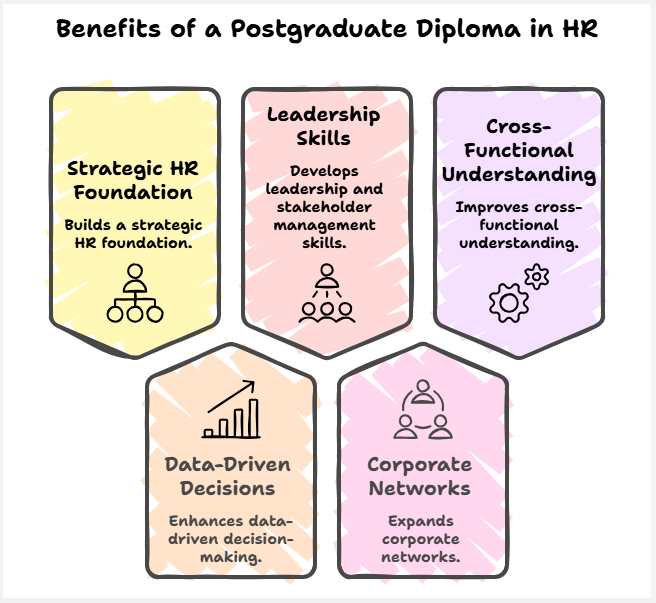
A strong HR programme does more than teach policies. It prepares you to influence organisational strategy. Here is how it supports career growth-
- Builds a strategic HR foundation: Students learn workforce planning, talent strategy and organisational behaviour.
- Enhances data-driven decision-making: Modern HR uses analytics to predict hiring needs, retention risks and performance trends.
- Develops leadership and stakeholder management skills: HR professionals regularly interact with executives, employees and external partners.
- Expands corporate networks: Industry exposure and internships create valuable connections for career opportunities.
- Improves cross-functional understanding: HR leaders must understand finance, operations, and marketing to align people strategy with business goals.
Skills Required to Succeed After PGDM in HR
To truly succeed after a PGDM in HR management, professionals need both human insight and analytical capability. Key skills include:
- Strategic thinking: Ability to align workforce planning and HR initiatives with long-term organisational goals.
- HR analytics: Using employee data and metrics to improve hiring, retention, and performance decisions.
- Communication and persuasion: Clearly conveying ideas while influencing employees, managers, and leadership effectively.
- Negotiation and conflict resolution: Managing workplace disagreements and reaching balanced solutions that support both employees as well as the organisation.
- Data interpretation: Analysing HR reports and workforce trends to guide informed business decisions.
- Tech adaptability: Comfortably adopting HR technologies, digital platforms and AI tools that streamline modern HR operations.
The future HR leader is someone who can understand people and interpret data at the same time.
How Do Career Options After PGDM in HR Compare With Other Management Specialisations?
Parameter | PGDM in HR Management | PGDM in Marketing | PGDM in Finance |
Core Focus | Talent development, organisational culture, workforce strategy | Understanding customers, building brands, driving market growth | Managing financial resources, risk assessment |
Skill Orientation | Employee engagement, HR analytics, interpersonal communication | Creativity, market research, sales and branding | Risk management, data interpretation, financial planning |
Leadership Path | HR manager, HR business partner, CHRO | Marketing manager, VP Marketing, CMO | Finance manager, finance director, CFO |
Industry Demand (2026) | High demand across all sectors | High demand in digital economy sectors | High in global financial markets, fintech |
Why is a PGDM in HR Management Relevant for Future and AI-Driven Careers?
Changing Nature of Work
AI is reshaping HR operations. According to McKinsey, around 30% of routine HR tasks could be automated by 2030, especially payroll processing and basic recruitment screening. This means HR professionals will focus more on strategy, culture, and leadership development.
Rise of Human Skills
The World Economic Forum reports that emotional intelligence, leadership, and people management are among the top future skills employers seek. These are exactly the competencies developed through a post graduate diploma in human resource management.
HR Tech & Analytics Boom
The global market of HR technology is projected to grow at over 9% CAGR through 2030. Meanwhile, LinkedIn lists HR analytics and people strategy roles among the fastest-growing HR careers globally. This means HR professionals who understand analytics and workforce strategy will be in strong demand.
The future of HR belongs to professionals who combine human empathy with data intelligence.
FAQs
1. What is the best career option after PGDM in HR Management?
Roles like HR Business Partner, Talent Acquisition Manager, and Learning & Development Head are among the most rewarding long-term career paths.
2. Does PGDM in HR Management offer good salary growth?
Yes. HR professionals typically progress from HR executive roles to senior leadership positions like HR Director or CHRO, with significant salary growth over time.
3. Can fresh graduates build leadership careers through PGDM HR?
Absolutely! With the right experience and skill set, professionals can progress into leadership roles within 8-12 years.
4. Is PGDM in HR Management future-proof in the AI era?
Yes. While AI automates routine tasks; organisations increasingly need HR leaders who can manage talent strategy, organisational culture and workforce transformation.