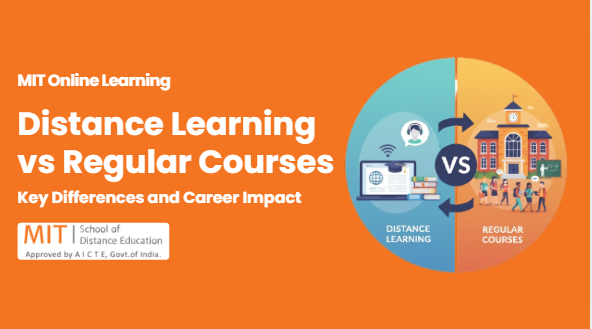
As education evolves, so do the choices available to learners. While this growth brings flexibility and accessibility, it can also create confusion about what learning format is best. One of the biggest debates today revolves around distance learning courses in India versus traditional, in-person education.
With technology reshaping how we learn, distance education for graduation has become just as credible and industry-recognized as regular classroom learning.
In this blog, we’ll explore both systems, their key differences, and their career impact — helping you decide what suits your goals best.
What Is Distance Learning?
Distance learning is a mode of education where students and teachers are not physically present together. Instead, technology bridges the gap through online classes, recorded lectures, and digital study material. It allows learners to study from anywhere, at their own pace — making it ideal for working professionals or those in remote locations.
Key Aspects of Distance Learning
- Flexibility: Learn anytime, anywhere, and at your own pace.
- Technology-driven: Uses tools like video conferencing, e-learning portals, and mobile apps.
- Accessibility: Removes geographical barriers, offering education to a broader audience.
- Formats: Includes synchronous (live online classes), asynchronous (recorded sessions), or hybrid models.
Advantages
- Convenience and Flexibility: Balance work, family, and studies effortlessly.
- Cost-Effective: Save on travel, accommodation, and materials.
- Personalized Learning: Move faster through topics you understand and revisit challenging ones.
- Skill Enhancement: Build digital literacy, time management, and self-discipline.
- Career Advancement: Access specialized distance education bachelor degree programs and certifications without leaving your job.
What Is Traditional Learning?
Traditional learning involves in-person instruction within a physical classroom. It follows a fixed timetable, where students and teachers interact directly. This model emphasizes structured schedules, face-to-face discussions, and practical learning experiences.
Key Characteristics
- Teacher-led approach with direct guidance.
- Fixed schedule and curriculum with set class timings.
- Face-to-face interaction encourages engagement and teamwork.
- Assessment methods include written exams and assignments.
- Access to campus resources like libraries, labs, and workshops.
Advantages
- Structured Environment: Helps develop discipline and time management.
- Real-time Feedback: Immediate clarification from instructors.
- Hands-on Learning: Ideal for technical or practical subjects.
- Networking Opportunities: Build connections with peers, professors, and alumni.
- Social Development: Improves communication and interpersonal skills.
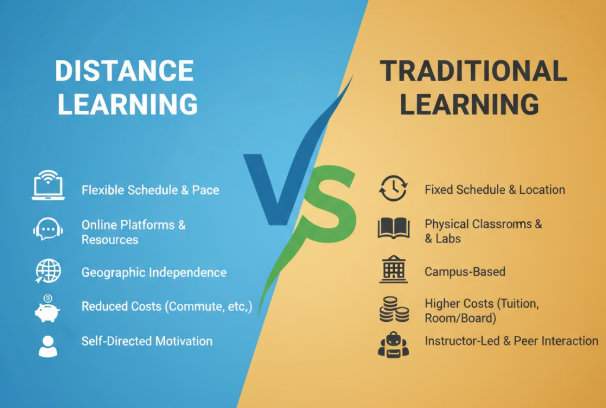
Key Differences: Distance Learning vs Traditional Learning
Aspect | Distance Learning | Traditional Learning |
Flexibility | Study at your own pace, from anywhere. | Follows a fixed schedule at a physical location. |
Interaction | Limited real-time interaction; digital communication. | Direct, face-to-face engagement. |
Learning Materials | Digital resources like videos, PDFs, and e-modules. | Textbooks and classroom materials. |
Cost | More affordable; saves on travel and housing. | Higher costs due to commuting and campus fees. |
Structure | Self-paced and independent; needs self-discipline. | Highly structured and instructor-led. |
Accessibility | Available to anyone with internet access. | Restricted by geography. |
In short, distance learning universities in India focus on flexibility, technology, and accessibility, while traditional learning emphasizes physical presence, routine, and interpersonal engagement.
Career Impact: Which Works Better?
Both learning formats can lead to successful careers — the key lies in aligning your learning style and career goals.
- Networking: Traditional universities offer stronger in-person networks, while distance programs provide global online communities.
- Skill Development: Traditional methods work better for hands-on skills; distance education for graduation excels in digital literacy and self-management.
- Accessibility: Distance learning courses in India are ideal for working professionals or those balancing multiple responsibilities.
- Credibility: Today, employers widely recognize degrees earned through the best distance learning universities, provided they are accredited and reputed.
Industry Preference
Certain industries — especially those requiring fieldwork or labs — still lean toward traditional learning. However, corporate, IT, finance, and marketing sectors now actively value best distance education courses for upskilling, reskilling, and professional development.
Choosing What’s Right for You
Choose Distance Learning If You:
- Need flexibility and cost-effectiveness.
- Are working or managing personal commitments.
- Prefer self-paced learning and digital tools.
- Want access to niche or specialized programs.
Choose Traditional Learning If You:
- Thrive in a structured classroom setting.
- Need hands-on training or lab experience.
- Value in-person networking and mentorship.
Why Choose MITSDE for Distance Education?
If you’re considering the best distance education courses to upgrade your career, MIT School of Distance Education (MITSDE) is among the best distance learning universities in India.
MITSDE offers UGC-approved programs designed for real-world application. Learners can choose from diverse options like PGDM, Executive PGDM, Dual Specialization (EMBA + Executive PGDM), and industry-driven courses in Business Analytics, Project Management, Banking & Financial Services, Digital Marketing, and more.
With flexible schedules, expert faculty, and 100% online accessibility, MITSDE ensures your graduation courses distance education journey is as powerful and recognized as any traditional degree.
👉 Explore more: https://mitsde.com/
Final Thoughts
The debate between distance learning and traditional learning isn’t about which is better, it’s about what fits your life and career goals. While traditional education offers structured guidance and in-person experience, distance education for graduation provides unmatched flexibility, affordability, and accessibility.
If you’re looking to learn, grow, and advance your career on your own terms, MITSDE’s distance learning courses in India are the perfect step toward a successful future.