Table of Content
- Why Project Management Certifications Matter
- Key Factors to Consider Before Choosing a Certification
- Comparison Table – Major Project Management Credentials
- How to Choose the Right Certification for You
- Career Opportunities After Project Management Certification
- Conclusion
Whether you are overseeing a construction site, launching a software update, or managing a marketing campaign, the principles of project management are the glue that holds complex initiatives together. The ability to deliver results on time and within budget is the most valuable skill you can have, no matter what industry you work in.
However, as the field grows, so does the noise. A quick search online reveals a wide variety of acronyms, such as PMP, PRINCE2, CAPM, and various university diplomas. This brings us to an important question – Which is the best project management certification for your specific career path? This guide will navigate this question, so let us scroll down!
Why Project Management Certifications Matter
While experience is invaluable, a Project Management Certification acts as a verified seal of quality. It tells employers that you possess a standardised set of skills and speak the global language of management.
Validation of Expertise
Certifications validate your skills in handling risks, resources, and timelines. They validate that you understand not just how to do the job, but the methodology behind why it is done that way.
Career and Salary Boost
There is a direct correlation between certification and remuneration. According to global salary surveys, professionals holding a Top Project Management Certification often earn significantly higher salaries than their non-certified counterparts.
Global Recognition
Whether you are looking to work in India or abroad, certifications like PMP or recognised Post Graduate Diplomas are transferable assets. They demonstrate commitment to the profession, giving you a competitive edge in the job market.
Key Factors to Consider Before Choosing a Certification
Before enrolling in a course, consider the following factors –
- Current Experience Level – Are you a fresh graduate or a seasoned veteran? Some certifications require certain hours of leading projects, while others are designed for beginners.
- Methodology Preference – Do you work in software development or in marketing? Many certifications are tailored to specific industries.
- Time and Cost – Consider the Return on Investment (ROI). Can you afford to take months off for study, or do you need a flexible distance learning option?
- Career Goals – If you want to move into general management, a broader diploma might be a better choice.
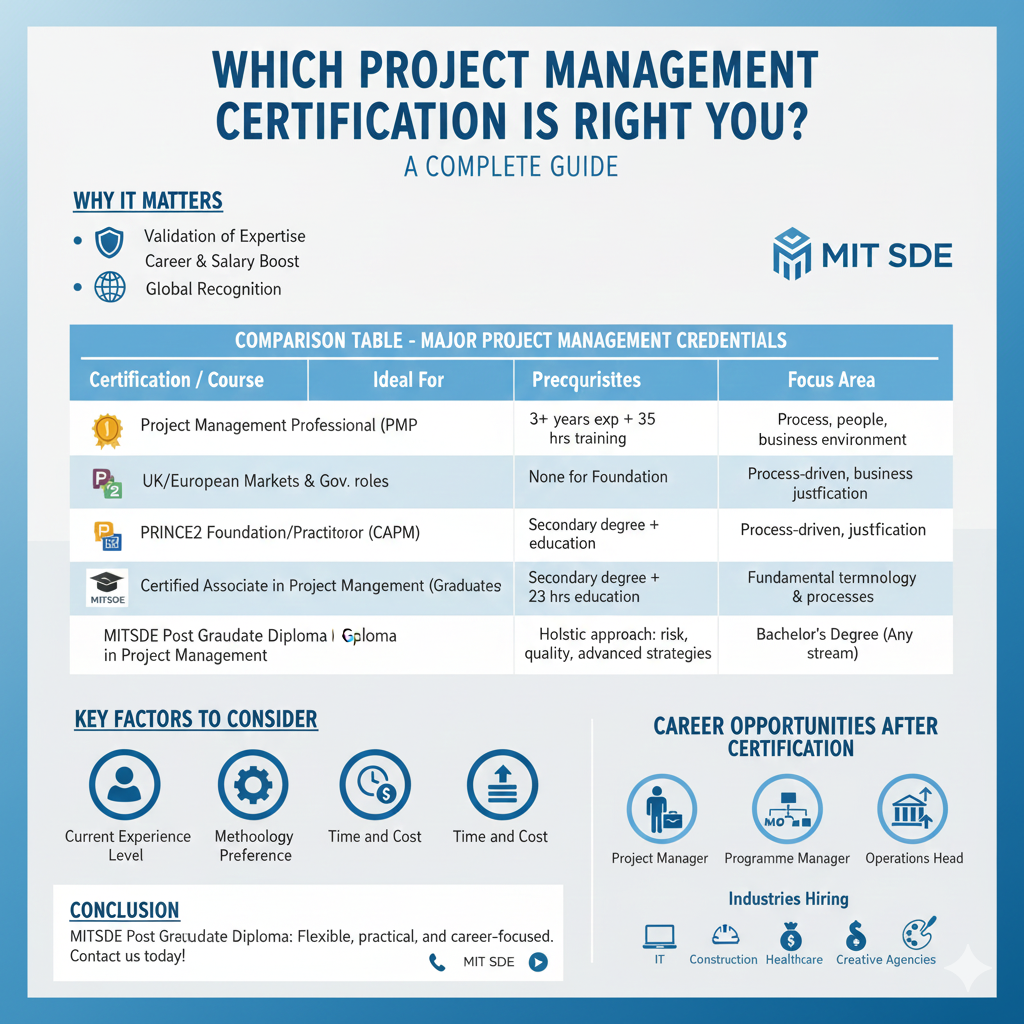
Comparison Table – Major Project Management Credentials
Here is a comparison of some of the most sought-after project management courses, including flexible options for working professionals.
Certification / Course | Ideal For | Prerequisites | Focus Area |
Project Management Professional (PMP) | Experienced Project Managers | 3+ years of project leadership experience + 35 hours of training. | Gold standard for process, people, and business environment. |
PRINCE2 Foundation/Practitioner | UK/European Markets & Gov. roles | None for Foundation; Foundation required for Practitioner. | Process-driven methodology focusing on business justification. |
Certified Associate in Project Management (CAPM) | Entry-level / Beginners | Secondary degree + 23 hours of project management education. | Fundamental terminology and processes of project management. |
MITSDE Post Graduate Diploma in Project Management | Working Professionals & Graduates | Bachelor’s Degree (Any stream). No prior work exp required, though helpful. | A holistic approach covering risk, quality, and advanced management strategies specifically for career growth. |
How to Choose the Right Certification for You
Selecting the right path requires aligning the curriculum with your lifestyle. For example, if you are already working full-time, you should look for project management courses that offer flexibility. Here are some other factors to consider –
- Evaluate the Content – Look for a Top Project Management Certification or diploma that covers the modern “Project Economy.” It should teach you leadership, conflict resolution, and agile adaptation.
- Accreditation – If you opt for a Post Graduate Diploma, ensure the institution is recognised. For instance, courses that offer e-learning support allow you to balance your current job while upskilling.
- Career Opportunities – Once certified, the career opportunities for you will grow significantly. So choose a certificate that helps with it.
Career Opportunities After Project Management Certification
Once certified, your career opportunities will grow significantly. So choose a certificate that helps with it. Some of the most common roles include –
- Project Manager – The general role, responsible for the end-to-end delivery of projects.
- Programme Manager – Overseeing multiple related projects to achieve a strategic organisational goal.
- PMO Analyst – Working within the Project Management Office to standardise processes.
- Operations Head – ensuring the smooth running of business protocols.
Industries Hiring
While IT and Construction are the traditional heavyweights, there is a surging demand in Healthcare, Finance, Manufacturing, and even Creative Agencies. As businesses become more project-oriented, the need for certified professionals is also high.
Conclusion
Project Management is one of the most relevant qualifications that can help advance your career. A Post Graduate Diploma in Project Management offered by institutes like MIT School of Distance Education (MITSDE) is perfect for those looking for a flexible option to upskill. The curriculum is designed to equip you with practical skills and theoretical knowledge, ensuring you are ready to manage any project! So, get in touch with us today to learn more about the course!