In today’s fast-paced business world, professionals often seek ways to upgrade their skills without pausing their careers. That’s where the Executive MBA (EMBA) comes in — a specialized management program designed for working professionals aiming to accelerate their careers and move into senior leadership roles.
This guide explores what an Executive MBA degree is, its eligibility criteria, course structure, duration, and why it’s ideal for professionals who want to lead in a competitive corporate environment.
What Is an Executive MBA?
An Executive MBA (EMBA) is a postgraduate management program tailored for working professionals with significant work experience. Unlike a regular MBA that focuses on foundational business knowledge, the Executive MBA course emphasizes leadership, strategic management, and real-world problem-solving.
The curriculum is designed to balance theory with practical application — helping professionals learn how to make high-impact decisions and manage complex business challenges effectively.
Why Pursue an Executive MBA Degree?
Pursuing an Executive MBA degree offers numerous career benefits, including:
- Career Advancement: Gain the skills needed to move into managerial or executive roles.
- Leadership Development: Learn to lead teams, manage projects, and make strategic decisions.
- Networking Opportunities: Connect with industry leaders, entrepreneurs, and professionals across various domains.
- Global Perspective: Many Executive MBA programs include international case studies and exposure to global business practices.
- Work-Study Balance: Most EMBA programs are designed with flexible schedules — allowing professionals to study without leaving their jobs.
Who Should Pursue an Executive MBA?
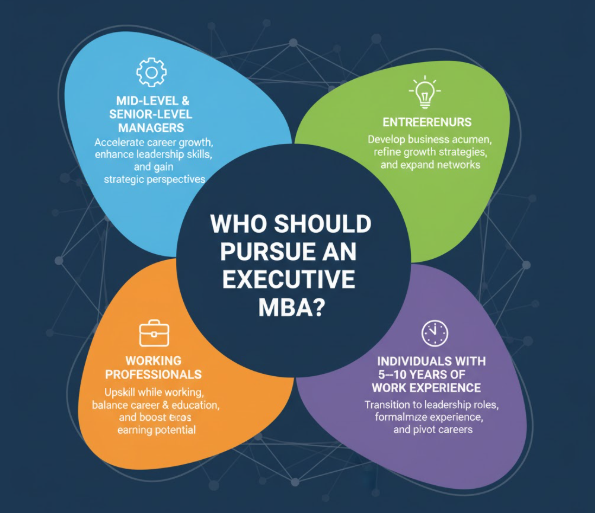
An Executive MBA in India is ideal for:
- Mid-level and senior-level managers who want to enhance leadership and strategic thinking.
- Entrepreneurs aiming to scale their businesses.
- Working professionals seeking career transition or promotion into management roles.
- Individuals with 5–10 years of work experience looking to formalize their business knowledge.
If you want to gain managerial expertise while continuing your career, an Executive MBA course is the perfect choice.
Executive MBA Eligibility Criteria
While eligibility may vary across institutions, the general Executive MBA eligibility requirements include:
- A Bachelor’s degree (in any discipline) from a recognized university.
- Minimum 3–5 years of full-time work experience (some programs require more).
- Entrance exams such as CAT, GMAT, or institution-specific tests (may vary).
- A statement of purpose (SOP) and professional recommendations in some cases.
Many top executive MBA colleges in India also conduct personal interviews to assess leadership potential and motivation.
Course Duration and Structure
The duration of an Executive MBA typically ranges from 12 months to 24 months. However, flexible or part-time options are available for professionals balancing work and study.
Common Course Modules:
- Strategic Management
- Business Analytics
- Financial Management
- Marketing Strategies
- Leadership and Organizational Behavior
- Global Business Environment
- Operations and Supply Chain Management
The 2-year Executive MBA format is popular in India for those who prefer a more comprehensive learning experience alongside their careers.
Top Executive MBA Colleges in India
India offers several reputed institutions for Executive MBA programs, known for their academic excellence and industry connections.
Some of the best Executive MBA colleges in India include:
- Indian School of Business (ISB) – Hyderabad & Mohali
- IIM Ahmedabad, Bangalore, and Calcutta – Post Graduate Program for Executives (PGPX)
- MIT School of Distance Education (MITSDE) – Flexible online Executive MBA programs ideal for working professionals
- XLRI Jamshedpur – Executive PGDM
- SP Jain Institute of Management and Research (SPJIMR) – Executive Management Program
Executive MBA Admissions Process
The Executive MBA admission process usually includes:
- Online Application Form submission through the university’s official website.
- Submission of academic records and professional experience certificates.
- Entrance exam or eligibility test (depending on the college).
- Personal Interview or Statement of Purpose (SOP) evaluation.
- Final selection based on merit, experience, and overall profile.
For online institutes like MITSDE, admissions are simplified — professionals can apply online, get academic counseling, and start learning without interrupting their careers.
Career Opportunities After an Executive MBA
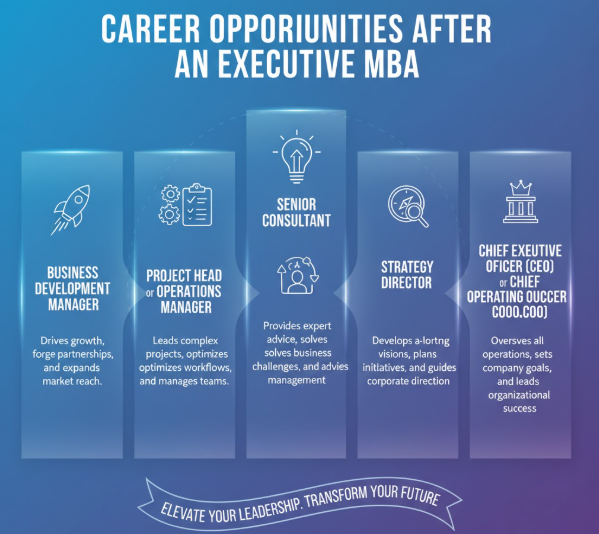
After completing an Executive MBA program, professionals can advance into leadership roles such as:
- Business Development Manager
- Project Head or Operations Manager
- Senior Consultant
- Strategy Director
- Chief Executive Officer (CEO) or Chief Operating Officer (COO)
The program opens doors to new opportunities across industries like finance, IT, consulting, manufacturing, and healthcare.
Why Choose an Executive MBA in India?
Pursuing an Executive MBA in India offers cost-effective education, access to diverse peer networks, and programs tailored to India’s fast-growing corporate ecosystem.
With the emergence of online EMBA programs from reputed institutes like MITSDE, professionals can now earn an accredited Executive MBA degree from anywhere in India — combining flexibility, quality, and industry relevance.
Conclusion
An Executive MBA isn’t just another degree — it’s a transformational experience for professionals seeking leadership excellence, strategic growth, and a competitive edge in their careers.
Whether you choose a 2-year Executive MBA or an online format from institutes like MITSDE, the investment you make in your education will pay off in the form of new opportunities, global recognition, and lifelong learning.