Operations play a mission-critical role in every organisation — ensuring that resources, people, processes, and technology come together seamlessly to deliver value. Whether it’s manufacturing, services, logistics, retail, or e-commerce, efficient operations directly impact profitability and customer satisfaction.
A PGDM in Operations Management is designed to prepare future-ready operations leaders who can plan, improve, and optimise processes across industries. If you’re a graduate or a working professional seeking a fast-growing, impactful career, this operations course gives you the right blend of managerial expertise and technical knowledge.
1. Course Details
What is PGDM in Operations Management?
A Post Graduate Diploma in Management (PGDM) in Operations Management is a specialised program focusing on planning, execution, supply chain coordination, productivity enhancement, and quality control. The course teaches the frameworks and tools required to streamline business operations and improve efficiency.
This makes the program highly valuable for individuals who want to enter or grow in operations, supply chain, production, logistics, or project management domains.
Eligibility Criteria
The minimum requirement to enroll is:
- A bachelor’s degree (in any stream) from a recognised university
- Professionals with experience in operations, manufacturing, supply chain, logistics, or plant management will gain additional value
- Fresh graduates with an interest in managing processes and systems can pursue this program too.
Program Duration & Learning Mode
- Duration: 1–2 years
- Modes Available:
- Online / Distance: For working professionals
- Hybrid: Online classes + campus immersion
- Classroom: Face-to-face interactive learning
The flexible online mode is especially beneficial for working professionals who want to upskill without leaving their jobs.
2. Syllabus & Modules
The curriculum is designed to offer a perfect blend of core management knowledge along with specialised operations modules. The syllabus is comparable to top B-schools and continually updated to meet industry needs.
Semester-wise Course Structure (Indicative)
Semester 1: Management Foundations
- Principles of Management
- Business Communication
- Accounting for Managers
- Marketing Management
- Business Law
- Quantitative Techniques for Management
These subjects prepare learners with essential business fundamentals to build a strong decision-making base.
Semester 2: Core Operations Concepts
- Operations Management
- Production Planning & Control
- Supply Chain Management
- Quality Management Systems (QMS)
- Managerial Economics
- Research Methodology
This semester focuses on understanding how processes, resources, and people work together in an operational environment.
Semester 3: Advanced Operations & Analytics
- Lean Management Systems
- Total Quality Management (TQM)
- Project Management
- Business Analytics
- Inventory & Warehouse Management
- Logistics & Distribution Management
Here, learners gain exposure to modern operations tools and methodologies used to optimise workflows.
Semester 4: Integrative Learning
- Strategic Operations Management
- Supply Chain Analytics
- Technology in Operations
- Industry Electives:
- Customer Relationship Management (CRM)
- Marketing of Services
- Business Ethics
- Project / Internship
This final phase helps students apply learning to real business cases.
3. Learning Outcomes
After completing the PGDM operations management program, learners can:
✔ Design Efficient Operational Strategies
Understand how to plan production, manage processes, and optimise resources.
✔ Enhance Quality Standards
Use Lean, Six Sigma, TQM, and continuous improvement methodologies.
✔ Strengthen Supply Chain & Logistics Knowledge
Predict demand, manage inventory, improve warehouse operations, and ensure timely distribution.
✔ Lead Operational Projects
Apply project management tools like Gantt charts, PERT, CPM, and Agile methodologies.
✔ Use Data to Drive Decisions
Interpret data, performance metrics, and KPIs to improve operational efficiency.
✔ Integrate Technology in Operations
Gain familiarity with ERP systems, automation tools, and analytics dashboards.
4. Career Scope & Opportunities
Operations is one of the most dynamic and in-demand fields across industries. Graduates of this program can work in:
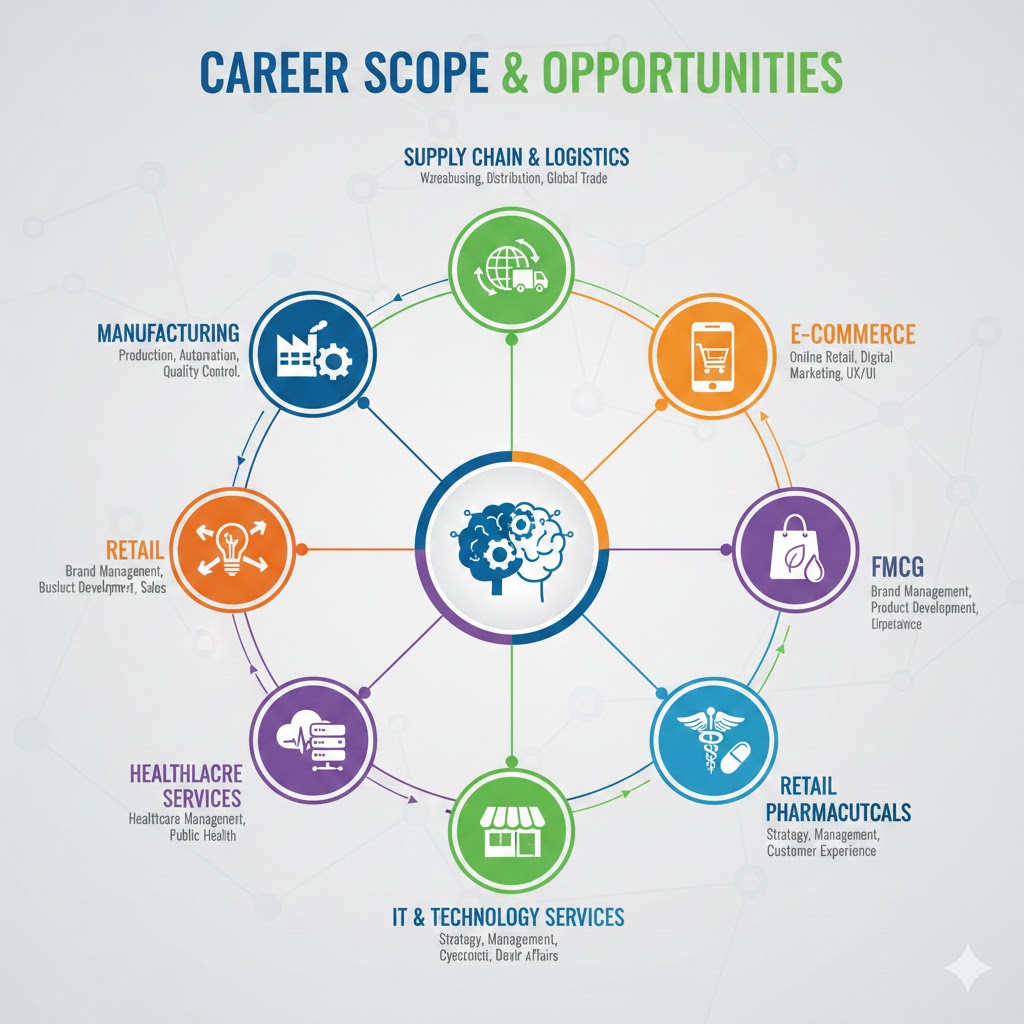
- Manufacturing
- Supply Chain & Logistics
- E-commerce
- FMCG
- Retail
- Pharmaceuticals
- Consulting
- IT & Technology Services
- Healthcare Operations
Popular Job Roles After PGDM in Operations Management
- Operations Executive / Manager
- Supply Chain Manager
- Production Manager
- Logistics & Distribution Analyst
- Quality Assurance Manager
- Warehouse Manager
- Process Improvement Specialist
- Project Manager – Operations
- Inventory Controller
The skills taught in this operations course are transferable across industries, offering excellent job mobility and growth opportunities.
5. Who Should Enroll?
This course is ideal for:
Graduates
Looking to build a strong career foundation in operations or supply chain.
Working Professionals
Wanting to transition into managerial roles or move from frontline roles to strategic positions.
Career Switchers
From domains like sales, administration, or IT who want to explore the operational side of business.
Why Choose MITSDE for PGDM in Operations Management?
If you’re looking for a trusted, industry-recognized institute for an operations program, MIT School of Distance Education (MITSDE) is one of the top choices.
What Makes MITSDE Stand Out?
- AI-powered learning platform
- Flexible online classes for working professionals
- Industry-driven curriculum
- 1:1 career guidance and mentoring
- Placement assistance and corporate tie-ups
- Real-world case studies and practical assignments
- Affordable fees with EMI options
MITSDE ensures that learners gain both academic knowledge and practical operational skills needed in today’s industry.
Conclusion
A PGDM in Operations Management is the perfect stepping stone for anyone looking to build a powerful career in operations, production, supply chain, or logistics. The curriculum is comprehensive, the skills are future-proof, and the career opportunities are immense.
If you aspire to lead processes, manage teams, improve systems, and become an operations expert — this is the right time to begin your journey.
FAQs
Q1. Is PGDM in Operations Management a good career choice?
Ans. Yes. Operations roles are available in every industry, making it one of the most stable and rewarding career paths.
Q2. Can I pursue this course while working?
Ans. Absolutely. Many institutes offer online/distance modes designed for working professionals.
Q3. Does the course include practical learning?
Ans. Yes. Case studies, projects, simulations, and industry-focused assignments are included.
Q4. Do I need an engineering background?
Ans. No. Graduates from any stream can pursue this course. The curriculum is designed for diverse learners.
Q5. What skills are most important for operations professionals?
Ans. Analytical skills, problem-solving, communication, process knowledge, and data-driven decision-making.
Q6. What is the starting salary after this PGDM?
Ans. Depending on experience and location, operations roles typically offer competitive salaries with rapid growth potential.