
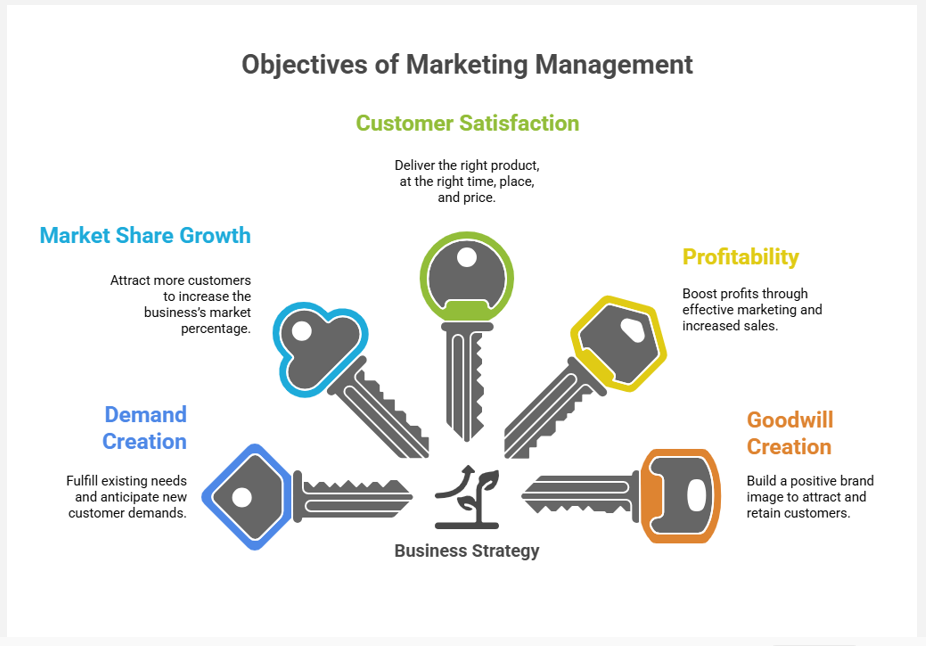
The core objectives of marketing management are: creating and sustaining customer demand, achieving high customer satisfaction, generating sustainable profit, building market share and brand reputation, and delivering quality products at a fair price. Together, these objectives align a company’s marketing activity with its broader business goals rather than treating marketing as a standalone sales function.
Why “Objectives” Is the Question Every Marketing Student Gets Wrong
Ask most first-year marketing students what marketing management is for, and you’ll usually get one answer: selling more. It’s not wrong, exactly — it’s incomplete. Marketing management has a specific set of objectives that go beyond a single sales number, and understanding them is often the difference between a marketer who executes campaigns and one who can build a marketing strategy.
This matters whether you’re a student preparing for an exam, a working professional trying to structure a marketing plan, or a founder wondering what your marketing team should actually be measured against. Below is a complete breakdown of each objective, why it exists, and how it connects to the others — because in practice, these objectives don’t operate in isolation. A business that chases profit while ignoring customer satisfaction, for instance, usually loses on both fronts within a few quarters.
What Is Marketing Management?
Marketing management is the process of planning, organizing, directing, and controlling an organization’s marketing activities — from market research and product positioning to pricing, promotion, and customer relationship management — to meet defined business objectives. It’s the discipline that turns a product into a business outcome.
The Core Objectives of Marketing Management
1. Creating and Sustaining Demand 📈
Every business exists to meet a need — but needs don’t stay static. Customer preferences shift, competitors enter the market, and yesterday’s must-have product becomes today’s afterthought. A core objective of marketing management is to continuously identify unmet or evolving needs and create demand around solving them, rather than waiting for demand to already exist.
2. Customer Satisfaction
Getting the right product to the right customer, at the right time, at the right price, is the practical definition of customer satisfaction in marketing terms. This objective exists because dissatisfied customers don’t just fail to return — they actively discourage others from buying, making satisfaction a long-term survival metric, not just a service nicety.
3. Generating Sustainable Profit
Marketing management isn’t just about visibility or goodwill — it exists to help a business earn money reliably. Effective marketing increases market share and strengthens demand, which directly supports the organization’s bottom line. A marketing plan that drives traffic or engagement without contributing to profit isn’t meeting this objective, no matter how good the metrics look on a dashboard.
4. Building Market Share and Brand Reputation
A strong public image and reputation directly influence how many potential customers even consider a business in the first place. This objective covers everything from brand positioning and public perception to competitive differentiation — the work of making sure a business is remembered, and remembered well, in a crowded market.
5. Delivering Quality at a Fair Price
Consistently offering quality goods or services at a reasonable price builds long-term trust and word-of-mouth — arguably the cheapest and most durable form of marketing a business can have. This objective ties pricing strategy directly to brand perception, not just short-term sales volume.
6. Social Responsibility and Ethical Marketing
Increasingly recognized as a core (not optional) objective, this involves ensuring marketing practices are honest, non-manipulative, and considerate of broader social and environmental impact — a factor that growing numbers of customers actively factor into purchase decisions.
7. Innovation and Adaptation
Markets change, and a marketing objective that doesn’t account for evolving technology, customer behavior, and competitive pressure quickly becomes obsolete. This objective is about ensuring the organization’s marketing approach evolves rather than ossifies.
How These Objectives Work Together
None of these objectives function well in isolation. A business chasing profit while ignoring customer satisfaction typically sees short-term gains erode within a few quarters as churn and negative word-of-mouth catch up. Similarly, building brand reputation without backing it up with product quality creates a credibility gap that competitors are quick to exploit. The strongest marketing management strategies treat these objectives as an interconnected system, with trade-offs made deliberately rather than by accident.
Short-Term vs. Long-Term Marketing Objectives: A Comparison
| Objective Type | Focus | Example Metric | Typical Timeframe |
|---|---|---|---|
| Short-term (tactical) | Immediate demand and sales | Monthly sales volume, campaign CTR | 1-3 months |
| Medium-term | Customer satisfaction and retention | Customer satisfaction score, repeat purchase rate | 3-12 months |
| Long-term (strategic) | Brand reputation and market share | Brand awareness surveys, market share % | 1-3+ years |
A common mistake in marketing plans is measuring only short-term metrics (clicks, immediate sales) while the strategic objectives — brand reputation, market share, customer loyalty — go untracked entirely, even though they’re what sustain a business past its first few sales cycles.
Build a Career Around These Objectives
Understanding marketing management objectives conceptually is a strong start — but translating them into an actual marketing strategy, budget, and team structure is a specialized skill. MITSDE offers PGDM and PGDBA programs in Marketing Management designed around exactly this kind of practical, objective-driven marketing strategy, with study material developed by industry practitioners.
👉 Explore PGDM/PGDBA in Marketing Management at MITSDE and learn how to turn these objectives into a working marketing strategy.
Frequently Asked Questions
-
1. What are the 5 main objectives of marketing management?
The five most commonly cited objectives are: creating demand, ensuring customer satisfaction, generating profit, building market share and brand reputation, and delivering quality at a fair price.
-
2. What is the primary objective of marketing management?
While all objectives matter, most marketing management frameworks treat customer satisfaction as central — since demand creation, profit, and brand reputation are all difficult to sustain without it.
-
3. How is marketing management different from marketing?
Marketing refers to the specific activities used to promote and sell products or services. Marketing management is the broader discipline of planning, organizing, staffing, directing, and controlling those marketing activities to meet business goals.
-
4. Why is customer satisfaction considered a marketing objective and not just a service goal?
Because dissatisfied customers reduce repeat purchases and generate negative word-of-mouth, which directly undermines demand creation and profit — the other core marketing objectives. Satisfaction functions as a multiplier (or drag) on everything else.
-
5. Do small businesses need to follow all these objectives, or just focus on sales?
Even small or early-stage businesses benefit from tracking these objectives, since focusing only on immediate sales while ignoring satisfaction or reputation tends to create growth that doesn't hold up past the first year.
Author
Pranav Kulkarni
Pranav Kulkarni is a content and digital marketing professional who writes about education, technology, and industry trends. His content helps learners and professionals make informed career decisions.