Pursuing a dual degree or Dual MBA can be a powerful way to accelerate your professional journey, especially in today’s competitive, multi-disciplinary job market. Whether you’re a student preparing for higher studies or a mid-career professional looking for a strategic transition, planning your career effectively is essential. With the right dual degree career planning and smart dual MBA strategy, you can position yourself as a versatile, business-ready professional capable of handling diverse roles.
This blog offers a practical roadmap to help you balance two academic programs, manage internships, and leverage your dual qualifications for maximum career impact.
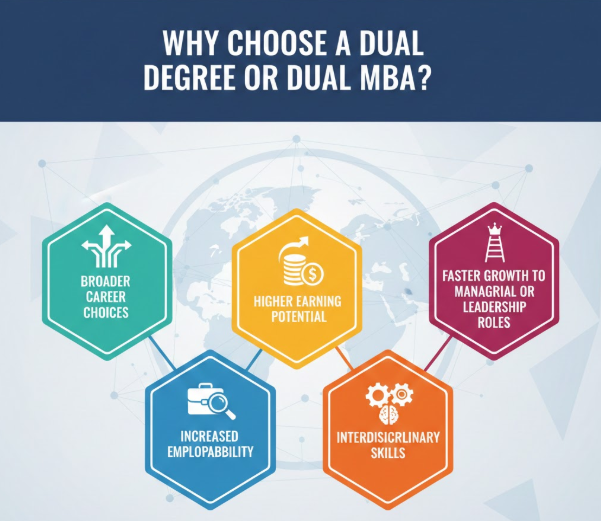
Why Choose a Dual Degree or Dual MBA?
A dual degree or Dual MBA lets you combine two complementary specializations—such as marketing + analytics, finance + operations, HR + business law, or technology + management. The biggest advantage is versatility. Employers today look for professionals who can bridge knowledge gaps, manage cross-functional teams, and make analytical decisions.
Here are some of the key benefits:
- Broader career choices
- Increased employability
- Higher earning potential
- Interdisciplinary skills
- Faster growth to managerial or leadership roles
But benefits alone are not enough—you need a proper plan to make it work.
1. Start with a Clear Career Vision
The foundation of effective dual degree career planning is clarity. Before choosing your programs, ask:
- What career path am I targeting?
- Do these two degrees complement each other?
- Where do I see myself five years from now?
For example:
If your goal is to become a strategy consultant, combining an MBA in Strategy with a master’s in Data Analytics can be a powerful blend. If you want to work in HR technology, choose HR plus IT management.
Having a clear roadmap helps you stay focused and reduces academic and mental overload.
2. Select Specializations That Make Sense Together
The right combination of programs strengthens your profile. Here are some smart Dual MBA combinations:
- Finance + Business Analytics – ideal for financial modelling, investment research
- Marketing + Digital Business – perfect for digital-first roles
- HR + Operations – beneficial for people operations & organisational development
- IT + Project Management – strong for tech leadership roles
- Supply Chain + Operations Management – great for operations & manufacturing careers
Choose specializations that complement each other—not compete.
3. Create a Schedule That Balances Both Programs
Balancing two academic programs can be challenging—but it’s manageable with structure. Develop a productivity plan:
✔ Prioritize core subjects
Focus on foundational courses first; they form your conceptual base.
✔ Use a semester-wise plan
Break your workload into weekly or monthly chunks.
✔ Avoid overlapping demanding subjects
If one program includes heavy analytics, pair it with lighter electives from the other.
✔ Maintain buffer time
Reserve slots for revision, project work, and unexpected academic pressures.
Consistency matters more than intensity. With discipline, you can manage both programs smoothly.
4. Do Not Skip Internships—They’re Crucial
One common mistake students make is neglecting internships due to busy schedules. But in dual degree career planning, internships play a critical role.
🔶 Why internships matter?
- They give you real-world exposure.
- They help you test which specialization you enjoy more.
- They add credibility to your resume.
- They often lead to pre-placement offers (PPOs).
🔶 How to manage internships with a dual program?
- Choose remote, part-time, or project-based internships.
- Opt for internships aligned with your long-term goal.
- Avoid doing unrelated internships just to fill your resume.
Always prioritize quality over quantity.
5. Build a Strong Network Across Both Fields
Networking is one of the most important components of any dual MBA strategy.
Join:
- Professional associations
- Online communities
- LinkedIn groups
- Webinars & workshops
- Alumni networks
This expands your opportunities for internships, mentorships, and job referrals. Networking accelerates your growth far faster than academics alone.
6. Gain Hands-On Experience Through Projects
While balancing two degrees, focus on practical learning. Most recruiters today value experience more than just certifications.
Engage in:
- Live business projects
- Capstone projects
- Industry simulations
- Case studies
- Consulting assignments
This helps you apply learning from both degrees and positions you as a job-ready candidate.
7. Highlight Your Dual Expertise in Your Resume & Interviews
Your resume should clearly show your dual specialization and why it makes you unique.
✔ Add a “Dual Qualification Summary”
Example:
“Pursuing Dual MBA in Finance & Analytics with strong skills in financial modelling, data interpretation, and strategic decision-making.”
✔ Showcase cross-functional projects
✔ Include technical and managerial skills
✔ Prepare a dual-degree elevator pitch
When asked, “Tell me about yourself,” highlight how your dual expertise creates value.
8. Choose Institutes That Offer Flexibility & Industry-Relevant Learning
Dual degrees require academic flexibility. Look for institutions that offer:
- Online or blended learning
- Self-paced modules
- Applied curriculum
- Industry certifications
- Placement support
This ensures you can manage studies, internships, and work without burnout.
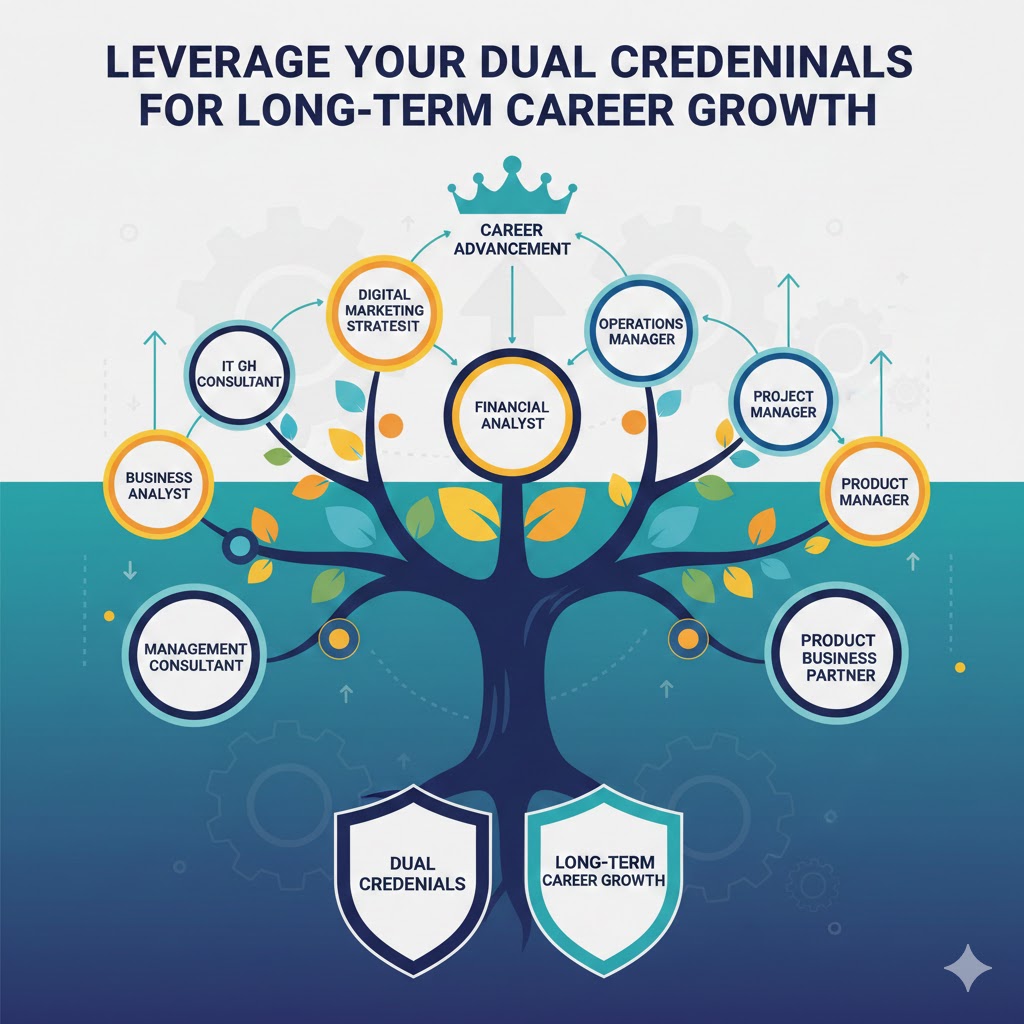
9. Leverage Your Dual Credentials for Long-Term Career Growth
Your journey doesn’t end after completing both programs—your dual qualification becomes your lifelong career advantage.
With strategic planning, you can enter high-impact roles such as:
- Business Analyst
- Management Consultant
- Product Manager
- HR Business Partner
- Digital Marketing Strategist
- Financial Analyst
- Operations Manager
- Project Manager
- IT Consultant
Dual degrees strengthen your leadership potential and accelerate promotions.
Why MITSDE Is a Smart Choice for Dual Learning
If you’re planning a flexible, industry-aligned academic journey, MIT School of Distance Education (MITSDE) offers programs ideally suited for students pursuing multi-disciplinary or dual learning paths.
✔ Flexible Online Learning
Perfect for balancing two degrees or work + study.
✔ Industry-Aligned Curriculum
Updated course content curated by academic and industry experts.
✔ Career Support
Resume building, mock interviews, job assistance, and career counselling.
✔ Strong Reputation
MITSDE is part of the prestigious MIT Group of Institutions, known for academic excellence for 40+ years.
Whether you’re combining management with analytics, marketing, operations, or HR, MITSDE’s PGDM programs help you build a future-ready career advantage.
FAQs
1. Is a dual degree or Dual MBA difficult to manage?
Ans. It can be challenging, but with proper scheduling, discipline, and support from flexible institutions like MITSDE, it becomes manageable.
2. Is a dual degree useful for career growth?
Ans. Yes! Dual degrees open multiple career paths and give you an edge in promotions, leadership roles, and cross-functional job opportunities.
3. Do employers value Dual MBAs?
Ans. Absolutely. Dual MBAs demonstrate commitment, versatility, and the ability to handle complex, multi-disciplinary tasks.
4. Can I work while pursuing a dual degree?
Ans. Yes—you can, especially if one or both programs are offered in flexible online mode.
5. Which PGDM combinations work best with career goals?
Ans. Popular combinations include Marketing + Digital Business, HR + Analytics, Finance + Operations, and IT + General Management.