The Indian Banking, Financial Services, and Insurance (BSFI) sector has changed so much over the years that there has been a massive shift in how professionals and laymen understand finance. What worked a few years ago no longer works now, and what works now may not work tomorrow. With so much change, the demand for financial expertise is skyrocketing.
If you are a finance professional looking to upgrade your career, you are likely facing a common dilemma – Should you pursue an MBA in Finance or a specialised Master’s in Financial Management?
Want to know which one is best for you? Read our guide on the difference between the two courses below!
Difference Between an MBA in Finance and a Master’s in Financial Management
Core Focus & Curriculum – Width vs. Depth
The easiest way to understand the difference is to look at the curriculum.
- MBA in Finance – This degree provides a broad business education with a finance emphasis. Here, you study finance and also accounting, marketing, strategy, and operations. An online MBA in finance is designed to develop managerial skills, integrating finance topics into a general management framework.
- Master’s in Financial Management – The curriculum is highly specialised, focusing intensively on financial theory, investment analysis, and quantitative methods. It creates technical experts who can crunch complex numbers and puts less emphasis on general business topics like marketing or HR.
Program Duration & Structure
The commitment required for these programs differs significantly. Here is a quick look at the structural differences –
Feature | MBA in Finance | Master’s in Financial Management |
Duration | 18–24 months (Full-time/Online) | 9–12 months (Full-time) |
Focus | Broad Business with a focus on Finance | Deep Finance Specialisation |
Work Experience | Usually required or preferred | Often not required |
Career Outcomes & Pathways
If you want to know how both courses can impact your career trajectory, then here is how.
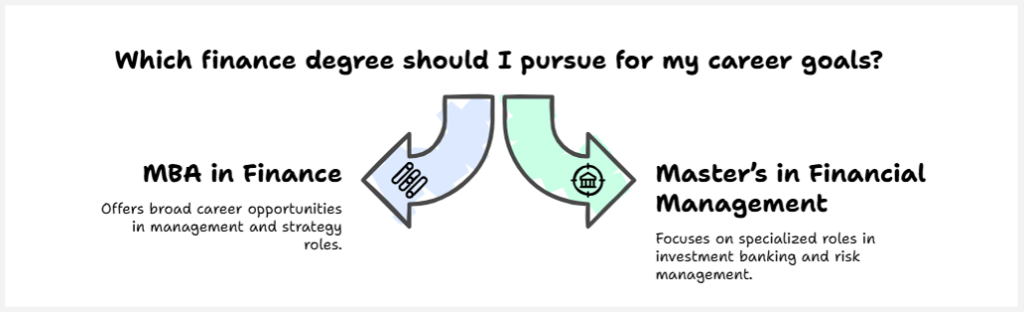
- MBA in Finance – This degree is designed to prepare you for the boardroom. Graduates typically target roles such as Finance Manager, Corporate Strategy Analyst, Consultant, and eventually, Chief Financial Officer (CFO). It offers stronger networking opportunities and pathways into corporate leadership.
- Master’s in Financial Management – This prepares you for specialised roles where technical skill is king. Typical job titles include Investment Banking Analyst, Risk Manager, Portfolio Manager, or Quantitative Analyst.
Skill Development
With an MBA in Finance and Masters in Financial Management, you develop different sets of skills that can define how you are perceived in the job market.
- MBA Skills – You will gain high proficiency in Leadership & Strategy. You will understand business ethics, organisational behaviour, and how to manage teams. While you learn financial modelling, it is often taught through the lens of business decision-making.
- Master’s Skills – You will gain high proficiency in Quantitative Finance. You will master econometrics, derivatives, and asset valuation. However, you will have less exposure to soft skills like negotiation or general business operations.
Which One Should You Choose?
Making the right choice comes down to your ultimate career goal. Here is a brief guide on how to make the right decision.
Choose the MBA in Finance if –
- You want senior leadership or management responsibilities.
- You value networking and want the flexibility to move across different industries.
- You prefer a broader career scope rather than a strictly technical role.
Choose the Master’s in Financial Management if –
- You want deep finance expertise and technical analytical skills.
- You plan to enter front-office finance roles like investment banking or asset management.
- You are early in your career and want a quicker, more focused program.
Conclusion
Both an MBA in Finance and a Master’s in Financial Management offer opportunities to excel in a finance career. However, you need to know your interests and priorities before settling on either choice. To know more, get in touch with us at MIT SDE, where we offer industry-aligned management programs designed for working professionals to help you upgrade and upskill!