
In today’s competitive and fast-evolving job market, professionals are constantly exploring ways to differentiate themselves. One powerful option that has gained significant traction is pursuing a dual degree or Dual MBA. These integrated programs allow students to combine two complementary disciplines—such as business and technology, marketing and analytics, or HR and operations—to build a broader career foundation.
But is a dual degree the right choice for you? This blog breaks down the dual MBA advantages and the major dual degree challenges to help students and working professionals make informed decisions.
Why Students Choose a Dual Degree or Dual MBA
The purpose of any higher education program is to build expertise, improve employability, and accelerate career growth. A dual degree goes one step further by merging two skill sets, giving learners a powerful edge in roles that require cross-functional understanding.
Key reasons learners consider dual programs:
- To gain a competitive advantage in job markets
- To develop strong, interdisciplinary knowledge
- To increase eligibility for leadership roles
- To pursue careers that demand multi-domain expertise
⭐ Advantages of Pursuing a Dual Degree or Dual MBA
Dual degrees offer distinct academic and career benefits. Here are the most important dual MBA advantages:
1. Enhanced Skill Set Across Two Domains
A dual degree equips learners with an integrated knowledge base. For example, pairing an MBA with subjects like analytics, IT, finance, or HR helps students operate confidently across multiple functions. This multidimensional skill set makes them valuable assets to employers.
2. Stronger Career Opportunities
A dual qualification significantly expands your job options. Instead of restricting yourself to one domain, you gain the flexibility to explore:
- Cross-functional management roles
- Strategy and leadership positions
- Specialized roles requiring multi-domain skills
This opens doors to industries such as consulting, tech, manufacturing, retail, finance, and more.
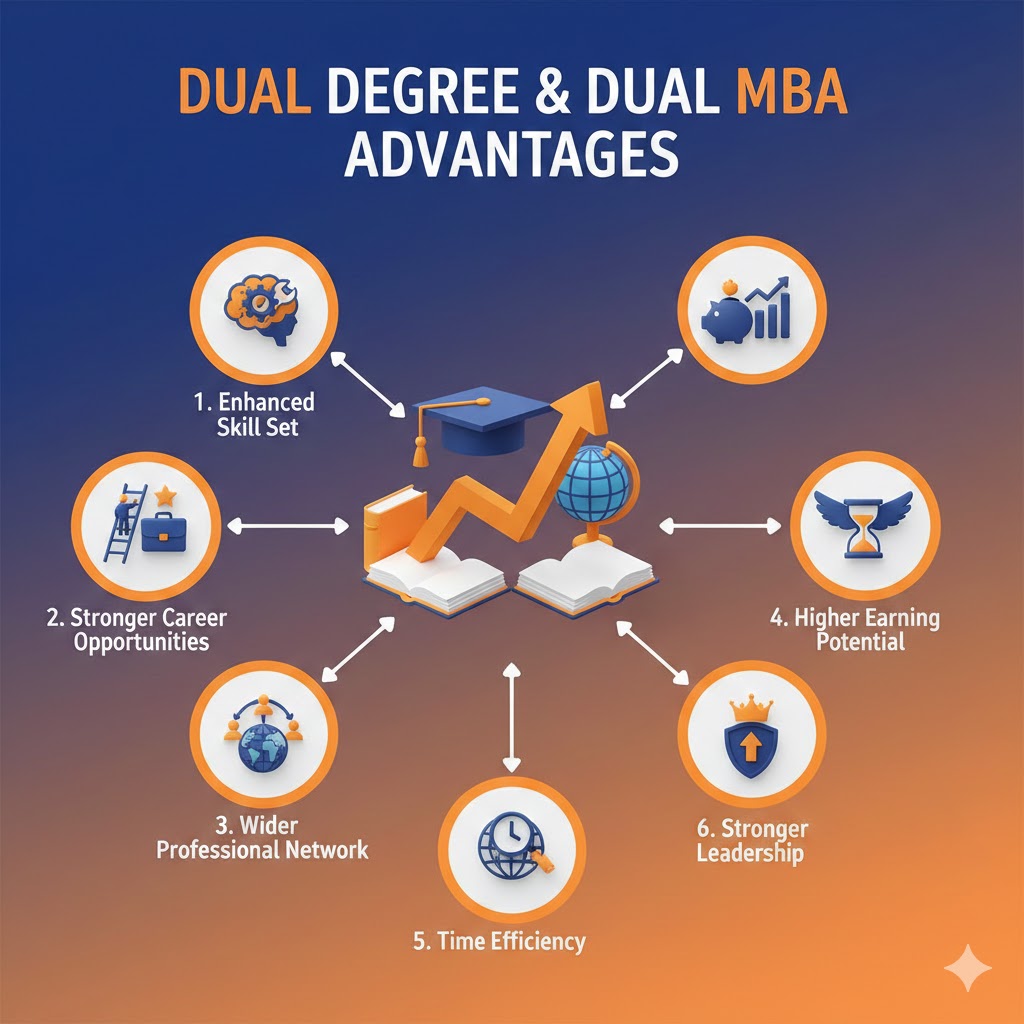
3. Wider Professional Network
Dual programs bring together students and faculty from different disciplines. This allows you to build a stronger peer network, connect with diverse professionals, and collaborate with individuals who bring unique perspectives—an essential element for leadership development.
4. Higher Earning Potential
One of the lesser-known dual MBA advantages is its impact on earning potential. Companies often value candidates who bring multi-dimensional skills, leading to better salary negotiations and faster promotions.
5. Time Efficiency Compared to Doing Two Separate Degrees
A dual program saves considerable time. Instead of pursuing two degrees separately—taking 4 to 5 years—you complete both in a compact, structured format, often within 2 years.
6. Stronger Leadership and Decision-Making Skills
Dual degrees encourage critical thinking, adaptability, and strategic problem-solving. These qualities position graduates for managerial and leadership roles early in their career.
❗ Challenges of Pursuing a Dual Degree or Dual MBA
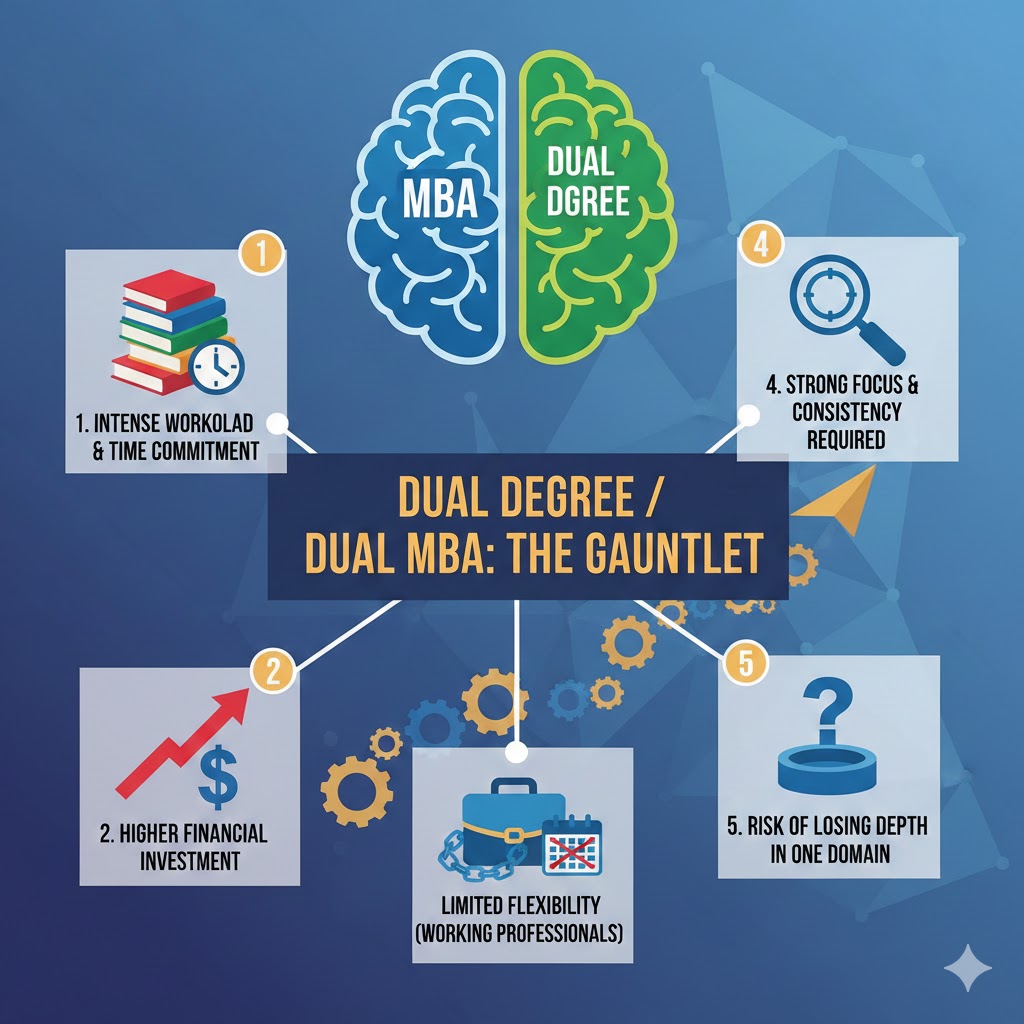
While the benefits are strong, there are also crucial dual degree challenges you must consider before enrolling.
1. Intense Workload and Time Commitment
Dual programs compress two areas of study into a tighter schedule. Students often report heavy coursework, assignment deadlines, and overlapping projects. Balancing both streams requires discipline and strong time-management skills.
2. Higher Financial Investment
Dual degrees can sometimes cost more than traditional single-specialisation programs. Students should evaluate the return on investment by comparing long-term benefits with the initial expense.
3. Limited Flexibility for Working Professionals
If the program is full-time, professionals may find it challenging to juggle job responsibilities along with dual academic requirements. Online dual-specialisation programs offer better flexibility, but the workload is still significant.
4. Requires Strong Focus and Consistency
Dual degrees demand continuous effort. Students who prefer a relaxed pace may find it overwhelming. This is one of the most common dual degree challenges faced by learners.
5. Risk of Losing Depth in One Domain
Some students may struggle to maintain depth in both subjects. Balancing two domains requires clarity, consistent revision, and practical application.
📝 Should You Pursue a Dual Degree or Dual MBA?
If you are someone who:
- wants multi-disciplinary expertise,
- aims for leadership roles,
- thrives under challenging academic environments,
- or wants to accelerate career growth,
then a dual degree may be the perfect choice.
However, if you prefer focused specialization, or if you are unable to commit time and resources, a single-degree program may suit you better.
🎓 Dual Degree Options with Flexible Learning from MITSDE
For professionals looking for a flexible and industry-focused qualification, MIT School of Distance Education (MITSDE) offers dual specialization options in its PGDM programs.
These programs help students build cross-functional managerial skills while enjoying the flexibility of online learning. MITSDE’s curriculum, virtual support, placement mentoring, and industry-aligned modules make it a strong choice for those seeking dual expertise without compromising work-life balance.
❓ Frequently Asked Questions (FAQs)
1. What is a Dual MBA?
Ans. A Dual MBA allows students to specialize in two different management domains within one program—such as Marketing + Finance or HR + Operations.
2. What are the key dual MBA advantages?
Ans. Some major advantages include enhanced domain knowledge, stronger career opportunities, time savings, and better earning potential.
3. Are dual degree programs more difficult than regular programs?
Ans. Yes, they can be. The workload is higher since you are studying two domains simultaneously.
4. What are the biggest dual degree challenges?
Ans. Time management, financial investment, workload pressure, and maintaining equal focus on both domains.
5. Who should consider a Dual MBA?
Ans. Graduates and working professionals who want multi-domain expertise or who aim for leadership roles should consider it.
6. Can working professionals pursue a dual degree?
Ans. Yes, especially if they choose online or distance-learning formats like those offered by MITSDE.
7. Does a Dual MBA improve salary growth?
Ans. Yes. Multi-skilled candidates often qualify for higher-level roles, leading to better compensation packages.
8. Is a dual degree worth it in the long run?
Ans. Absolutely—if you want versatility, long-term career growth, and leadership potential.