
Table of Contents
- Best Financial Analyst Course in Mumbai
- What Does a Financial Analyst Do?
- How to Become a Financial Analyst in Mumbai?
- Important Financial Analyst Skills
- Financial Analyst Career Path
- Average Financial Analyst Salary in Mumbai
- Financial Analyst Internship in Mumbai
- Financial Analyst vs Investment Banker
- How to Choose the Best Financial Analyst Course?
- How Can a Financial Analyst Course in Mumbai Accelerate Your Career?
Key Takeaways
- The best financial analyst course offers a practical and industry-oriented finance training
- Financial analysts work with financial data to aid businesses and investors in making decisions
- Their key skills include financial modelling, Excel, valuation, and analytical thinking
- Internships and projects provide the relevant practical experience needed to bridge the gap between education and the workplace
- Their career path progresses through entry-level analyst roles to higher-level finance positions
- One must consider the course’s curriculum, practical application, and certification when selecting a financial analyst course.
Mumbai serves as India’s financial capital, housing a large number of banks, investment firms, corporates, and a burgeoning fintech ecosystem, all of which require skilled financial analysts to advise on their financial decision-making and therefore, a well-structured financial analyst course in Mumbai can help bridge the gap between academic finance knowledge and actual practical skills needed by employers.
Best Financial Analyst Course in Mumbai
What Does a Financial Analyst Course Teach You?
A financial analyst course teaches the fundamentals of financial analysis in detail while also linking the concepts learned in class directly to their practical applications in the field of finance, equipping the student with practical skills in areas such as financial statements, financial modelling, valuation, forecasting, budgeting, and investment analysis among others.
Who Should Consider a Financial Analyst Course?
- Finance graduates looking to improve their practical skills
- Commerce and business students looking to join the workforce
- MBA or PGDM aspirants looking to major in finance
- Professionals changing career paths
- Professionals looking to improve their financial analysis skills
What Are the Benefits of Taking Such a Course in Mumbai?
Industry-specific skills, practical experience, a better understanding of the financial market, improved career readiness and opportunities for internships and entry-level jobs are all some of the benefits of taking the course in one of India’s financial hubs.

What Does a Financial Analyst Do?
What Are the Main Responsibilities?
A financial analyst conducts financial statements analysis, prepares financial models, evaluates the business performance of a company, performs market and industry analysis, prepares forecasts, and makes investment and business recommendations.
Where Do Financial Analysts Work?
In banks, investment firms, consulting companies, corporates, financial services companies, and fintech organisations, among others, what a financial analyst does differs depending on the industry but the core skills remain the same.
What Skills Are Required?
Financial modelling, Excel, data analysis, financial statement analysis, valuation, research, communication, and critical thinking are some of the key skills required for the role.
How to Become a Financial Analyst in Mumbai?
What Educational Qualifications Are Needed?
A bachelor’s degree in finance, commerce, economics, business or any other related disciplines is required for most roles, and relevant postgraduate qualifications if any.
What Certifications Can Help?
Industry-recognised finance certifications can help boost one’s credentials considerably, though certified financial analyst eligibility varies depending on the certifying body against which one is applying, so it is important to research the requirements of each certifying organisation before choosing which examination to take.
Why Can a Course Improve Career Readiness?
A course offers a much-needed boost to one’s employability by providing structured learning, practical projects, financial modelling skills, interview preparation, and industry-specific knowledge and experience required by employers, which would not be available if one were to take a self-learned approach, hence playing a critical role in helping one understand how to become a financial analyst.
What Are the Most Important Financial Analyst Skills to Develop?
Which Technical Skills Matter Most?
Financial modelling, excel, financial statement analysis, valuation, forecasting and data analysis are all essential technical skills that one must develop to be successful in the role.
Which Soft Skills Are Important?
Analytical thinking, problem-solving, communication, attention to detail, presentation, and business sense are just some of the crucial soft skills that one needs.
How Can a Course Help Develop These Skills?
Case studies, financial analysis of data sets, financial modelling, business analysis projects, and presentations and assessments that follow a structured approach can all help a student gain mastery of the relevant skills through repeated and guided practice.
What Is the Financial Analyst Career Path?
Graduate -> Finance intern or trainee -> Junior financial analyst -> Financial analyst -> Senior financial analyst -> Finance manager is the usual progression, where one needs to gain technical and industry experience, improve one’s leadership skills, acquire relevant certifications, and take on more complex financial projects to advance to higher roles, and from there, a financial analyst career path can branch out into investment analysis, corporate finance, equity research, FP&A, risk analysis, investment banking, and financial consulting.
What Is the Average Financial Analyst Salary in Mumbai?
What Factors Influence It?
Experience, education, certifications, technical skills, industry, company size, and job responsibilities are just some of the main factors that determine a financial analyst’s salary, and as of June 2026, the average financial analyst salary in Mumbai costs around ₹6,15,000 per annum with the salaries ranging between ₹3,60,000 and ₹9,50,000 depending on one’s experience and the company they are working for.
Do Certifications and Practical Skills Affect Growth?
Having the right qualifications and practical skills can significantly boost one’s career, albeit without guarantees on a particular salary level or jump.
How Does Experience Increase Earning Potential?
By moving from junior to senior analyst positions and eventually to management roles as a finance manager or similar positions where one can rely on their technical know-how, experience, and leadership skills to demand a higher salary.
How Can a Financial Analyst Internship in Mumbai Help Your Career?
A financial analyst internship in Mumbai offers students the opportunity to gain the much-needed practical experience that complements their academic knowledge, boosts their confidence in the workplace, and adds valuable work experience to their resume, and a financial analyst internship in Mumbai generally entails financial reporting, data analysis, market research, financial modelling, forecasting, and business research, and students can find financial analyst internships in Mumbai by searching on company career pages, internship platforms, college placement cells, and networks within the finance community.
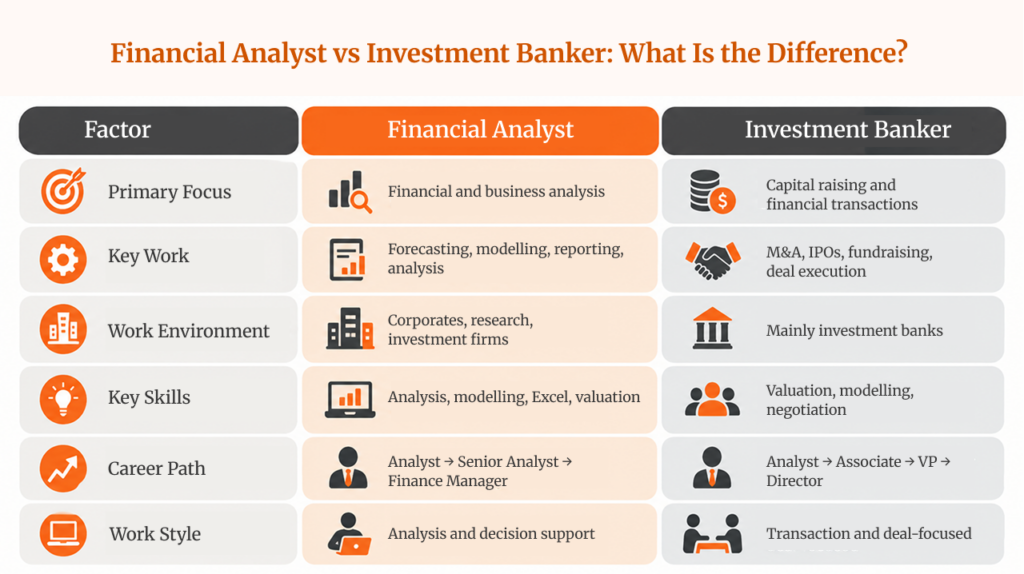
Financial Analyst vs Investment Banker: What Is the Difference?
Factor | Financial Analyst | Investment Banker |
Primary Focus | Financial and business analysis | Capital raising and financial transactions |
Key Work | Forecasting, modelling, reporting, analysis | M&A, IPOs, fundraising, deal execution |
Work Environment | Corporates, research, investment firms | Mainly investment banks |
Key Skills | Analysis, modelling, Excel, valuation | Valuation, modelling, negotiation |
Career Path | Analyst → Senior Analyst → Finance Manager | Analyst → Associate → VP → Director |
Work Style | Analysis and decision support | Transaction and deal-focused |
Deciding between a financial analyst vs investment banker is ultimately a matter of personal preference and professional goals, and not which is intrinsically ‘better’ than the other.
How Do You Choose the Best Financial Analyst Course?
Looking for an industry-specific curriculum that includes practical financial modelling components, experienced faculty, projects and case studies, certification, internship and placement support, and flexible learning options among other considerations, and the breadth and depth of the course’s curriculum and practical application matter more than its duration, and courses that include relevant projects tend to help students demonstrate their competence to employers effectively.
How Can a Financial Analyst Course in Mumbai Accelerate Your Career?
A financial analyst course in Mumbai helps bridge the gap between academic finance knowledge and actual practical skills needed by employers, building job-ready competencies, and with projects in financial modelling, company valuation, financial statement analysis, industry analysis, and forecasting that enhance one’s resume and relevant certification that offers credibility, complemented by the skills and practical experience they need most.
MITSDE’s PGDM in Finance Management is designed around these principles, offering courses in financial modelling, valuation, corporate finance, and risk management, through case studies and projects, and being an AICTE-approved programme offered by the MIT Group, known for its years of experience in delivering professional education along with flexible online learning and placement support, offers a solid foundation for those looking to build a career as a financial analyst in Mumbai.