
Table of Contents
- Why Choose a Construction Management Course in Mumbai?
- What Makes Mumbai a Strong Market for Construction Management Careers?
- How Does Construction Management Training Improve Career Prospects?
- What Should You Look for in the Best Construction Management Course in Mumbai?
- How Long Is a Construction Management Course?
- How Can Construction Management Placement Support Your Career?
- What Career Opportunities Are Available After Construction Management?
- What Is a Construction Manager’s Job Description?
- Construction Management Course vs Traditional Civil Engineering Education
- How Can the Best Construction Management Course Accelerate Your Career?
- How to Choose Among Construction Management Colleges in Mumbai?
- What Is the Career Path After a Construction Management Course?
Key Takeaways
- Mumbai offers strong career opportunities in construction management due to ongoing infrastructure, real estate, and commercial development.
- A good construction management course should combine technical knowledge, management skills, leadership, and practical training.
- Practical exposure through live projects, industry assignments, case studies, internships, and site visits can strengthen industry readiness.
- Students should develop skills in project planning, scheduling, budgeting, contract management, quality, safety, risk, and team management.
- Placement support should include industry connections, internships, career counselling, resume building, interview preparation, and employer interaction.
- Construction management graduates can pursue roles such as Construction Manager, Project Manager, Planning Engineer, Quantity Surveyor, Contracts Manager, and Cost Control Manager.
- When choosing a course or college, consider the curriculum, faculty, industry exposure, projects, placement support, duration, infrastructure, and alumni network.
- A typical career progression can move from course and practical exposure to project or site roles, project management, and senior construction leadership.
Skilled construction management professionals are gaining increasing demand in India, and Mumbai is right in the middle of the demand since it hosts several upcoming infrastructure, real estate, and commercial developments.
The best construction management course provides technical know-how, managerial and leadership skills, and practical training that enables individuals to transition from being a worker on the construction site to a leader in charge of the project.
Simply put, the best construction management course in Mumbai enables professionals to get equipped with the latest skills relevant to the construction and project management niche while also providing them with quality placement support to expedite their career in the field of construction and project management.
Why Choose a Construction Management Course in Mumbai?
What Makes Mumbai a Strong Market for Construction Management Careers?
- Constant infrastructure development projects, including metro, coastal roads, etc.
- Several real-estate developments and residential and commercial projects
- Development and expansion of transport and infrastructure
- Growing need for project management professionals in both private and government sectors
India’s Economic Survey highlights that construction is the third-largest employer in the country with over 13% of the workforce currently engaged in the industry.
How Does Construction Management Training Improve Career Prospects?
A construction management course in Mumbai equips participants with skills and competencies in project planning, budgeting, risk management, resource allocation, quality control, construction technology, and leadership and communication, among others. Thus, a professional gains a comprehensive skill set that is not only technically sound but also integrates management and leadership skills.

What Should You Look for in the Best Construction Management Course in Mumbai?
Does the Course Offer Practical Training?
This includes live projects, industry-related assignments and cases, and site visits, among others. It is always advisable to go for construction management courses that offer a comprehensive package that is not limited to theoretical skills only, which is a common pitfall of many programs.
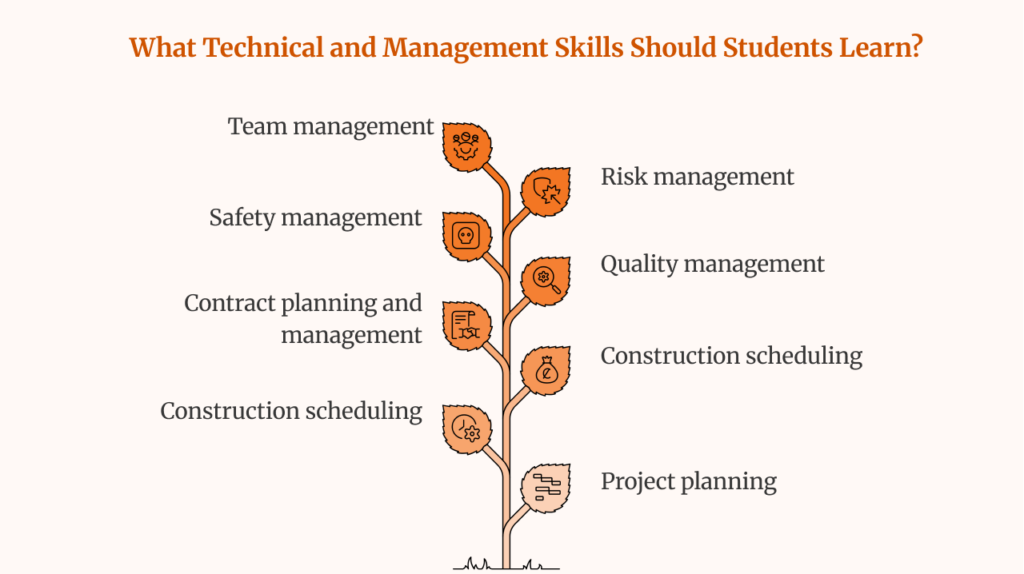
What Technical and Management Skills Should Students Learn?
- Project planning
- Construction scheduling
- Budgeting and estimating
- Contract planning and management
- Quality management
- Safety management
- Risk management
- Team management
Does Industry Exposure Matter?
Interaction with industry professionals including live project exposure, internships, and even practical training plays a significant role in making one desirable in the industry.
How Long Is a Construction Management Course?
Depending on the program one chooses, a construction management course can either be short-term and perfect for those looking to enhance their current skill set, or it might be a diploma or degree program, depending on one’s career needs and objectives.
On the other hand, some construction management programs are meant for working professionals and can therefore be considered executive programs. The table below summarises the different programs:
Program Type | Typical Duration | Best Suited For |
Certificate | Short-term | Skill enhancement |
Diploma | Medium-term | Career entry / upskilling |
Degree (PGDM) | Longer-term | Comprehensive education |
Executive Program | Varies | Working professionals |
For accurate construction management course duration, it is advisable to consult your preferred institution as the course differs according to the provider.
How Can Construction Management Placement Support Your Career?
What Does a Good Placement Program Include?
Quality industry connections, internship opportunities, resume building and interview prep support, career counselling, employer interaction, and actual job opportunities are good indicators of the type of construction management placement program you are considering.
Why is Industry-Connected Learning Important for Placements?
Industry exposure enhances one’s chances of landing a job after completing a construction management course or enhances employability, which is often the case when switching careers. This is because such individuals have practical skills and are thus more competitive than their non-exposed counterparts.
What Should Students Check Before Choosing a Placement-Focused Course?
- Whether placement is guaranteed
- Companies that offer recruitment
- Jobs on offer
- Internship opportunities
- Alumni and network
Strong construction management placement increases the chances of actually securing a job after completing the course.
What Career Opportunities Are Available After Construction Management?
Which Jobs Can You Get After a Construction Management Course?
- Job Role Key Responsibility
- Construction Manager Manages construction projects
- Project Manager Manages a project
- Site Manager Manages a worksites construction activities
- Planning Engineer Manages schedules
- Quantity Surveyor Manages costs
- Contracts Manager Manages contracts
- Project Coordinator Coordinates projects
- Cost Control Manager Manages budgets
Which Industries Hire Construction Management Professionals?
Construction companies, real-estate developers, infrastructure developers, EPCs, property developers, consulting firms, project management agencies, and government infrastructure projects are the major employers of construction management professionals.
What Is a Construction Manager’s Job Description?
What Does a Construction Manager Do?
A construction manager is responsible for planning, coordinating, supervising, and overseeing construction projects to ensure they are completed within the stipulated time, scope, quality, safety, and budget.
What Are the Main Responsibilities?
The key responsibilities of a construction manager include project planning, construction management, supervising teams of workmen, monitoring schedules, budgeting and cost control, vendor management, quality control, safety management, client liaison, risk management, and reporting.
What Skills Does a Construction Manager Need?
The key skills required for this job include leadership, communication, problem-solving, project management, negotiation, and technical know-how, among others.
Construction Management Course vs Traditional Civil Engineering Education
While construction management focuses mainly on construction projects, civil engineering focuses on engineering works. Construction management entails more skills on project planning and management, unlike civil engineering, which is more on technical aspects. While civil engineers can offer technical expertise on construction-related issues, construction managers are better placed in terms of project management skills.
Civil engineering graduates, architecture professionals, construction professionals, project co-ordinators, working professionals looking to advance their careers, and even those with an interest in construction leadership are ideal candidates for construction management courses.
How Can the Best Construction Management Course Accelerate Your Career?
A quality construction management course enables individuals to gain practical and technical skills and get the required practical training to take them from being a worker to a project manager and then to a construction manager. The construction management course is a stepping stone to a rewarding career in construction management.
The progression would typically be as follows: course, skills acquisition (practical and theoretical), practical exposure, construction management jobs, and then career progression. Certifications are also relevant and should be considered as an option to complement one’s experience and education.
How to Choose Among Construction Management Colleges in Mumbai?
Some of the considerations when it comes to choosing construction management colleges in Mumbai include relevance of the curriculum, faculty, exposure, projects, placement support, duration of the course, infrastructure and facilities, and alumni and networks. Before choosing any institution consider the following questions:
- What is the course about? What is the course duration?
- Does the course provide site visits?
- Does the course offer any placement support?
- What are the job opportunities after completing the course?
- Are there any industry experts involved in training?
- What are the entry requirements?
What Is the Career Path After a Construction Management Course?
The career path in construction management follows a pattern of: Construction Management Course → Internship or Practical Exposure → Project Coordinator or Project Site Role → Assistant Project Manager → Project Manager → Construction Manager → Senior Construction or Project Leadership.
Having a clear picture of the career path makes it easier to plan the next steps instead of getting stuck at some point in the future and having to reconsider your options.
MITSDE’s PGDM in Construction and Project Management, accredited by AICTE and supported by insights from KPMG in India, is designed to enable professionals to acquire relevant practical skills in construction management.
With a strong focus on practical aspects of construction management using state-of-the-art software such as Primavera and MS Project, the course comes with a package of cases, live projects, and practical exposure together with quality placement support.
Due to the expertise of the MIT Group in professional education and accreditation, the MITSDE PGDM program is a viable option for working professionals and even graduates considering a career switch, who are serious about acquiring cutting-edge practical construction management skills.