If you’re an engineer, diploma holder, or graduate looking to accelerate your career in the booming construction and infrastructure sector, a PGDM in Construction Management could be an excellent choice. This postgraduate diploma blends management principles with construction-focused project planning, execution, and leadership skills — preparing you for managerial roles in one of India’s fastest-growing industries.
In this guide, we’ll cover everything you need to know about the PGDM construction management course — from syllabus and eligibility to fees, career scope, and salary prospects.
1. What Is PGDM in Construction Management?
A Post Graduate Diploma in Management (PGDM) in Construction Management is a specialised postgraduate program designed to equip students with the managerial, technical, and strategic skills required to oversee and lead construction projects efficiently. This course focuses on planning, coordinating, budgeting, and supervising construction activities in sectors like real estate, infrastructure, industrial, and institutional projects.
2. Why Choose This Course?
Today’s construction industry demands professionals who can combine management expertise with on-field decision-making. With rapid infrastructure growth in India, candidates with both technical know-how and managerial skills are in high demand. Managers who can ensure timely delivery, control costs, and handle legal and safety standards are especially valued.
3. Course Highlights
Feature | Details |
Course Name | PGDM in Construction Management / Construction & Project Management |
Duration | 15–24 months (varies by institute) |
Eligibility | Any graduate (10+2+3) or as specified by the institute; work experience required for executive modes |
Mode of Learning | Full-time / Part-time / Online / Hybrid |
Focus | Project planning, execution, resource & cost management |
Industry Relevance | High demand in real estate, infrastructure, and construction sectors |
4. Eligibility Criteria
To enroll in a PGDM in Construction Management:
- Minimum qualification: Graduate degree in any discipline from a recognised university.
- Executive options: Some programs require work experience (e.g., 5+ years) for admission.
Tip: Institutes may also consider scores from management entrance tests and/or interviews — check specific college requirements before applying.
5. Duration & Structure
Most PGDM in Construction Management programs run for about 15 to 24 months.
- Full-time mode: Typically 2 years (4 semesters).
- Executive/Online mode: Often 15–21 months for working professionals.
The program may include core management modules, construction specialisations, and project work or internship, depending on the institute.
6. Syllabus & Key Subjects
While curricula vary by institution, the core subjects in a PGDM Construction Management program typically include:
📘 Core Management Modules
- Principles of Management
- Accounting & Financial Management
- Business Communication
- Legal & Business Environment
- Strategic Management
- Business Analytics
🏗 Construction-Focused Subjects
- Construction Site Management
- Project Planning & Control
- Cost Estimation & Contracts
- Construction Technology & Infrastructure Development
- Tools like Oracle Primavera (in some programs)
📌 Project Work
Many programs include a research project or industry assignment to apply learned concepts in practical scenarios.
7. Fees & Scholarships
The course fees for PGDM in Construction Management can vary widely based on the institute, mode (online/full-time), and duration:
Typical fee range (India):
- 📍 ₹90,000 – ₹1,82,000 total tuition (varies)
Examples include:
- Online/Distance PGDM: Around ₹90,000 – ₹96,000, with installment options and scholarships at some institutes.
- Full-time classroom PGDM: Approx ₹1,82,000 at some colleges.
🎓 Scholarships may be available for alumni, defence personnel, specially-abled candidates, and others (varies by institute).
Note: Fees mentioned are indicative and may change yearly; always verify with the institute’s official sources.
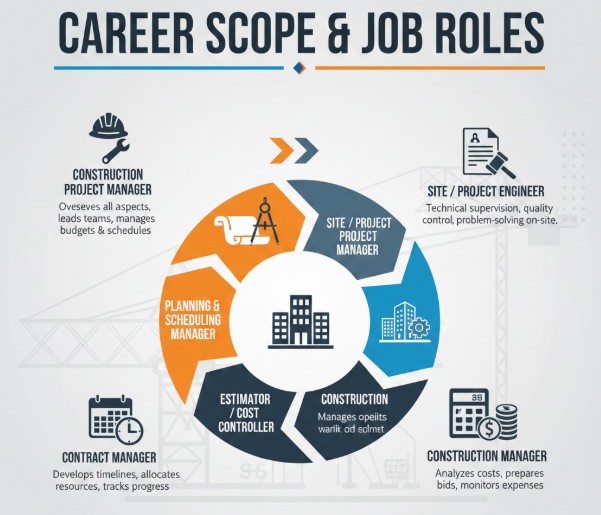
8. Career Scope & Job Roles
A PGDM in Construction Management opens doors to managerial and leadership roles across project and operations verticals:
🔹 Popular Job Profiles
- Construction Project Manager
- Site/Project Engineer
- Construction Manager
- Estimator / Cost Controller
- Planning & Scheduling Manager
- Contract Manager
With India’s robust infrastructure pipeline and real estate growth, demand for skilled construction management professionals remains strong, from residential projects to large-scale infrastructure.
9. Salary Trends
Salaries in construction management depend on your role, experience, and company size:
Role | Approx. Salary (India) |
Entry-Level Construction Managers | ₹3.8 – ₹8 LPA (varies) |
Experienced Managers | ₹8 – ₹19.5 LPA or more |
Industry reports indicate that construction managers and related professionals in India can command competitive pay, particularly with experience and specialised skills.
10. Skills You’ll Develop
Completing this course helps you build:
- Project planning & scheduling
- Budgeting & cost control
- Resource & contract management
- Construction technology and tools
- Leadership & decision-making skills
These are critical competencies sought by employers in the construction and infrastructure sectors.
11. Is It Worth It?
Yes — if you aspire to combine management expertise with construction execution skills. This PGDM specialization helps you:
✔ Enter leadership roles in construction and project execution
✔ Bridge technical and managerial gaps in teams
✔ Build a future-proof career in infrastructure and real estate
✔ Command higher salaries with experience
With India’s infrastructure spending accelerating, professionals with both business acumen and construction knowledge are well-placed for long-term career growth.
Frequently Asked Questions (FAQs)
1. Who is eligible for a PGDM in Construction Management?
Ans. Any graduate (10+2+3) from a recognised university; engineers preferred.
2. Is this course good for civil engineers?
Ans. Yes, it helps civil engineers move into planning and managerial roles.
3. What is the course duration?
Ans. Typically 15–24 months depending on the institute and mode.
4. What is the expected salary after completion?
Ans. Freshers earn ₹3.8–₹8 LPA; experienced professionals can earn ₹10–20+ LPA.
5. What job roles can I get?
Ans. Project Manager, Site Engineer, Planning Engineer, Estimator, Contract Manager.
6. Is this course suitable for working professionals?
Ans. Yes, online and executive formats offer flexible, self-paced learning.
7. Do I need work experience?
Ans. Not required for regular PGDM; executive PGDM may need experience.
8. What is the future scope of construction management?
Ans. Very high—India’s infrastructure boom is creating strong long-term demand.