The financial sector is rapidly evolving—digital banking, fintech innovations, and global expansion have created immense opportunities for skilled professionals. For finance graduates and working bankers, a Post Graduate (PG) Course in Banking and Finance could be your launchpad to a rewarding, future-proof career.
What is a PG Course in Banking and Finance?
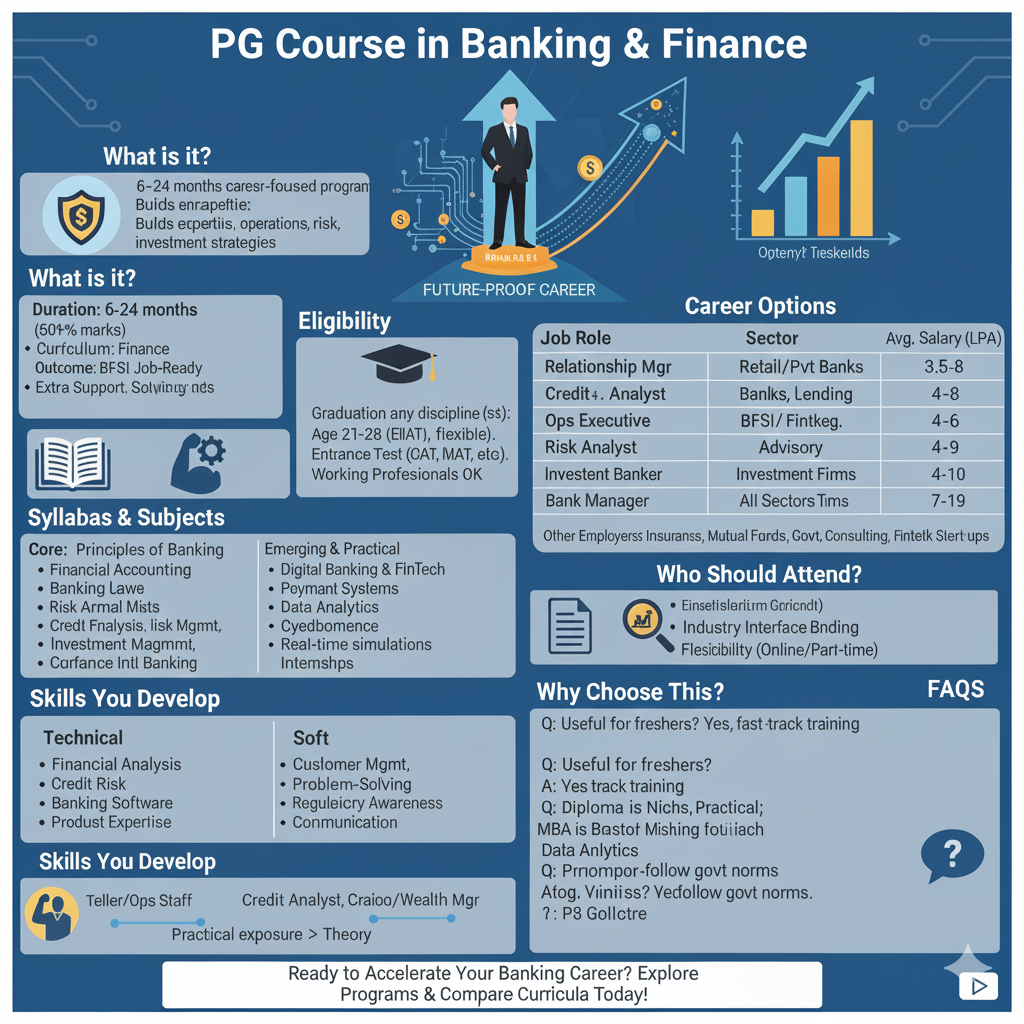
A PG course, whether it’s a PGDM, PGDBF, or PG Diploma in Banking and Finance, is a 6–24 month career-focused program designed to build expertise in banking operations, finance management, risk analysis, and investment strategies. Unlike a generic MBA, this program delivers hands-on skills for immediate job-readiness and placement in the BFSI sector.
Program Highlights
- Duration: 6–24 months (full/part-time, classroom, hybrid, online)
- Curriculum: Finance, banking operations, risk management, Excel, compliance, digital banking
- Outcome: Ready for BFSI roles in banks, NBFCs, fintechs, and more
- Extra support: Interview prep, resume building, career mentorship, industry tie-ups
Eligibility Criteria
To enroll in a PG course in banking and finance:
- Graduation in any discipline (Commerce, Management, Economics preferred)
- Minimum 50–60% marks (varies by institution)
- Age usually 21–28 years, but flexible for professionals
- Entrance test may be required (CAT, MAT, XAT, GMAT, or college-specific)
- Working professionals often get preference or direct admission routes
Syllabus & Subjects
Core Subjects
- Principles of Banking: Retail, digital, and corporate banking basics
- Financial Accounting & Reporting
- Banking Laws and Regulations
- Risk Management in Banking
- Financial Markets: Debt, equity, forex
- Credit Analysis & Loan Appraisal
- Investment & Portfolio Management
- Corporate Finance
- International Banking & Foreign Exchange
Emerging Areas
- Digital Banking & FinTech
- Payment Systems (UPI, RTGS, NEFT)
- Data Analytics & MIS Reporting
- Cybersecurity in Financial Services
Regulatory/Compliance
- RBI/SEBI Regulations, AML, KYC, Basel norms
- Ethics & corporate governance in banking
Practical Exposure
- Real-time simulations
- Industry projects & case studies
- Internship, live bank projects
- Capstone/dissertation (for advanced programs)
Skills You Develop
Technical Skills:
- Financial statement analysis
- Credit risk assessment
- Banking software mastery
- Loan/investment/risk product expertise
Soft Skills:
- Customer relationship management
- Problem-solving & decision-making
- Regulatory awareness & detail orientation
- Communication, negotiation
Career Options After PG in Banking and Finance
Graduates are prepared for high-demand roles across:
|
Job Role |
Sector |
Avg. Annual Salary (INR) |
|
Relationship Manager |
Retail/Private Banks |
3.5–8 LPA |
|
Credit Analyst |
NBFCs, Lending Firms |
4–8 LPA |
|
Operations Executive |
Banks, Fintech |
3–6 LPA |
|
Risk & Compliance Analyst |
BFSI/Regulatory Firms |
4–7 LPA |
|
Wealth Manager/Financial Planner |
Advisory, Planning Firms |
4–9 LPA |
|
Investment Banker/Analyst |
Investment Firms |
4–10 LPA |
|
Bank Manager/Portfolio Manager |
All Sectors |
7–19 LPA |
Other employers include insurance companies, mutual funds, government financial institutions, consulting & advisory firms, and fintech start-ups.
Who Should Attend?
- Fresh graduates (BCom/BBA/BA/BSc/BTech) with 50%+ marks
- Working professionals in banking/finance
- Career switchers seeking BFSI roles
- Professionals needing digital banking/analytics upskilling
How to Choose the Best PG Program
- Accreditation/recognition (AICTE/UGC/industry endorsements)
- Curriculum with current digital banking, fintech, and analytics modules
- Industry interface: Guest lectures, internships, real recruiters
- Proven placement records and alumni strength
- Flexibility for professionals: Online/blended/weekend modes
FAQs
Q1: Is a PG course in Banking and Finance useful for freshers?
Yes, it provides industry-relevant, fast-track training for BFSI careers with placement support.
Q2: What’s the difference between a PG Diploma in Banking and Finance and MBA Finance?
MBA is broader and management-focused; PG Diplomas are niche, practical, and placement-oriented.
Q3: Can non-commerce graduates apply?
Yes, most programs welcome any graduate discipline.
Q4: What is the average starting salary?
Usually ₹4–10 LPA, depending on role, location, and prior experience.
Q5: Is this course valid for government bank jobs?
It builds relevant skills; for government positions, follow hiring-specific requirements.
Q6: Can I pursue this part-time or online as a working professional?
Yes, many top colleges offer flexible and online models.
Q7: Which is better: PG Diploma Banking & Finance or PG Diploma Marketing?
Choose based on interest—finance for BFSI careers; marketing for sales, branding.
Real Success Stories
Many graduates have moved from entry roles (teller, operations staff) to advanced credit analysis, relationship management, and advisory positions after completing this program. Choose a college with a proven track record and practical exposure modules—these matter more than theory.
Ready to Accelerate Your Banking Career?
If you’re serious about a future in finance, a focused PG course can be your springboard to lucrative roles in banking, investment, and fintech.
Explore top programs, compare curricula, and take a step toward your future today!