In today’s fast-paced and competitive world, professionals constantly seek ways to stand out. One powerful way to do that is by earning two degrees at once — through a Dual Degree or a Dual MBA program.
Both paths offer a chance to expand your knowledge, gain diverse skills, and fast-track your career. But while they may sound similar, there are some crucial differences between the two. This guide will help you understand what makes a Dual Degree different from a Dual MBA, their benefits, and which one suits your career goals best.
🎓 What is a Dual Degree?
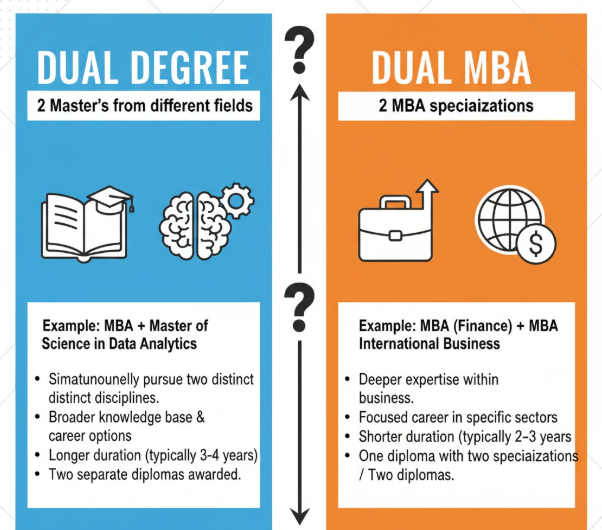
A Dual Degree program lets students earn two distinct academic qualifications simultaneously, often in complementary fields. For instance, you could pursue an Executive PG Diploma in Management (PGDM) along with an Executive MBA, combining technical expertise with leadership skills.
The primary goal of a dual degree is to save time and effort while expanding your career scope across multiple disciplines.
✳️ Examples of Dual Degree Programs:
- Executive PGDM in Project Management + Executive MBA in Operations
- Master’s in Data Science + MBA in Business Analytics
- B.Tech + MBA (Technology + Management)
Such programs prepare learners for interdisciplinary roles where business meets technology, leadership, or analytics.
🎯 What is a Dual MBA?
A Dual MBA (also known as a Dual Specialization MBA) focuses on two business domains within one MBA program. Rather than earning two separate degrees, you gain expertise in two areas of management — such as Finance and HR, Marketing and Operations, or IT and Project Management.
This approach is ideal for professionals who want to develop a versatile business skill set and become eligible for leadership roles across multiple domains.
✳️ Examples of Dual MBA Combinations:
By pursuing a Dual MBA, you don’t just diversify your learning — you build the flexibility to shift careers or lead cross-functional teams in dynamic business environments.
⚖️ Key Differences Between Dual Degree and Dual MBA
Aspect | Dual Degree | Dual MBA |
Definition | Combines two different degrees (e.g.,Executive PGDM +Executive MBA). | Combines two specializations under a single MBA program. |
Duration | 2–3 years combined. | Typically 2 years. |
Eligibility | Bachelor’s degree in any field; some may require work experience. | Bachelor’s degree; ideal for business-focused learners. |
Focus | Academic, interdisciplinary (technical + managerial). | Business-oriented, multi-domain management learning. |
Outcome | Two independent qualifications. | One MBA degree with dual specializations. |
Career Scope | Broader – mix of academic, technical, and managerial roles. | Focused – leadership and management roles. |
ROI (Return on Investment) | High due to skill diversity. | High due to corporate growth opportunities. |
💎 Benefits of Each Program
🎯 Benefits of a Dual Degree
- Two recognized degrees in less time.
- Broader skill development – blend of technical and managerial expertise.
- Career flexibility – work in multiple domains or industries.
- Stronger ROI – better employability and academic prestige.
🚀 Benefits of a Dual MBA
- Master two business disciplines to enhance leadership potential.
- Cross-functional opportunities – from finance and HR to marketing and operations.
- Higher salary growth due to multi-domain expertise.
- Ideal for working professionals looking for quick career advancement.
Whether you pursue double degree courses or two degrees at the same time, both pathways help you build a competitive edge and long-term career stability.
🧭 Who Should Choose What?
Profile Type | Recommended Program | Why It’s Best |
Students or Fresh Graduates | Dual Degree | Gain two qualifications early to diversify career options. |
Working Professionals (Mid-Career) | Dual MBA | Deepen managerial expertise and qualify for leadership roles. |
Technical or Engineering Professionals | Dual Degree (Exec. PGDM +Exec MBA) | Combine technology and management for strategic growth. |
Managers Seeking Cross-Functional Roles | Dual MBA | Strengthen management skills across multiple business areas. |
👉 Tip: If you want academic breadth and flexibility — choose a Dual Degree.
If you’re focused on management excellence and corporate leadership — go for a Dual MBA.
🏁 Conclusion
Choosing between a Dual Degree and a Dual MBA depends entirely on your career goals, background, and aspirations.
- A Dual Degree suits those who want diversity and interdisciplinary learning — perfect for tech, analytics, or business aspirants.
- A Dual MBA fits professionals aiming for managerial growth and corporate leadership within business domains.
Both are excellent choices for building a future-ready career. With many institutes now offering online dual programs, it’s easier than ever to earn two degrees at the same time without compromising your job or personal commitments.
Take the next step — invest in your dual advantage today and open the door to limitless opportunities!
🔍 Quick Summary Table
Category | Dual Degree | Dual MBA |
Type | Two separate degrees | One MBA with two specializations |
Duration | 2–3 years | 2 years |
Ideal For | Students & technical professionals | Managers & executives |
Outcome | Broader academic scope | Focused business leadership |
Flexibility | Interdisciplinary learning | Management-focused growth |
💬 FAQs
Q1. Which is better: Dual Degree or Dual MBA?
Ans. It depends on your goals. Choose a Dual Degree for diverse academic exposure, and a Dual MBA for leadership-focused business expertise.
Q2. Can I pursue a Dual Degree online?
Ans. Yes! Many institutes offer online dual degree programs allowing flexibility for working professionals.
Q3. Does a Dual MBA increase my salary?
Ans. Absolutely. Dual MBA graduates often earn higher packages due to their multi-domain managerial expertise.
Q4. How long does a Dual Degree take?
Ans. Typically between 2 to 3 years, depending on the university and structure.