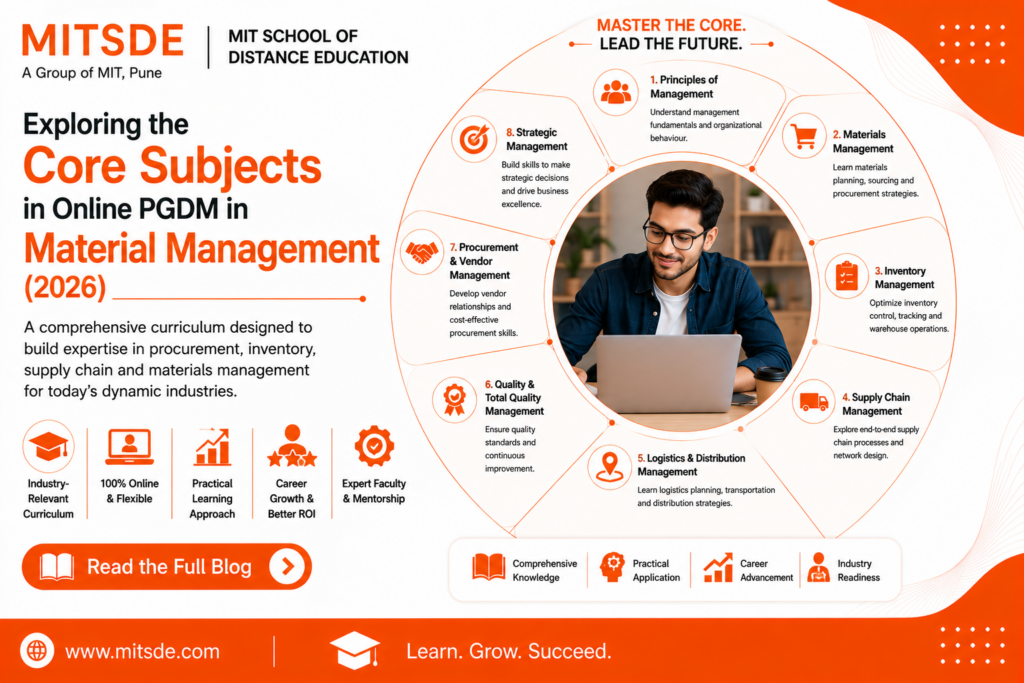
A PGDM in Material Management covers 6 core subjects: Marketing Management (demand forecasting), Accounting for Managers (cost analysis, budgeting), Business Communication (negotiation, reporting), Principles of Management (leadership, planning), Indian Economy and Policy (regulatory context), and Legal and Business Environment (contracts, compliance). Together, these build both the technical and managerial skills needed for supply chain and procurement leadership roles.
Table of Contents
- Introduction: The World of Material Management
- 1. Marketing Management
- 2. Accounting for Managers
- 3. Business Communication
- 4. Principles of Management
- 5. Indian Economy and Policy
- 6. Legal and Business Environment
- FAQs
Introduction: The World of Material Management
In today’s fast-paced business environment, efficient management of materials and resources has become a critical factor in organizational success. As companies strive to optimize their supply chains and streamline operations, demand for skilled material management professionals has risen sharply driving specialized educational programs like the Online Post Graduate Diploma in Material Management (PGDM).
Below, we explore the core subjects that form the backbone of this program.
1. Marketing Management: The Foundation of Business Success
Marketing Management provides students with a solid foundation in marketing principles and practices, essential for any business professional regardless of specialization.
Typically covers:
- Market research and analysis
- Consumer behavior
- Product development and pricing strategies
- Promotion and advertising techniques
- Distribution channels and logistics
Application to material management: understanding marketing principles helps material managers forecast demand more accurately, collaborate with sales and marketing teams, develop packaging and presentation strategies, and optimize inventory levels based on market trends.
2. Accounting for Managers: Crunching the Numbers
This course equips students with the financial knowledge necessary to make sound business decisions and effectively manage resources.
Key topics:
- Basic accounting principles
- Financial statement analysis
- Cost accounting and budgeting
- Investment decision-making
- Working capital management
Application to material management: accounting knowledge is invaluable for calculating total cost of ownership, assessing the financial impact of inventory decisions, evaluating supplier contracts, preparing budget reports for procurement, and measuring ROI of material management initiatives.
3. Business Communication: The Art of Effective Interaction
This course focuses on honing students’ verbal, written, and interpersonal communication skills.
Typically covers:
- Written communication (emails, reports, memos)
- Oral presentations and public speaking
- Active listening and feedback
- Nonverbal communication
- Cross-cultural communication
Application to material management: strong communication skills help material managers negotiate with suppliers and vendors, collaborate across departments, present proposals to senior management, resolve conflicts, and communicate complex technical information to non-technical stakeholders.
4. Principles of Management: The Bedrock of Organizational Success
This course provides a comprehensive understanding of core concepts and theories that drive successful organizations essential for anyone aspiring to leadership roles.
Key areas:
- Planning and decision-making
- Organizing and structuring teams
- Leading and motivating employees
- Controlling and measuring performance
- Change management and innovation
Application to material management: understanding these principles helps professionals develop and implement effective strategies, lead and motivate procurement/inventory teams, align material management goals with organizational objectives, manage change, and make balanced decisions weighing efficiency, cost, and quality.
5. Indian Economy and Policy: Understanding the Business Landscape
Understanding the country’s economic landscape is crucial for students pursuing an Online PGDM in Material Management in India.
Typically covers:
- Overview of the Indian economic system
- Fiscal and monetary policies
- Industrial policies and regulations
- Foreign trade and investment
- Economic reforms and their impact on businesses
Relevance to material management: helps professionals understand the impact of government policies on supply chains, navigate regulatory requirements, assess economic feasibility of sourcing decisions, anticipate business environment changes, and identify opportunities in the Indian market.
6. Legal and Business Environment: Navigating the Regulatory Landscape
This course focuses on legal and regulatory aspects impacting business operations, crucial for ensuring compliance and managing risk.
Key topics:
- Contract law and commercial transactions
- Intellectual property rights
- Labor laws and employee relations
- Environmental regulations
- Corporate governance and ethics
Application to material management: understanding this domain is essential for drafting/negotiating supplier contracts, ensuring compliance with environmental and safety regulations, managing intellectual property in the supply chain, adhering to labor laws in warehouse/logistics operations, and implementing ethical sourcing practices.
FAQ's
-
1. What are the core subjects in a PGDM in Material Management?
Marketing Management, Accounting for Managers, Business Communication, Principles of Management, Indian Economy and Policy, and Legal and Business Environment.
-
2. Why is Marketing Management included in a material management program?
Because understanding marketing principles helps material managers forecast demand more accurately and collaborate effectively with sales teams on inventory and product decisions.
-
3. How does Accounting for Managers help material management professionals?
It equips them to calculate total cost of ownership, assess financial impacts of inventory decisions, evaluate supplier contracts, and measure the ROI of material management initiatives.
-
4. Why is Business Communication a core subject in this program?
Because material managers regularly negotiate with suppliers, collaborate across departments, and present proposals to senior management — all requiring strong communication skills.
-
5. What does the Indian Economy and Policy subject cover?
The Indian economic system, fiscal/monetary policies, industrial regulations, foreign trade, and economic reforms — all relevant to understanding supply chain impacts.
-
6. What legal topics are covered in this program?
Contract law, intellectual property rights, labor laws, environmental regulations, and corporate governance essential for compliance in procurement and supply chain operations.